
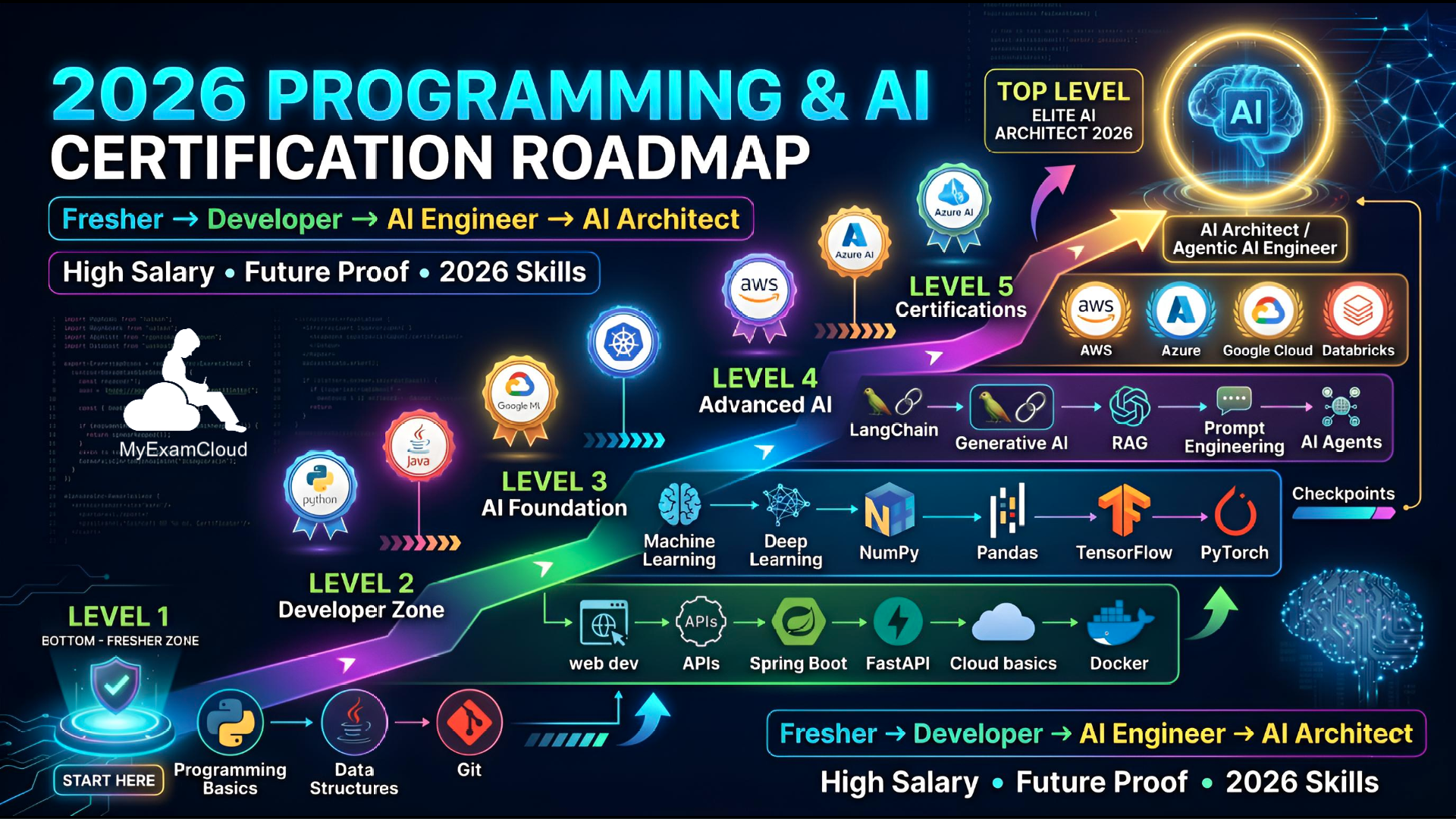
2026 Programming & AI Certification Roadmap: Complete Guide from Fresher to AI Architect
Read this MyExamCloud Blog article for practical insights on Artificial Intelligence. Explore more blog categories, search related topics in blog search, or return to the MyExamCloud Blog home.
The technology landscape in 2026 is no longer about writing code alone. Developers are expected to build intelligent systems, integrate artificial intelligence, deploy scalable applications, and design enterprise-level architectures. This shift has created a new career path that combines programming, cloud computing, and AI.
This guide provides a complete roadmap from beginner to advanced AI architect. Whether you are a fresher or an experienced developer, this roadmap will help you build the right skills, work on real-world projects, and choose the correct certifications.
To understand the broader AI journey, read AI Roadmap 2026.
Why This Roadmap Matters in 2026
In 2026, coding is just the foundation. The real demand is for professionals who can combine development, cloud, and AI to build intelligent systems. Companies are hiring AI engineers, cloud engineers, and AI architects at a much higher rate than traditional developers.
To understand salary differences, read AI vs Cloud vs Software Developer Salary.
Level 1: Programming Foundation (Fresher Stage)
Your journey starts with programming. Python and Java are the most important languages in 2026 for AI and enterprise applications. You also need to learn data structures, problem-solving, and version control using Git.
At this stage, focus on building small projects like automation scripts, APIs, and basic applications. These projects build your problem-solving ability and coding confidence.
To validate your skills, prepare using Python Certifications and Java Certifications.
If you are unsure which language to choose, read Python vs Java for AI Development.
Level 2: Developer Stage (Building Real Applications)
At this stage, you move from learning to building real-world applications. You learn backend development, APIs, authentication, and database integration.
Real-world example: Build a job portal with login systems, resume uploads, and search functionality. This prepares you for real developer roles.
To validate your development skills, prepare using Oracle Java Certifications and Azure Certifications.
To understand how developers transition into AI roles, read Java AI Developer Guide.
Level 3: Cloud & DevOps
Modern applications are built and deployed in the cloud. You need to learn AWS, Azure, Docker, and CI/CD pipelines.
A real-world case study includes deploying applications using Docker containers and automating deployments using CI/CD pipelines.
To prepare for certifications, explore AWS Certifications, Docker Certified Associate (DCA) Certification, and Kubernetes Certifications.
For detailed preparation, read AWS Certification Preparation Guide.
Level 4: AI & Machine Learning
This is where you transition into AI. You learn machine learning, deep learning, and data processing using tools like NumPy and Pandas.
Real-world projects include recommendation systems, predictive analytics, and customer behavior analysis.
To validate your skills, prepare using AI and ML Certifications and Data Engineering Certifications.
To explore frameworks, read AI ML Frameworks Guide.
Level 5: Advanced AI (Generative AI & AI Agents)
This stage focuses on generative AI, large language models, RAG systems, and AI agents. These technologies are transforming how applications are built in 2026.
You can build AI assistants, document-based chat systems, and automation agents.
To prepare, explore Generative AI Certifications and AWS Generative AI Developer Certification.
To understand AI agents deeply, read AI Agents Guide.
Level 6: Azure AI Certifications (2026 Updated)
Microsoft Azure has become one of the most important platforms for AI in 2026. It supports enterprise AI, generative AI, and agentic AI systems.
Azure Certifications cover cloud fundamentals and AI services.
Azure AI Fundamentals Certification (AI-900) is ideal for beginners.
Azure AI Engineer Certification (AI-102) is the core certification for building AI solutions.
Microsoft AI Business Professional Certification (AB-730) focuses on business AI use cases.
Microsoft AI Transformation Leader Certification (AB-731) helps professionals lead AI transformation.
Microsoft Agentic AI Solutions Architect Certification (AB-100) is one of the most advanced certifications focused on AI architecture and agentic systems.
Level 7: AI Architect (Elite Stage)
At this stage, you design enterprise AI systems, manage large-scale deployments, and build intelligent architectures.
You work on healthcare AI, financial AI systems, and enterprise automation platforms.
To reach this level, prepare using Google Cloud Certifications and Databricks Certifications.
For deeper understanding, read AI Architectures Guide.
Common Mistakes to Avoid
Many developers stay stuck in coding and never move to AI or cloud. Others jump into AI without strong fundamentals.
To avoid mistakes, read Developer Career Mistakes.
Conclusion
The future belongs to developers who can build intelligent systems. If you follow this roadmap, you can move from a fresher to an AI architect.
The journey is simple: learn programming, build applications, deploy on cloud, integrate AI, and design intelligent systems.
Start today and future-proof your career in 2026.
Frequently Asked Questions (FAQs) – 2026 Programming & AI Certification Roadmap
1. What is the best roadmap to become an AI Engineer in 2026?
The best roadmap starts with programming (Python or Java), moves into backend development, then cloud and DevOps, followed by machine learning and generative AI. Finally, you specialize in AI architecture and agentic AI systems.
To understand the full learning path, read AI Roadmap 2026.
2. Which programming language is best for AI in 2026?
Python is widely used for AI and machine learning, while Java is strong for enterprise AI systems. Both languages are important depending on your career goals.
To compare both, read Python vs Java for AI.
3. What certifications should beginners start with in AI?
Beginners should start with programming certifications followed by AI fundamentals. The most recommended starting points are Python certifications, Java certifications, and Azure AI Fundamentals.
Explore Python Certifications, Java Certifications, and Azure AI Fundamentals Certification (AI-900).
4. Which cloud certifications are best for AI engineers in 2026?
Cloud skills are essential for AI engineers. The most valuable certifications include AWS, Azure, and Google Cloud certifications.
Start with AWS Certifications, Azure Certifications, and Google Cloud Certifications.
5. What is the most important Azure AI certification in 2026?
The most important certification is the Azure AI Engineer Certification (AI-102). It validates your ability to build and deploy AI solutions using Azure services.
Prepare using Azure AI Engineer Certification (AI-102).
6. What are the latest Azure AI certifications for 2026?
In addition to AI-900 and AI-102, Microsoft has introduced advanced certifications focused on enterprise and agentic AI systems.
These include Microsoft AI Business Professional Certification (AB-730), Microsoft AI Transformation Leader Certification (AB-731), and Microsoft Agentic AI Solutions Architect Certification (AB-100).
7. How long does it take to become an AI Engineer?
With consistent learning and practice, it typically takes 12 to 24 months to move from beginner to job-ready AI engineer. The timeline depends on your background and learning speed.
8. Do I need cloud knowledge for AI jobs?
Yes, cloud knowledge is essential because most AI applications are deployed on cloud platforms. Skills in AWS, Azure, and Docker significantly increase job opportunities.
Start with Docker Certified Associate (DCA) Certification.
9. What is Generative AI and why is it important in 2026?
Generative AI refers to AI systems that can generate content such as text, images, and code. It is one of the most in-demand skills in 2026.
Learn more from AI Agents Guide.
10. What is the role of an AI Architect?
An AI Architect designs large-scale AI systems, integrates multiple AI models, and ensures scalability and performance. This is one of the highest-paying roles in the tech industry.
To understand architecture concepts, read AI Architectures Guide.

