
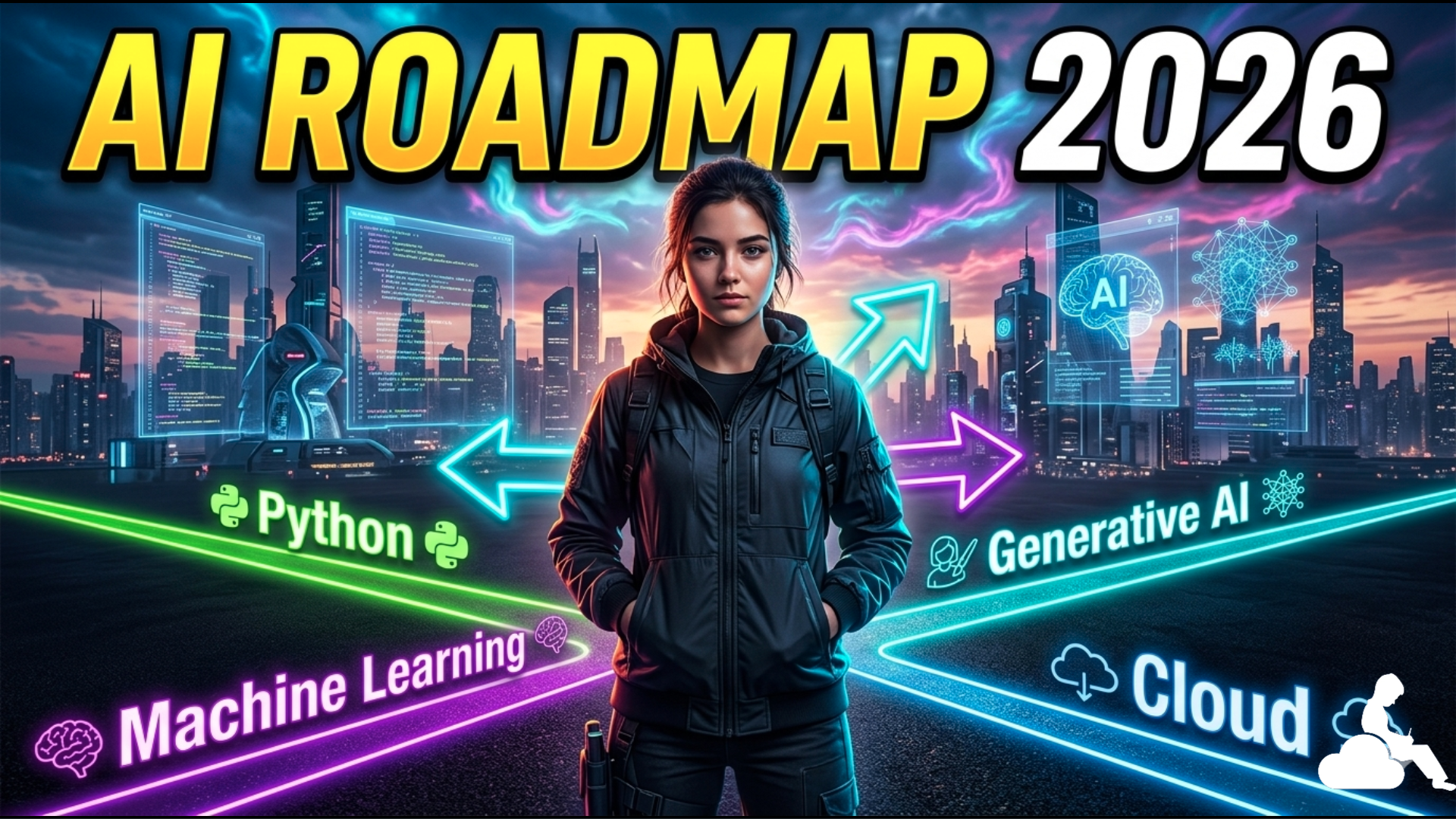
How to Learn AI in 2026: A Complete Roadmap with Certifications
Read this MyExamCloud Blog article for practical insights on Artificial Intelligence. Explore more blog categories, search related topics in blog search, or return to the MyExamCloud Blog home.
Artificial intelligence is transforming industries at an unprecedented pace. Whether you're starting from scratch or transitioning from another field, 2026 offers a clear path to building AI skills that employers actively demand. This guide provides a practical, step-by-step roadmap to help you get started and grow in the AI field.
Why Learn AI in 2026?
Organizations across every industry are building AI-powered applications to automate processes, analyze large-scale data, and generate insights. Technologies like large language models are fundamentally changing how software is built and used, improving efficiency, accuracy, and productivity across domains such as customer service, data analysis, and business operations.
The demand for AI professionals continues to grow rapidly, making 2026 an ideal time to enter this field.
Related article: AI Developer Roadmap 2026
Step-by-Step Learning Guidelines
Step 1: Master Programming Fundamentals
Programming forms the foundation of AI development. Python remains the most widely used language for machine learning, while Java, C++, and Scala are valuable in enterprise-scale systems.
What to learn:
- Python syntax, data structures, and libraries such as NumPy and Pandas
- Basic algorithms and object-oriented programming
- Version control using Git
Recommended Certifications:
Related article: How to Start Python for AI Developers in 2026
Step 2: Build Your Mathematics Foundation
You don’t need advanced theoretical expertise, but a solid understanding of core mathematical concepts is essential for AI.
Essential topics:
- Linear algebra (vectors, matrices, transformations)
- Calculus (derivatives and gradients for optimization)
- Probability and statistics (distributions, hypothesis testing)
Focus on practical applications and how these concepts are used in real-world machine learning systems.
Step 3: Learn Machine Learning Core Concepts
Machine learning is at the core of most AI systems. Understanding how models learn from data and make predictions is critical.
Key concepts to master:
- Supervised learning (classification and regression)
- Unsupervised learning (clustering and dimensionality reduction)
- Model evaluation and validation techniques
Frameworks to learn:
- Scikit-learn for traditional machine learning
- TensorFlow and PyTorch for deep learning
Recommended Certifications:
Related article: Machine Learning Engineer vs Data Scientist in 2026
Step 4: Dive Into Generative AI
Generative AI is one of the most impactful areas in modern AI. Employers are increasingly looking for professionals who can build applications using large language models and AI agents.
Key technologies to learn:
- Large Language Models (LLMs)
- Prompt engineering and fine-tuning
- Vector databases and retrieval-augmented generation (RAG)
- AI agent frameworks
Recommended Certifications:
- Generative AI Leader Certification
- AWS Certified Generative AI Developer Professional (AIP-C01)
- Microsoft Certified Azure AI Engineer Associate (AI-102)
Related articles: Java AI Developer Guide 2026, Top AI Agents in 2026
Step 5: Learn Cloud AI Platforms
Modern AI applications rely heavily on cloud infrastructure for scalability, training, deployment, and data management.
Platform-specific certifications to consider:
AWS Path:
Microsoft Path:
Google Cloud Path:
Related article: Google Cloud AI vs AWS AI Certifications in 2026
How to Stand Out in 2026
1. Build Impactful Projects
The most effective way to stand out is by building projects that demonstrate real-world impact. Focus on solving meaningful problems and, wherever possible, quantify the results of your work.
- Build a domain-specific RAG chatbot (healthcare, finance, education)
- Create an automated data analysis pipeline
- Develop a recommendation system with measurable outcomes
Related article: Build AI Application with Java and Python
2. Develop Communication Skills
Technical skills alone are not enough. Being able to clearly explain your work, present ideas, and communicate results is essential for career growth.
- Write blog posts explaining your projects
- Create video demonstrations
- Present your work in meetups or online communities
How Long Does It Take?
With consistent effort (10–15 hours per week), most learners can build job-ready AI skills within 6–12 months. Those with prior experience in programming or mathematics may progress faster.
Can You Get an AI Job Without a Degree?
Yes. The industry increasingly values practical skills over formal degrees. What matters most is your ability to demonstrate real capabilities.
- Earn industry-recognized certifications
- Build and deploy real-world projects
- Contribute to open-source AI initiatives
- Showcase your work on platforms like GitHub and LinkedIn
Recommended Certification Roadmap for 2026
Beginner (0–3 months):
Intermediate (3–6 months):
Advanced (6–12 months):
Final Thoughts
Artificial Intelligence represents a major shift in how technology is built and used. The professionals who succeed in 2026 and beyond will combine strong technical foundations with hands-on project experience and effective communication skills.
Start with programming and mathematics, progress through machine learning fundamentals, specialize in generative AI, and validate your expertise with certifications. Most importantly, showcase your work and demonstrate the value you can create.
Your AI career journey starts today.
| Author | Ganesh P Certified Artificial Intelligence Scientist (CAIS) | |
| Published | 4 months ago | |
| Category: | Artificial Intelligence | |
| HashTags | #Java #Python #Programming #CloudComputing #Software #Architecture #AI #ArtificialIntelligence |

