
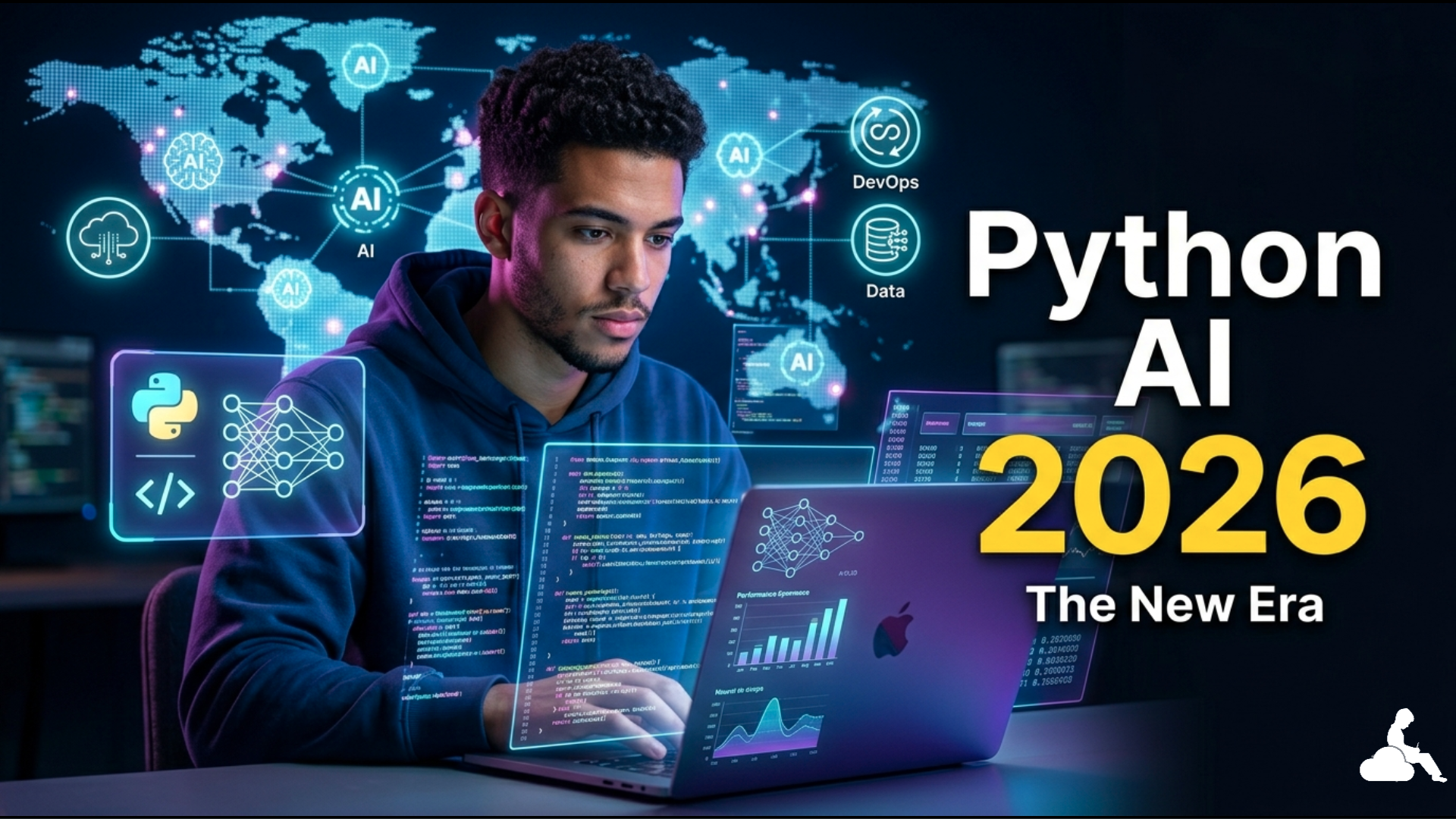
How to Start Python in 2026 for AI Developers: Complete Roadmap to High-Paying Jobs Worldwide
Read this MyExamCloud Blog article for practical insights on Artificial Intelligence. Explore more blog categories, search related topics in blog search, or return to the MyExamCloud Blog home.
Python has firmly established itself as the number one programming language for Artificial Intelligence (AI) in 2026. Whether you aim to become an AI Engineer, Machine Learning Engineer, or Generative AI Developer, Python is the foundation that powers almost every modern AI system.
This comprehensive pillar guide explains everything you need to know—from absolute basics to advanced AI systems—so you can build a high-paying global career in AI using Python.
Why Python is the Best Choice for AI in 2026
Python dominates AI development due to its simplicity, scalability, and ecosystem.
It is widely used in:
-
Machine Learning systems
-
Deep Learning frameworks
-
Generative AI applications
-
Data science and analytics
-
AI agents and automation systems
Python allows developers to focus on problem-solving rather than syntax complexity, making it ideal for both beginners and experienced engineers.
Global Demand for Python AI Developers
The demand for Python AI developers is growing rapidly across industries such as:
-
Healthcare (AI diagnostics)
-
Finance (fraud detection, trading bots)
-
E-commerce (recommendation systems)
-
Autonomous systems (self-driving, robotics)
-
SaaS and enterprise platforms
High-paying roles include:
-
AI Engineer
-
Machine Learning Engineer
-
Generative AI Developer
-
Data Scientist
-
NLP Engineer
-
Computer Vision Engineer
-
AI Architect
These roles offer competitive salaries globally because they require a combination of software engineering + AI expertise.
Step 1: Python Basics (Your Foundation)
Before entering AI, you must master Python fundamentals.
What You Will Learn
-
Python data types: int, float, str, bool
-
Variables and assignments
-
Basic calculations and expressions
-
Writing simple programs
Core Concepts
-
Running Python scripts
-
Using Python as a calculator
-
Variable assignment
-
Type conversion
This stage builds your logical thinking and programming foundation, which is essential for all AI development.
Step 2: Python Lists and Data Structures
Lists are fundamental because AI systems deal with large datasets.
What You Will Learn
-
Creating lists
-
Working with nested lists
-
Subsetting and slicing
-
Modifying list elements
Key Skills
-
Handling structured data
-
Data manipulation
-
Efficient storage of information
This step prepares you for real-world data processing tasks.
Step 3: Functions, Methods, and Packages
Efficient Python coding requires understanding reusable components.
What You Will Learn
-
Functions and arguments
-
Methods for strings and lists
-
Importing packages
-
Code modularity
Why This Matters
AI development relies heavily on libraries. Learning how to use packages helps you leverage existing tools instead of reinventing the wheel.
Step 4: NumPy for Data Science
NumPy is the backbone of numerical computing in Python.
What You Will Learn
-
NumPy arrays vs Python lists
-
Vectorized operations
-
2D arrays and matrix computations
-
Statistical functions (mean, median, std, correlation)
Why It Matters
NumPy enables fast data processing, which is critical for AI and machine learning.
Step 5: Mathematics for AI
AI is built on mathematics. You don’t need to be an expert, but you must understand key concepts.
Core Topics
-
Linear algebra (vectors, matrices)
-
Calculus (derivatives, optimization)
-
Probability theory
-
Statistics
These concepts help you understand how AI models work and improve them
Step 6: Machine Learning Fundamentals
Machine Learning is the core of AI.
Key Concepts
-
Supervised learning
-
Unsupervised learning
-
Reinforcement learning
-
Model evaluation
Algorithms to Learn
-
Linear regression
-
Decision trees
-
Support vector machines
-
Clustering
These form the foundation of intelligent systems
Step 7: Deep Learning
Deep learning powers modern AI breakthroughs.
Topics
-
Neural networks
-
Backpropagation
-
Activation functions
-
Optimization techniques
Advanced Areas
-
CNN (image processing)
-
RNN and LSTM (sequences)
-
Transformers (LLMs)
These are critical for building advanced AI applications
Step 8: Generative AI
Generative AI is the most in-demand skill in 2026.
What to Learn
-
Prompt engineering
-
Fine-tuning models
-
Using LLM APIs
-
Building AI applications
Applications
-
Chatbots
-
AI assistants
-
Code generation tools
-
Content creation
This is where developers move into high-paying AI roles.
Step 9: AI Agents and Automation
AI is evolving from simple models to autonomous systems.
Key Skills
-
Agent frameworks
-
Tool integration
-
Workflow automation
-
Multi-agent systems
These systems can plan, execute, and automate tasks.
Step 10: Real-World AI Applications
You should build projects in:
-
NLP (text processing)
-
Computer vision (image recognition)
-
Speech processing
-
Recommendation systems
These applications are widely used in industry
Step 11: Deployment and MLOps
To become job-ready, you must deploy AI systems.
Skills
-
APIs (FastAPI, Flask)
-
Docker and Kubernetes
-
Cloud platforms (AWS, Azure, GCP)
-
CI/CD pipelines
This makes you industry-ready and employable globally
Step 12: AI Coding Tools for Python
Modern developers use AI tools to improve productivity.
Popular Tools
-
GitHub Copilot
-
ChatGPT
-
Codeium
-
Amazon CodeWhisperer
-
Replit AI
Benefits
-
Faster coding
-
Debugging assistance
-
Learning acceleration
These tools are essential for modern development workflows.
Step 13: Complete Learning Roadmap
Your structured path:
-
Python basics
-
Data structures and NumPy
-
Mathematics
-
Machine learning
-
Deep learning
-
Generative AI
-
AI agents
-
Deployment
Following this ensures steady progression to expert level.
Certifications for Python AI Developers (2026)
Certifications help validate your skills and improve job opportunities.
Python Certifications
-
Python Certification Practice Tests & Mock Exams – PCEP, PCAP, PCPP (2026)
-
PCAP-31-03 Python Associate Programmer Practice Tests (2026)
-
PCEP-30-02 Python Entry-Level Programmer Practice Tests (2026)
AI & Generative AI Certifications
-
AI & Machine Learning Certification Practice Tests – GenAI, ML & Data (2026)
-
Generative AI Certification Practice Tests – LLMs, Prompt Engineering & AI Workflows (2026)
Cloud AI Certifications
-
AWS Certified Generative AI Developer – Professional (AIP-C01)
-
Google Cloud Certification Practice Tests – GCP Associate, Professional (2026)
Data & Engineering Certifications
-
Data Engineer & Data Scientist Certification Practice Tests (2026)
-
Databricks Certified Machine Learning Professional Practice Tests (2026)
Final Thoughts
Python is the gateway to AI careers in 2026. However, success requires more than just learning syntax. You must build a complete skill set that includes programming, mathematics, AI models, tools, and system design.
The demand for AI developers is growing rapidly worldwide, and those who follow a structured roadmap will be able to secure high-paying global jobs.
If you stay consistent, build projects, and validate your skills with certifications, you can become a successful AI developer in 2026 and beyond.
Related Articles
-
AI Developer Roadmap 2026: Skills, Tools, and Certifications
-
Python AI Developer Roadmap in 2026: Skills, Certifications, and Career Path
| Author | Ganesh P Certified Artificial Intelligence Scientist (CAIS) | |
| Published | 4 months ago | |
| Category: | Artificial Intelligence | |
| HashTags | #Python #Programming #Software #Architecture #AI #ArtificialIntelligence #PythonCertification |

