
AI Architectures in 2026: Complete Guide from Neural Networks to Agentic AI Systems
Read this MyExamCloud Blog article for practical insights on Artificial Intelligence. Explore more blog categories, search related topics in blog search, or return to the MyExamCloud Blog home.
Artificial Intelligence in 2026 is no longer about isolated models. It has evolved into a layered ecosystem of architectures that work together to build intelligent and autonomous systems.
From simple neural networks to advanced Agentic AI systems, understanding these architectures is essential for developers, AI engineers, and businesses building real-world AI applications.
What Are AI Architectures?
AI architectures define how an AI system is structured, including how data flows, how models process information, and how decisions are made.
Modern AI systems combine multiple layers such as LLMs, RAG, vector databases, and AI agents.
Evolution of AI Architectures
The journey of AI started with simple neuron-inspired models and evolved into complex autonomous systems.
As explained in neural network research, early models like perceptrons were simple binary decision systems that laid the foundation for modern deep learning.
Neural Network Architectures
Perceptron
The perceptron is the simplest neural network model that performs linear classification.
Feedforward Neural Networks
These networks process data in one direction and are used for basic prediction tasks.
To understand how neural networks are implemented in real projects, refer to step-by-step AI model development guide for beginners .
Deep Learning Architectures
Convolutional Neural Networks (CNN)
Used for image processing, facial recognition, and medical imaging.
Recurrent Neural Networks (RNN) and LSTM
Used for sequential data like speech recognition and time-series prediction.
To explore frameworks used to implement these models, check AI/ML frameworks and libraries guide .
Transformer Architecture
Transformers introduced self-attention and parallel processing, making them the foundation of modern AI systems.
They power large language models and modern generative AI systems.
Large Language Models (LLMs)
LLMs are built on transformers and are capable of generating text, code, and intelligent responses.
If you are starting your journey, read Python roadmap for AI developers in 2026 .
Generative AI Architectures
Generative AI includes diffusion models and GANs that create images, videos, and audio content.
These architectures are widely used in marketing, media, and design automation.
RAG and Vector Database Architecture
Retrieval-Augmented Generation connects LLMs with real-world data sources to improve accuracy.
Vector databases enable semantic search by storing embeddings.
To understand real-world implementation, refer to Java AI developer guide with RAG and agents .
AI Agent Architecture
AI agents combine LLMs, tools, and decision-making to perform tasks autonomously.
They can plan, execute, and refine workflows.
Explore real-world agent examples in top AI agents guide .
Agentic AI Architecture
Agentic AI represents the next evolution where multiple agents collaborate to complete complex tasks.
These systems enable full automation of workflows.
Learn best practices in event-driven agentic AI design guide .
Multimodal and Emerging Architectures
Modern AI systems can process text, images, audio, and video together.
Emerging architectures include Graph Neural Networks, hybrid AI, and neuromorphic computing.
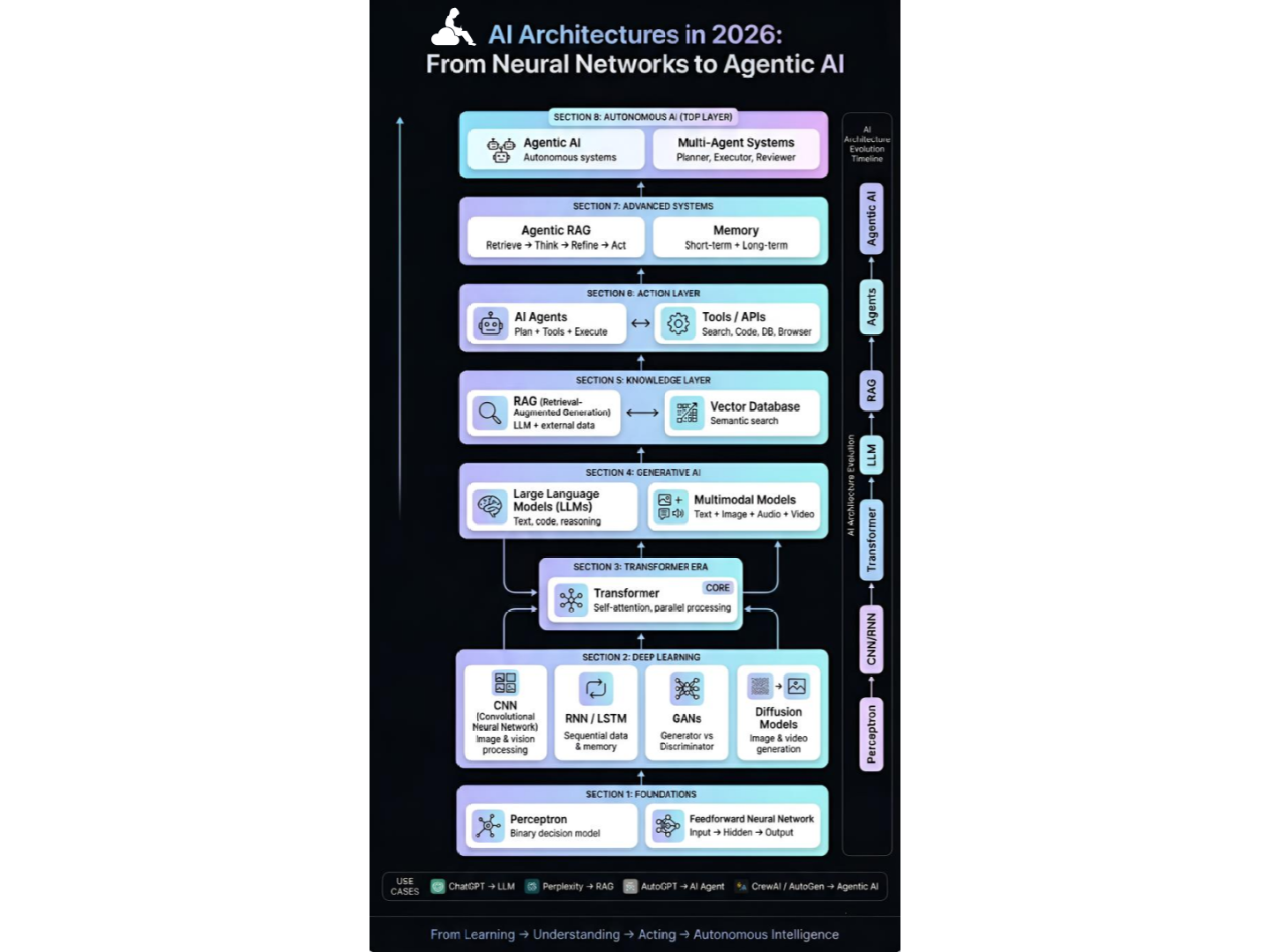
Complete AI Architecture Stack
Neural Networks learn patterns.
Transformers understand context.
LLMs generate intelligence.
RAG adds knowledge.
Agents take action.
Agentic AI enables full automation.
Certifications to Master AI Architectures
To validate your skills, explore AI and Machine Learning certification practice tests .
For Generative AI specialization, check Generative AI certification practice tests .
For cloud-based AI skills, explore AWS AI and cloud certifications .
Conclusion
AI architectures in 2026 are integrated systems combining multiple technologies.
Understanding these architectures helps you build scalable AI systems and stay ahead in the evolving AI landscape.
Explore more learning resources on MyExamCloud AI learning platform .
:| Author | Ganesh P Certified Artificial Intelligence Scientist (CAIS) | |
| Published | 4 months ago | |
| Category: | Artificial Intelligence | |
| HashTags | #Software #Architecture #AI #ArtificialIntelligence |

