
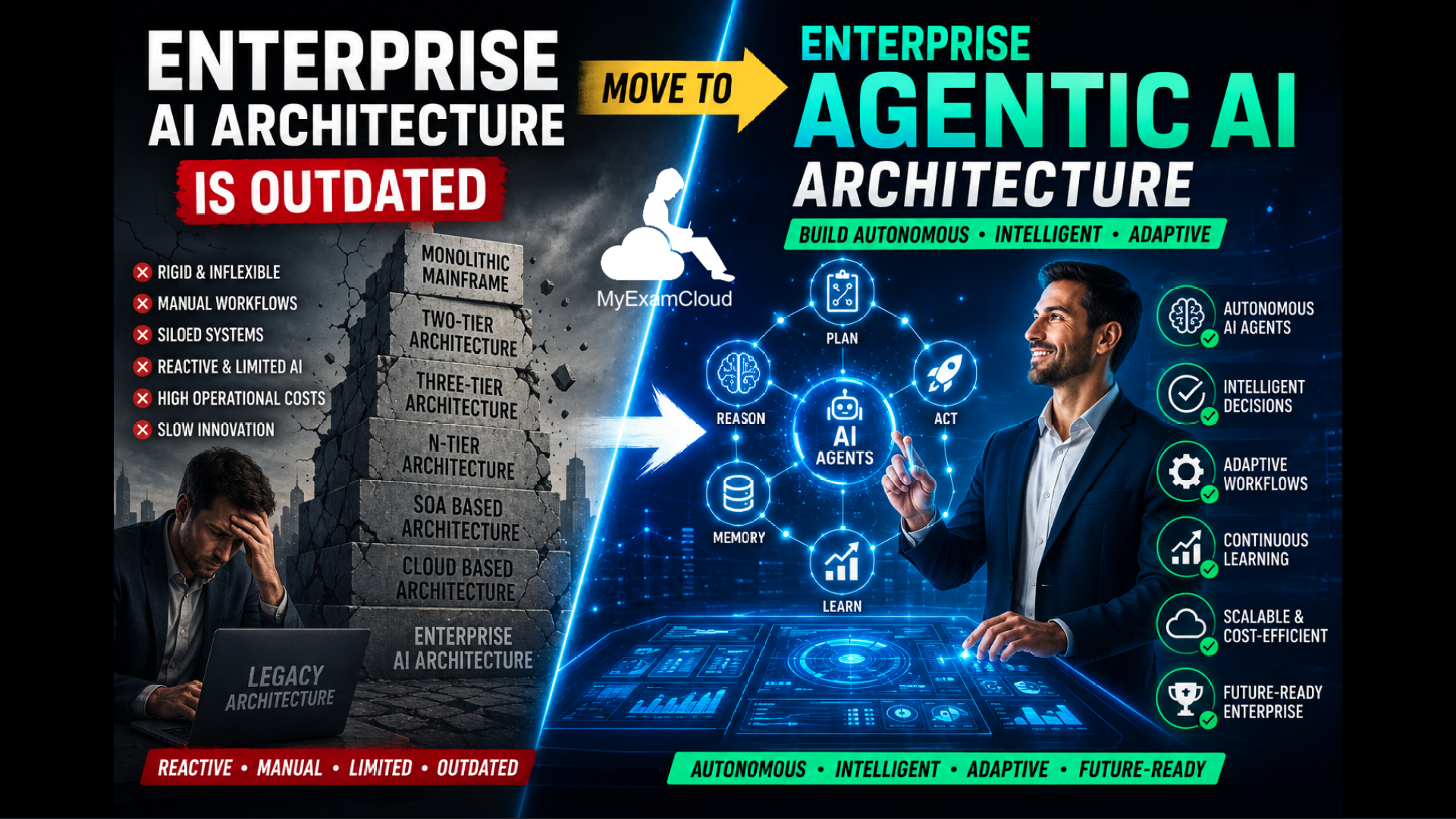
Enterprise AI Architecture Is Outdated - Move to Enterprise Agentic AI Architecture
Read this MyExamCloud Blog article for practical insights on Agentic AI. Explore more blog categories, search related topics in blog search, or return to the MyExamCloud Blog home.
Introduction
Enterprise technology architecture has continuously evolved for decades. Every major shift in computing introduced a new architecture paradigm designed to solve the limitations of the previous generation.
We moved from:
-
Monolithic mainframe systems
-
Client-server computing
-
Three-tier enterprise applications
-
Distributed n-tier systems
-
Service-Oriented Architecture (SOA)
-
Cloud-native microservices
-
Enterprise AI Architecture
Now the world is entering the next massive transformation:
Enterprise Agentic AI Architecture
This is not simply another technology upgrade.
It is a complete shift in how enterprise systems think, reason, plan, automate, collaborate, and make decisions.
Traditional enterprise applications were designed around:
-
Databases
-
APIs
-
Business rules
-
Human-driven workflows
Enterprise Agentic AI systems are designed around:
-
Autonomous AI agents
-
Memory systems
-
Reasoning engines
-
Multi-agent orchestration
-
Context awareness
-
Dynamic planning
-
Self-improving workflows
This transformation will redefine enterprise software over the next decade.
1. Monolithic Mainframe Single-Tier Architecture
The Beginning of Enterprise Computing
In the early days of enterprise computing, organizations relied heavily on large centralized mainframe systems.
Everything existed inside a single monolithic environment:
-
User interface
-
Business logic
-
Data processing
-
Database management
All operations were tightly coupled.
Characteristics
-
Single centralized machine
-
Vertical scaling
-
Terminal-based interfaces
-
Limited flexibility
-
High hardware costs
-
Vendor lock-in
Advantages
-
Centralized control
-
Strong transactional consistency
-
Reliable for financial systems
Limitations
As businesses grew:
-
Systems became extremely difficult to modify
-
Maintenance costs increased
-
Scalability was limited
-
Innovation slowed dramatically
This created the need for distributed computing models.
2. Two-Tier Architecture
Rise of Client-Server Computing
The introduction of personal computers changed enterprise computing forever.
Applications were split into:
-
Client layer
-
Database server layer
This became known as:
Two-Tier Architecture
Architecture Structure
Client Layer
-
User interface
-
Some business logic
Database Layer
-
Data storage
-
Query execution
Benefits
-
Reduced mainframe dependency
-
Improved user experience
-
Faster application development
Problems
Over time:
-
Fat clients became difficult to maintain
-
Security issues increased
-
Business logic duplication occurred
-
Scalability remained limited
This led to the next evolution.
3. Three-Tier Architecture
The Enterprise Revolution
Three-tier architecture became the foundation of enterprise software for many years.
It separated applications into:
-
Presentation Layer
-
Business Logic Layer
-
Database Layer
Why It Became Popular
This architecture improved:
-
Maintainability
-
Scalability
-
Security
-
Team collaboration
Example
Presentation Layer
-
Web UI
-
Desktop UI
-
Mobile UI
Application Layer
-
Business rules
-
Validation
-
Workflow logic
Database Layer
-
Oracle
-
SQL Server
-
DB2
Major Enterprise Systems
Many enterprise platforms adopted this architecture:
-
ERP systems
-
Banking systems
-
HR systems
-
Insurance platforms
Challenges
As enterprise ecosystems expanded:
-
Applications became too large
-
Integrations became difficult
-
Deployment cycles slowed
-
Reusability issues appeared
Organizations needed distributed services.
4. N-Tier Architecture
Distributed Enterprise Systems
N-tier architecture expanded the three-tier model into multiple specialized layers.
Common Layers
-
UI Layer
-
API Gateway
-
Authentication Layer
-
Business Services
-
Integration Layer
-
Messaging Layer
-
Data Access Layer
-
Database Layer
Benefits
-
Better scalability
-
Distributed processing
-
Team specialization
-
Improved modularity
Enterprise Impact
Large enterprises adopted:
-
Middleware platforms
-
Enterprise Service Buses
-
Distributed application servers
Problems
Eventually:
-
Systems became overly complex
-
Tight coupling still existed
-
Deployment overhead increased
-
Integration bottlenecks emerged
This paved the way for SOA.
5. Service-Oriented Architecture (SOA)
Reusable Enterprise Services
SOA introduced a major shift:
Applications became collections of reusable services.
Core Principles
-
Loose coupling
-
Reusable services
-
Enterprise integration
-
Standardized communication
Technologies
-
SOAP
-
WSDL
-
XML
-
ESB
-
BPM engines
Advantages
SOA enabled:
-
Enterprise-wide integrations
-
Reusable business capabilities
-
Cross-platform interoperability
Limitations
However:
-
ESB became centralized bottlenecks
-
SOAP was heavyweight
-
Governance complexity exploded
-
Performance overhead increased
The industry needed something lighter and faster.
6. Cloud-Based Solutions Architecture
Cloud Changed Everything
Cloud computing transformed enterprise architecture.
Infrastructure became:
-
Elastic
-
On-demand
-
Globally distributed
Cloud Architecture Principles
-
Horizontal scalability
-
Infrastructure as code
-
Managed services
-
Serverless computing
-
DevOps automation
Popular Cloud Platforms
-
Microsoft Azure
-
AWS
-
Google Cloud
Microservices Revolution
Applications shifted from monoliths to:
Microservices Architecture
Each service became:
-
Independently deployable
-
Independently scalable
-
API-driven
Benefits
-
Faster deployment
-
Better scalability
-
Cloud-native resilience
Problems
But cloud-native systems introduced:
-
Distributed complexity
-
Observability challenges
-
Service sprawl
-
Operational overhead
Then Artificial Intelligence entered the enterprise world.
7. Enterprise AI Architecture
AI Became Enterprise Infrastructure
AI moved from experimentation into enterprise production systems.
Organizations began integrating:
-
Machine learning
-
NLP systems
-
Recommendation engines
-
Computer vision
-
Generative AI
Enterprise AI Architecture Components
-
Data lakes
-
ML pipelines
-
Model training infrastructure
-
Vector databases
-
AI APIs
-
Prompt orchestration
-
RAG systems
Typical Enterprise AI Workflow
-
User request
-
AI model inference
-
Context retrieval
-
Response generation
Problems with Enterprise AI Architecture
Despite the excitement, traditional enterprise AI architecture still has major limitations.
AI Systems Are Mostly Reactive
Most enterprise AI systems:
-
Wait for user prompts
-
Execute predefined workflows
-
Lack autonomous reasoning
No Long-Term Planning
Traditional AI systems:
-
Cannot independently plan
-
Cannot dynamically coordinate workflows
-
Cannot intelligently adapt enterprise operations
Limited Autonomy
Enterprise AI today is often:
-
Assistant-based
-
Prompt-based
-
Human-triggered
This architecture is already becoming outdated.
8. Enterprise Agentic AI Architecture
The New Era
The next evolution is:
Enterprise Agentic AI Architecture
This architecture introduces:
-
Autonomous AI agents
-
AI reasoning systems
-
Persistent memory
-
Goal-driven execution
-
Multi-agent collaboration
-
Dynamic enterprise orchestration
Instead of applications simply responding to requests:
AI agents now:
-
Think
-
Plan
-
Collaborate
-
Execute
-
Learn
-
Optimize
What Is an AI Agent?
An AI agent is an autonomous system capable of:
-
Understanding goals
-
Planning tasks
-
Using tools
-
Accessing memory
-
Making decisions
-
Executing workflows
Enterprise Agentic AI Architecture Components
1. Agent Layer
Specialized enterprise AI agents:
-
Finance agents
-
HR agents
-
Security agents
-
Customer support agents
-
Engineering agents
2. Orchestration Layer
Coordinates:
-
Multi-agent workflows
-
Task routing
-
AI collaboration
-
Context sharing
3. Memory Systems
Persistent memory enables:
-
Historical awareness
-
Context retention
-
Personalized intelligence
4. Reasoning Engines
AI systems can:
-
Evaluate options
-
Make decisions
-
Optimize execution paths
5. Tool Integration Layer
Agents integrate with:
-
APIs
-
Databases
-
Enterprise systems
-
SaaS platforms
6. Human Governance Layer
Humans remain responsible for:
-
Governance
-
Compliance
-
Ethical oversight
-
Risk management
Why Enterprise AI Architecture Is Becoming Outdated
Traditional enterprise AI systems:
-
Assist users
Enterprise Agentic AI systems:
-
Operate autonomously
This is a massive architectural difference.
Old Enterprise AI Model
Human → Prompt → AI Response
Enterprise Agentic AI Model
Goal → AI Planning → Multi-Agent Execution → Continuous Optimization
Real Enterprise Use Cases
Autonomous Customer Support
AI agents can:
-
Analyze tickets
-
Coordinate systems
-
Resolve issues automatically
Enterprise DevOps Automation
AI agents can:
-
Detect failures
-
Deploy fixes
-
Monitor infrastructure
-
Optimize cloud resources
AI Business Operations
AI agents can:
-
Generate reports
-
Analyze KPIs
-
Predict risks
-
Coordinate teams
Key Technologies Powering Agentic AI
LLMs
-
GPT models
-
Claude
-
Gemini
-
Llama
Vector Databases
-
Pinecone
-
Weaviate
-
Chroma
Agent Frameworks
-
LangChain
-
Semantic Kernel
-
AutoGen
-
CrewAI
Cloud AI Platforms
-
Azure AI Foundry
-
AWS Bedrock
-
Google Vertex AI
The Future of Enterprise Architecture
The future enterprise architecture stack will likely evolve into:
-
Cloud-native infrastructure
-
Event-driven systems
-
Multi-agent orchestration
-
AI memory architecture
-
Autonomous workflow systems
-
Human-AI collaborative governance
Enterprise applications will gradually transform into:
Enterprise AI Ecosystems
New Enterprise Roles Emerging
Agentic AI Architect
Designs enterprise AI ecosystems.
AI Orchestration Engineer
Builds multi-agent workflows.
AI Governance Architect
Ensures ethical and secure AI operations.
Enterprise AI Strategist
Aligns AI systems with business goals.
Final Thoughts
Enterprise Architecture is undergoing its biggest transformation since cloud computing.
Traditional Enterprise AI Architecture is already showing limitations because:
-
It is reactive
-
Prompt-driven
-
Human-dependent
The future belongs to:
Enterprise Agentic AI Architecture
Organizations that adopt Agentic AI early will gain:
-
Massive automation advantages
-
Faster innovation
-
Reduced operational costs
-
Intelligent enterprise ecosystems
The enterprise systems of the future will not simply process requests.
They will think, reason, collaborate, and act autonomously.
Recommended Certifications for Enterprise Agentic AI Architecture
The shift from traditional Enterprise AI Architecture to Enterprise Agentic AI Architecture requires professionals to master cloud computing, AI engineering, AI orchestration, distributed systems, autonomous agents, and enterprise-scale AI governance.
The following certifications can help Solution Architects, Software Architects, Cloud Architects, AI Engineers, and Enterprise Architects transition into next-generation Agentic AI Architecture roles.
1. Microsoft Azure AI & Agentic AI Certifications
- AZ-900 Microsoft Azure Fundamentals Practice Tests
- AI-900 Microsoft Azure AI Fundamentals Practice Tests
- AI-102 Microsoft Azure AI Engineer Associate Practice Tests
- AB-730 Microsoft Certified AI Business Professional Practice Tests
- AB-731 Microsoft Certified AI Transformation Leader Practice Tests
- AB-100 Microsoft Certified Agentic AI Business Solutions Architect Practice Tests
2. Generative AI & AI Agent Certifications
- Generative AI Certification Practice Tests
- Generative AI Leader Certification Practice Tests
- AWS Certified Generative AI Developer Professional (AIP-C01)
- Databricks Certified Generative AI Engineer Associate
3. Cloud Architecture Certifications
- AWS Solutions Architect Associate (SAA-C03)
- AWS Solutions Architect Professional (SAP-C02)
- Google Professional Cloud Architect
- Google Associate Cloud Engineer
4. Programming Certifications for AI Architects
- Python Certification Practice Tests
- Java Certification Practice Tests
- Oracle Certified Professional Java SE 21 Developer
- PCPP Python Professional Programmer Certification
5. DevOps & Containerization Certifications
- Kubernetes Certification Practice Tests
- DevOps Certification Practice Tests
- Docker Certified Associate (DCA)
- HashiCorp Terraform Associate Certification
Related Articles
- How to Become an Agentic AI Architect in 2026
- AI Architectures in 2026: Complete Guide from Neural Networks to Agentic AI Systems
- Understand AI Concepts 2026: LLM, RAG, AI Agents and Agentic AI Explained
- Design Tips and Best Practices for Event-Driven Agentic AI
- AI Architecture and AI Models Every Software Architect Must Know
- AI Certification Roadmap 2026: From Beginner to AI Architect
- 2026 Programming & AI Certification Roadmap: Complete Guide from Fresher to AI Architect
- Context Engineering and MCP Toolbox: The Hidden Backbone of Modern AI
- How to Build an AI Model Driven Enterprise Application
- The Rise of AI Coding Assistants: From Copilot to Autopilot
Frequently Asked Questions (FAQs)
1. What is Enterprise Agentic AI Architecture?
Enterprise Agentic AI Architecture is a next-generation enterprise architecture model where autonomous AI agents can reason, plan, collaborate, make decisions, use tools, and execute workflows with minimal human intervention.
2. Why is traditional Enterprise AI Architecture becoming outdated?
Traditional Enterprise AI Architecture is mostly reactive, prompt-driven, and human-dependent. It lacks autonomous reasoning, long-term planning, dynamic workflow execution, and intelligent multi-agent collaboration capabilities required for future enterprise systems.
3. What is the difference between Enterprise AI Architecture and Enterprise Agentic AI Architecture?
Enterprise AI Architecture mainly focuses on AI-assisted systems, machine learning models, APIs, and prompt-based interactions. Enterprise Agentic AI Architecture introduces autonomous AI agents capable of reasoning, planning, memory retention, workflow execution, and continuous optimization.
4. What are AI agents in Enterprise Agentic AI Architecture?
AI agents are autonomous software entities capable of understanding goals, making decisions, accessing memory, using tools, interacting with enterprise systems, and executing tasks independently using Large Language Models (LLMs) and AI orchestration frameworks.
5. What technologies are used in Enterprise Agentic AI Architecture?
Common technologies include:
- Large Language Models (LLMs)
- Vector databases
- RAG systems
- LangChain
- Semantic Kernel
- CrewAI
- AutoGen
- Cloud-native microservices
- Event-driven architectures
- AI orchestration frameworks
6. What are the benefits of Enterprise Agentic AI Architecture?
Major benefits include:
- Autonomous workflow execution
- Intelligent decision making
- Reduced operational costs
- Continuous learning systems
- Scalable enterprise automation
- Adaptive business processes
- Improved productivity
- Faster enterprise innovation
7. What industries can benefit from Enterprise Agentic AI Architecture?
Industries including banking, healthcare, insurance, manufacturing, retail, logistics, telecommunications, cybersecurity, software engineering, customer support, and cloud operations can benefit significantly from autonomous AI agent systems.
8. What is the role of memory in Agentic AI systems?
Memory enables AI agents to retain historical context, understand previous interactions, personalize decisions, improve reasoning, and maintain long-term workflow continuity across enterprise systems.
9. Can Enterprise Agentic AI replace human employees?
Enterprise Agentic AI is designed to automate repetitive and operational tasks while augmenting human productivity. Human governance, ethical oversight, strategic planning, and critical decision-making remain essential in enterprise environments.
10. What skills are required to become an Enterprise Agentic AI Architect?
Important skills include:
- Cloud architecture
- AI engineering
- Python or Java programming
- LLM integration
- AI orchestration
- Distributed systems
- Microservices architecture
- Event-driven systems
- DevOps and Kubernetes
- Enterprise AI governance
11. What certifications are useful for Enterprise Agentic AI Architecture?
Useful certifications include AZ-900, AI-900, AI-102, AB-730, AB-731, AB-100, AWS AI certifications, Generative AI certifications, Kubernetes certifications, and cloud architecture certifications.
12. What is the future of Enterprise Agentic AI Architecture?
The future of enterprise systems is moving toward autonomous AI ecosystems where intelligent agents collaborate across cloud infrastructure, enterprise applications, APIs, databases, and business workflows to create self-optimizing enterprises.
| Author | Ganesh P Certified Artificial Intelligence Scientist (CAIS) | |
| Published | 3 months ago | |
| Category: | Agentic AI | |
| HashTags | #Java #Python #AWS #Programming #Software #AI #ArtificialIntelligence #agenticai |

