
Understand AI Concepts 2026: LLM, RAG, AI Agents and Agentic AI Explained
Read this MyExamCloud Blog article for practical insights on Artificial Intelligence. Explore more blog categories, search related topics in blog search, or return to the MyExamCloud Blog home.
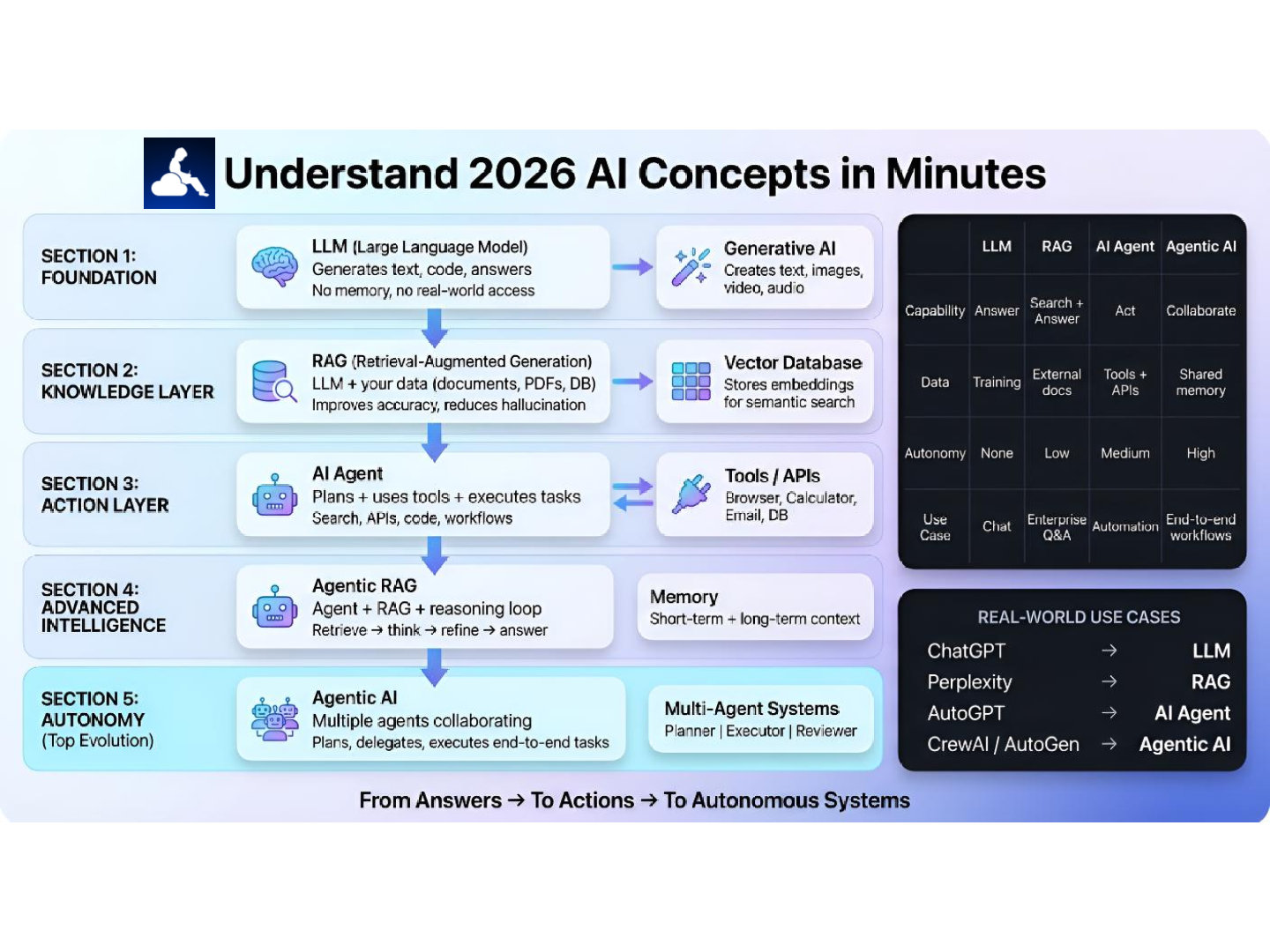
If you are trying to understand artificial intelligence in 2026, you are not alone. Terms like LLM, RAG, AI Agents, and Agentic AI are widely used, but they actually represent a clear evolution of AI systems.
Answers to Knowledge to Actions to Autonomous Systems
This guide explains each concept in a simple and practical way with real-world use cases.
LLM (Large Language Models) The Foundation
Large Language Models are the core of modern AI. They are trained on massive datasets and can generate text, code, summaries, and answers.
However, they do not have real-time knowledge or access to your private data unless connected to external systems.
Practical Use Cases
Writing emails, generating code, creating blog content, answering technical questions, and building chatbots.
Generative AI The Creation Layer
Generative AI extends LLM capabilities to create images, videos, audio, and other types of content.
This is where AI becomes a powerful creative tool.
Practical Use Cases
Content creation, marketing campaigns, AI-generated videos, voice assistants, and design automation.
RAG (Retrieval Augmented Generation) The Knowledge Layer
RAG connects AI models to external data sources such as documents, databases, and APIs to provide accurate and up-to-date answers.
How it works
Search relevant data, retrieve context, and generate accurate responses using the model.
Practical Use Cases
Enterprise chatbots, internal knowledge systems, customer support automation, and certification learning assistants.
Vector Databases The Intelligence Engine
Vector databases store data as embeddings, allowing AI systems to perform semantic search instead of keyword-based matching.
This enables understanding of meaning and intent.
Practical Use Cases
Recommendation systems, intelligent search engines, and RAG-based applications.
AI Agents The Action Layer
AI Agents go beyond answering questions. They can plan tasks, use tools, and execute workflows.
Capabilities
Planning, reasoning, tool usage, and execution.
Practical Use Cases
Automating research, generating content, executing workflows, and assisting developers with coding tasks.
Agentic RAG Thinking and Acting Together
Agentic RAG combines retrieval systems with AI agents and reasoning loops to improve outputs.
Process
Retrieve information, analyze it, refine results, and generate better responses.
Practical Use Cases
Technical documentation generation, debugging systems, research analysis, and long-form content creation.
Memory The Personalization Layer
Memory allows AI systems to remember previous interactions and user preferences.
Types
Short-term memory for conversations and long-term memory for personalization.
Practical Use Cases
Personalized assistants, recommendation engines, and adaptive learning systems.
Agentic AI The Autonomous System
Agentic AI involves multiple agents working together to complete complex tasks autonomously.
Roles
Planner, researcher, executor, and reviewer.
Practical Use Cases
Business automation, AI-driven applications, content pipelines, and autonomous systems.
The Big Picture
LLM provides answers.
RAG provides accurate answers.
AI Agents perform actions.
Agentic AI enables full automation.
Related Articles
- How to Start Python in 2026 for AI Developers: Complete Roadmap to High-Paying Jobs
- Java AI Developer Guide 2026: Basics to Advanced AI with Spring AI
- AI/ML Frameworks and Libraries Every Developer Must Know in 2026
Certifications to Master AI in 2026
Beginner Level
- AWS Certified AI Practitioner (AIF-C01) Practice Tests
- Microsoft Azure AI Fundamentals (AI-900) Practice Tests
Intermediate Level
- AWS Machine Learning Engineer Associate (MLA-C01) Practice Tests
- Databricks Certified Machine Learning Associate Practice Tests
Advanced Level
- AWS Certified Generative AI Developer Professional (AIP-C01) Practice Tests
- Databricks Certified Generative AI Engineer Associate Practice Tests
Bonus
Final Takeaway
To succeed in AI, start by understanding the concepts, then build real projects, and finally validate your skills through certifications.
This approach will help you move from beginner to AI engineer and beyond in 2026.
Explore more at MyExamCloud AI Learning Platform
| Author | Ganesh P Certified Artificial Intelligence Scientist (CAIS) | |
| Published | 4 months ago | |
| Category: | Artificial Intelligence | |
| HashTags | #Java #Python #Programming #CloudComputing #Software #Architecture #AI #ArtificialIntelligence #genai #machinelearning #ml #generativeai |

