
How to Build an AI Model Driven Enterprise Application: A Comprehensive Guide
Read this MyExamCloud Blog article for practical insights on Artificial Intelligence. Explore more blog categories, search related topics in blog search, or return to the MyExamCloud Blog home.
In today’s digital era, Artificial Intelligence (AI) is revolutionizing the way enterprises operate by enhancing processes, automating tasks, and augmenting human capabilities. Businesses across all industries are leveraging AI to stay competitive and drive innovation in the data-driven landscape.
But how does one build an AI model that can drive enterprise applications effectively? What are the challenges and considerations involved in building an intelligent AI model for an enterprise?
This comprehensive guide will walk you through the process of building an AI model for enterprises, along with the complexities and challenges associated with it. We will also discuss the essential components of enterprise AI architecture necessary for building a cohesive AI system.
The Unprecedented Growth of the Global AI Market
The adoption of AI technology is driving significant growth in the global AI market. According to Statista, the AI market, which is currently estimated to be worth around $100 billion, is expected to grow twenty times by 2030, reaching close to $2 trillion.
This rapid growth is attributed to the numerous industries that have already embraced AI, including healthcare, finance, retail, and more. The advancement of AI technology and the rise of new applications such as chatbots and image-generating AI has made the future of artificial intelligence a promising one.
What is an AI Model-Driven Enterprise Application?
An AI model-driven enterprise application is a sophisticated AI system with the ability to process large volumes of data, recognize patterns, and make decisions based on input. These AI models are built using complex algorithms and deep learning strategies, typically incorporating neural networks.
An intelligent AI model has the capability to learn, reason, understand, adapt, interact, solve problems, and generate accurate results. For example, an AI-powered language model like ChatGPT can understand and respond to commands and identify objects, people, and scenarios in photos.
One of the noteworthy enterprise applications of AI is its implementation in the healthcare sector. For instance, Babylon Health has built an AI-based chatbot that can diagnose patients, provide medical advice, and even schedule appointments with doctors.
AI model development services for enterprise
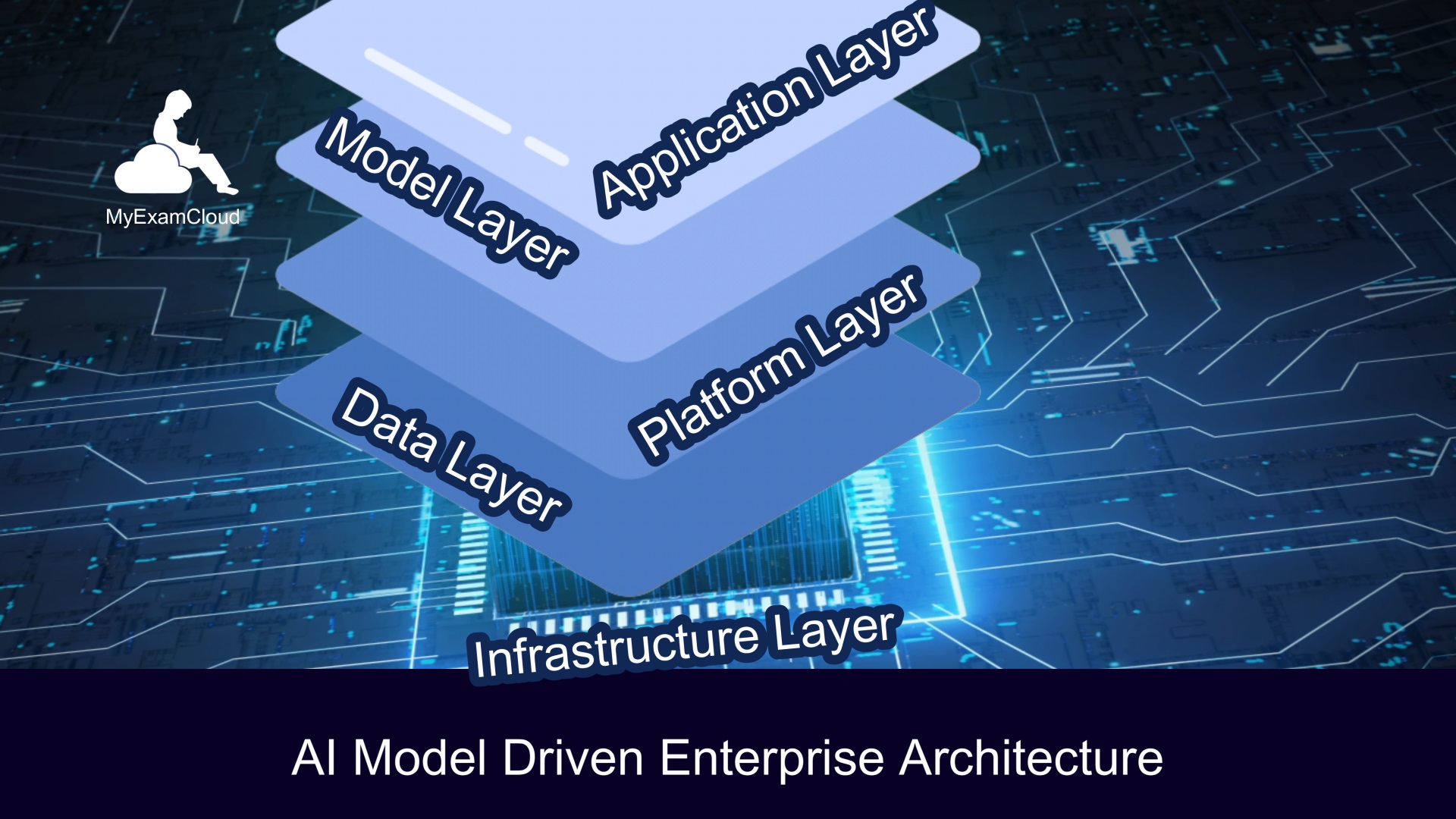
The Five-Layer Model for Enterprise AI Systems
The complex nature of enterprise AI systems calls for a well-structured architecture. The five-layer model is one of the popular strategies that break down an AI system into distinct levels, with each layer serving a different function.
1. Infrastructure Layer
The infrastructure layer provides the computing power needed for data processing and analysis. This layer comprises hardware resources such as servers, GPUs (Graphics Processing Units), and other specialized tools. Enterprises can choose scalable and adaptable infrastructure alternatives on cloud platforms like AWS, Azure, and Google Cloud.
2. Data Layer
Data is the foundation of any AI system. In the data layer, the data is collected, stored, and preprocessed. This includes tasks like data cleaning, normalization, and transformation. Once the data is preprocessed, it is fed into the next layer.
3. Platform Layer
The platform layer acts as the bridge between the data and the models. It includes tools and technologies such as data warehouses, data lakes, data analytics, and machine learning platforms that facilitate data processing, analysis, and visualization.
4. Model Layer
The model layer is the heart of an AI system. It hosts the models, including machine learning, deep learning, and artificial neural networks, that are used for recognizing patterns, training, and making predictions. This layer also comprises the tools and frameworks used for developing and training AI models.
5. Application Layer
The final layer is responsible for delivering the results. Here, the models trained in the previous layer are deployed and integrated with the enterprise applications. This allows the AI models to analyze real-time data, make decisions, and provide insights.
Building an AI Model-Driven Enterprise Application: A Step-by-Step Guide
Step 1: Define Objectives and KPIs
The first step to building an AI model for an enterprise application is to define the problem statement and the objectives that the AI model will be expected to achieve. Once the objectives are determined, key performance indicators (KPIs) can be identified to measure the success of the AI model.
For instance, the objective of building an AI-powered chatbot for a customer service enterprise application would be to improve customer satisfaction and increase efficiency. The KPIs can include the average response time, customer feedback, and the number of successful interactions.
Step 2: Data Collection and Preparation
The success of an AI model is heavily reliant on the quality and quantity of data it is trained on. A robust data collection and preparation process is crucial for building a reliable and accurate AI model. Data can be collected from various sources, including internal databases, web scraping, and third-party data providers.
After collecting the data, it is preprocessed to remove duplicates, irrelevant information, and deal with missing values. Data augmentation techniques such as image transformation and text data expansion can be used to increase the diversity of the dataset.
Step 3: Choose the Right Model and Algorithm
Based on the objectives and KPIs, the appropriate AI model and algorithm need to be selected. This will depend on factors such as the type of problem (classification, regression, or clustering), the type of data (text, image, or video), and the complexity of the problem.
Supervised learning algorithms such as logistic regression and decision trees are used for classification problems, while regression algorithms such as linear regression and neural networks are suitable for predicting continuous values. Clustering algorithms like K-means and hierarchical clustering are used for unsupervised learning problems.
Step 4: Train and Test the Model
The selected AI model and algorithm are then trained on the prepared dataset. The training process involves feeding the model with input data and the expected output data to learn patterns and make predictions. The model’s performance is evaluated by testing it on a subset of the data that it has not been trained on, known as the test set.
Based on the performance on the test set, the parameters and hyperparameters of the model are fine-tuned to achieve better results. This process is repeated until the model reaches a satisfactory level of accuracy.
Step 5: Model Deployment
Once the model has undergone thorough testing and has achieved the desired level of accuracy, it is ready to be deployed in the enterprise application. The model is integrated into the application and can now analyze real-time data and make predictions.
Step 6: Continuous Monitoring and Maintenance
An AI model-driven enterprise application is not a one-time effort; it requires constant monitoring and maintenance. The model needs to be evaluated continually, and improvements need to be made as the data and business requirements change.
Challenges and Considerations in Building an AI Model-Driven Enterprise Application
1. Data Quality and Availability
As mentioned earlier, data quality and availability are crucial factors that determine the success of an AI model. Most enterprises have massive amounts of data, but it may not always be clean and structured. This makes it challenging to preprocess and integrate the data into the AI model.
Furthermore, enterprises often have siloed data, preventing easy access and sharing of information across departments. Thus, data quality and availability are significant challenges that need to be addressed when building an AI model for an enterprise.
2. Scalability and Performance
The infrastructure layer of an AI model is responsible for providing the computing power needed for data analysis. As enterprise applications generate vast quantities of data, the AI model should have the capability to scale up or down as per the requirements. This ensures that the model's performance does not degrade with an increase in the number of users and data.
3. Regulatory Compliance
Enterprises deal with sensitive and confidential data, making it crucial to adhere to regulatory standards. Developing an AI model that is compliant with regulations such as GDPR and HIPAA is a challenge, as it involves handling personal data and ensuring its security and privacy.
4. Transparency and Bias
Transparency and bias in AI models are major concerns for enterprises. With the increasing use of AI decision-making in sensitive domains such as banking and insurance, it is essential to ensure that the AI models are transparent and free from any biases.
Transparency ensures that decisions made by AI models can be interpreted and justified, while the absence of bias prevents discrimination against certain groups of people, making the model unbiased.
Navigating the Challenges and Building a Competitive Enterprise AI System
In conclusion, building an AI model-driven enterprise application involves understanding the intricate architecture and gaining expertise in cutting-edge technologies like AI and machine learning. By following the steps outlined in this guide and keeping the challenges in mind, enterprises can leverage the power of AI to build scalable, accurate, and robust AI systems that drive innovation and stay ahead of the competition in this ever-evolving landscape.
Utilizing cutting-edge AI technology, the MyExamCloud AI Exam Generator was designed with an AI Model Driven architecture and rigorously tested using millions of records.
| Author | Ganesh P Certified Artificial Intelligence Scientist (CAIS) | |
| Published | 1 year ago | |
| Category: | Artificial Intelligence | |
| HashTags | #Java #Python #Programming #Software #Architecture #AI #ArtificialIntelligence |

