
Which Is Better for AI Career Growth in 2026? Java or Python
Read this MyExamCloud Blog article for practical insights on Artificial Intelligence. Explore more blog categories, search related topics in blog search, or return to the MyExamCloud Blog home.
Two massive ecosystems. One critical decision. Your engineering career trajectory depends on it.
The artificial intelligence landscape has reached a pivotal milestone. As organizations globally race to implement production-grade AI solutions, a fundamental shift is happening in the tech job market. The old debate isn't about which programming language is "better" in isolation anymore—it is about where you want to position yourself within the global AI economy.
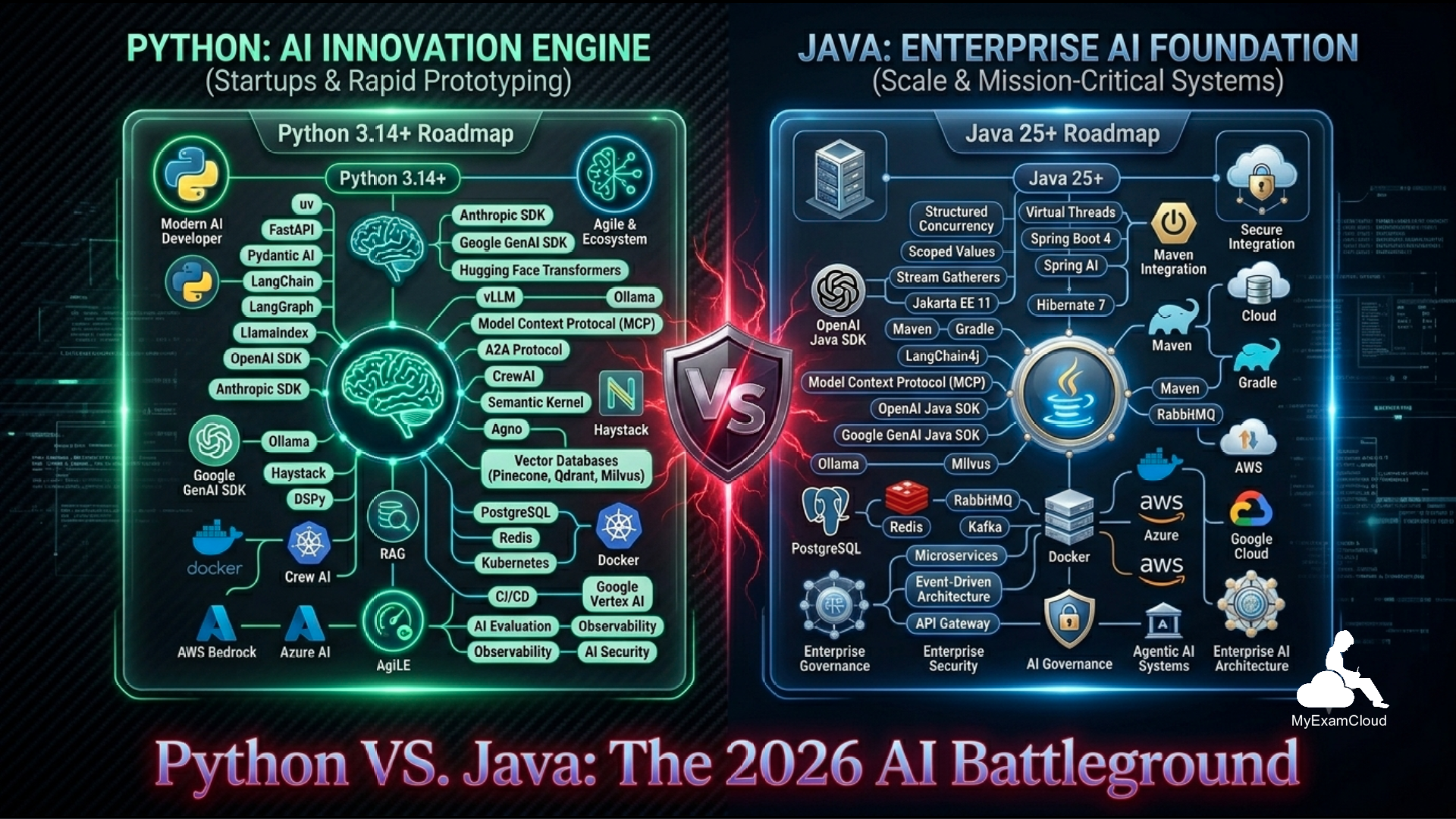
Our comprehensive 2026 comparison infographic in the article image lays out the complete technical roadmaps for both ecosystems side by side. It serves as a strategic blueprint for software engineers, freshers, and architects who need to navigate the modern tech landscape and maximize their global market value.
The Python Route: The AI Innovation Engine
If your career goal is to work at the absolute bleeding edge of model creation, autonomous agents, and rapid prototyping, Python remains the undisputed titan. Statistically, 90% of AI experimental work happens within the Python ecosystem, and nearly every major new AI model or framework launches with Python compatibility on day one.
Mastering the modern Python AI engineer stack requires deep familiarity with an agile, interconnected toolset:
- Core Runtime & Tooling: Building on Python 3.14+ optimizations with lightning-fast dependency management powered by uv.
- Frameworks & Orchestration: Developing with FastAPI and Pydantic AI for data validation, alongside agentic frameworks like LangChain, LangGraph, LlamaIndex, CrewAI, AutoGen, Semantic Kernel, Agno, Haystack, and DSPy.
- Model Deployment & Standards: Leveraging the OpenAI SDK, Anthropic SDK, and Google GenAI SDK while integrating local runtimes like vLLM, Ollama, and the open-standard Model Context Protocol (MCP).
- Data Infrastructure & MLOps: Structuring advanced RAG pipelines using Vector Databases (Pinecone, Qdrant, Milvus) alongside PostgreSQL, Redis, Docker, Kubernetes, and cloud suites like AWS Bedrock and Google Vertex AI.
Career Outlook: Python skills are prioritized by 56% of companies hiring for AI-native roles. AI engineers fluent in these agent frameworks command premium global salaries, tracking 1.4 to 2x above traditional software development baselines.
Master Python for AI
To claim your stake in fast-moving AI startups and innovation teams, establishing verified proficiency is non-negotiable.
- Get Certified: Access the MyExamCloud Python Certification Practice Tests & Mock Exams (PCEP, PCAP, PCPP, PCED, PCAD, PCET and PCAT) to accelerate your credentials.
The Java Route: The Enterprise AI Foundation
While Python wins the initial exploration battle, Java wins the long-term production war. Global enterprises do not ship experimental notebooks to millions of customers—they ship highly stable, secure systems that demand absolute observability, low latency, and predictable performance at scale. Today, 62% of enterprise organizations rely on Java to code production AI functionality into their core business logic.
A modern Enterprise Java AI Architect must navigate a highly robust infrastructure layer designed for massive scale:
- Core Language Overhauls: Utilizing Java 25+ execution features like Virtual Threads, Structured Concurrency, Scoped Values, and Stream Gatherers to handle high-throughput concurrency seamlessly.
- Enterprise Frameworks: Standardizing AI with Spring Boot 4 and Spring AI, while maintaining backend integrity through Jakarta EE 11, Hibernate 7, JPA, Maven, and Gradle.
- Production Architecture: Connecting heavy AI workflows to enterprise enterprise components like LangChain4j, Milvus, PostgreSQL, Redis, and streaming fabrics like Kafka and RabbitMQ.
- Scalability & Cloud Control: Operating across cloud clusters via Docker, Kubernetes, AWS, Azure, and Google Cloud within strict frameworks of AI Governance, API Gateways, and Enterprise Security.
Career Outlook: Java job openings remain roughly 1.5x higher than Python overall across the global tech index. It dominates the massive financial, banking, fintech, and healthcare sectors where long-term career stability and top-quartile enterprise compensation packages are guaranteed.
Secure the Enterprise AI Stack
If your goal is designing high-availability corporate systems where security and uptime are paramount, your Java foundational expertise must be bulletproof.
- Get Certified: Gain full access to professional tracks via the MyExamCloud Java Certification Practice Tests & Mock Exams – OCA, OCP Programming & Spring Developer.
The 2026 Career Verdict at a Glance
| Factor | Python Track | Java Track |
|---|---|---|
| Best Suited For | AI-native startups, rapid prototyping, and RAG products | Fortune 500 enterprise systems, fintech, and global banking |
| Core AI Strength | Model training, agentic frameworks, and data science | Scale, multi-threaded performance, and secure deployment |
| Global Compensation | High premium tier (driven by specialized AI-native roles) | Elite baseline tier (highly stable, senior enterprise architect packages) |
| Hiring Profile | Fastest-growing segment for standalone AI application engineers | Highest overall volume; dominates global IT services and corporate architecture |
The Winning Career Strategy
The reality of the 2026 market is that Python dominates the frontlines of AI development, while Java powers the heavy infrastructure running enterprise AI. Because these technologies increasingly cross paths via modern cross-language standards like the Model Context Protocol (MCP), the most forward-thinking engineers are not choosing one over the other—they are mastering both.
Major global institutions now explicitly seek hybrid developers who can build an agile prototype in Python and scale it securely inside a Java microservices environment.
- Choose Python if you want to build intelligence frameworks from scratch and thrive in rapid, iterative environments.
- Choose Java if you want to architect massive systems, manage enterprise cloud footprints, and enjoy long-term organizational stability.
- Choose both if you want to be completely unstoppable in the global tech ecosystem.
Related Articles
Expand your understanding of the evolving 2026 tech architectural landscape with these deep-dives from the MyExamCloud editorial team:
- How to Code and Deploy Your Agentic AI Jakarta EE Spring AI Enterprise Application on AWS
- Can AWS AI Replace Traditional Developers? The Real Future of Software Engineering in 2026
- Is This AI-Powered Platform the Secret to Passing IT Certifications?
| Author | Ganesh P Certified Artificial Intelligence Scientist (CAIS) | |
| Published | 2 months ago | |
| Category: | Artificial Intelligence | |
| HashTags | #Java #Python #Programming #Software #Architecture #AI #ArtificialIntelligence #JavaCertification #PythonCertification #spring #springboot |

