
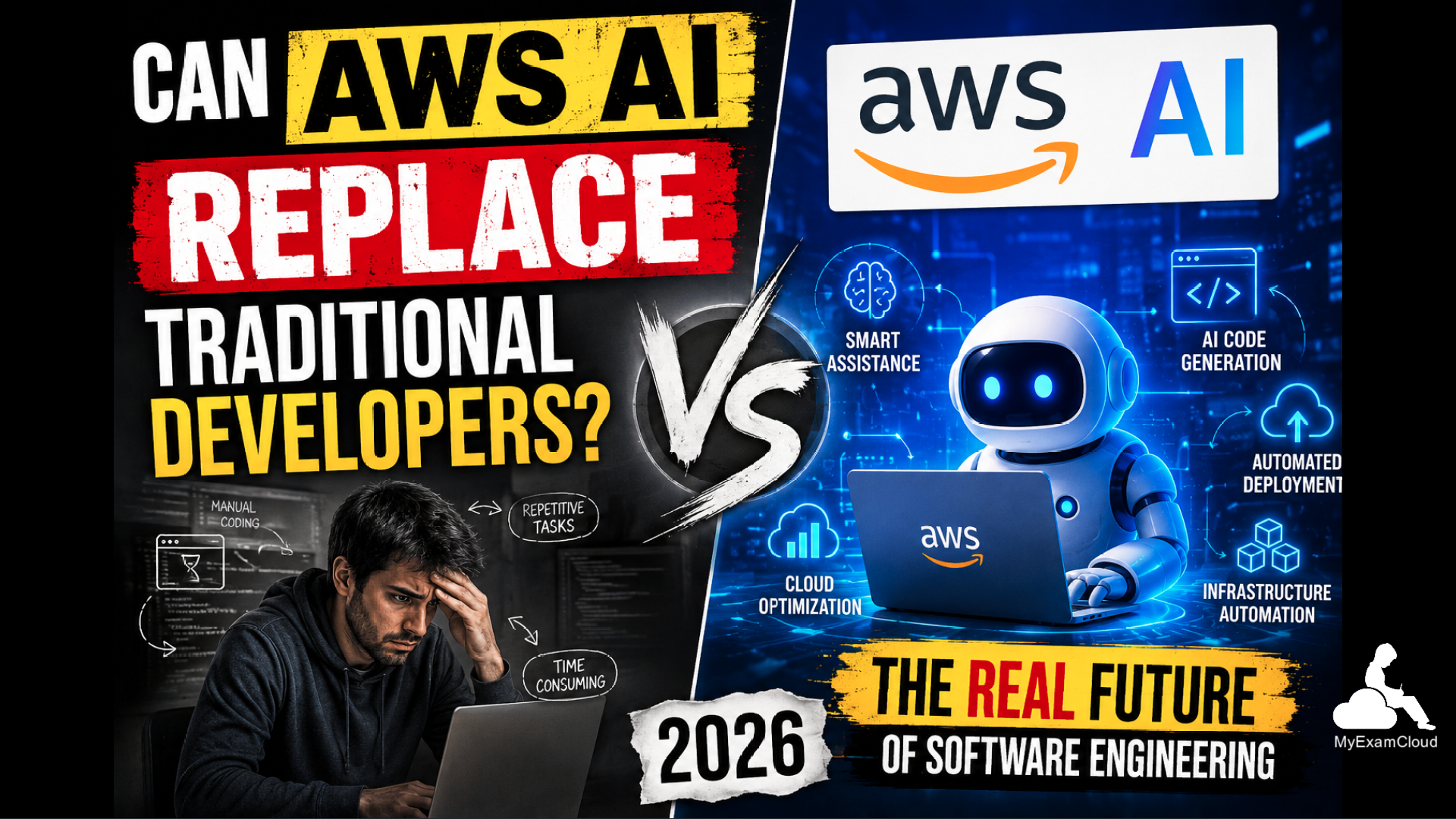
Can AWS AI Replace Traditional Developers? The Real Future of Software Engineering in 2026
Read this MyExamCloud Blog article for practical insights on AWS Certification. Explore more blog categories, search related topics in blog search, or return to the MyExamCloud Blog home.
A Complete Guide to AI-Augmented Development, Career Security, and Certification Roadmap
INTRODUCTION: THE FEAR AND THE TRUTH
In 2026, the question echoes across every engineering team, every tech conference, and every developer's mind: Will AWS AI replace me?
Amazon has invested over $10 billion in AI research. AWS Bedrock, CodeWhisperer, Q Developer, and SageMaker are transforming how software gets built. Headlines scream "AI kills coding jobs." But the reality is far more nuanced.
This article answers the question once and for all: No, AWS AI will not replace traditional developers. But developers who use AWS AI will replace those who don't.
PART ONE: WHAT AWS AI ACTUALLY DOES IN 2026
Amazon Q Developer (Formerly CodeWhisperer)
Amazon Q is an AI-powered coding assistant integrated into VS Code, IntelliJ, and AWS Console. It generates code, explains legacy code, creates unit tests, and documents functions.
AWS Bedrock
A fully managed service for building generative AI applications using foundation models from AI21, Anthropic, Cohere, Meta, Stability AI, and Amazon Titan.
AWS SageMaker
The leading platform for building, training, and deploying machine learning models at scale.
AWS CodeCatalyst with AI Workflows
Agentic AI that designs CI/CD pipelines, reviews pull requests, and suggests architectural improvements.
Amazon Titan Models
AWS's own family of foundation models for text generation, embeddings, and image analysis.
THE REAL CAPABILITIES (NOT HYPE)
- Automates boilerplate code generation
- Writes unit tests and documentation
- Explains legacy code in plain English
- Detects security vulnerabilities in real-time
- Suggests cloud-optimized architectures
WHAT AWS AI CANNOT DO TODAY
- Understand business context and stakeholder politics
- Make architectural trade-offs involving cost, speed, and compliance
- Lead cross-functional teams through ambiguity
- Take legal responsibility for production failures
- Build trust and relationships with clients
PART TWO: THE SIX AWS AI SKILLS COMPANIES WANT IN 2026
Skill 1: Prompt Engineering for AWS Bedrock
Companies need developers who can craft system prompts, few-shot examples, and chain-of-thought reasoning for foundation models on AWS Bedrock.
Skill 2: RAG Implementation on AWS
Retrieval-Augmented Generation using Amazon OpenSearch Serverless, Aurora PostgreSQL with pgvector, or Pinecone on AWS Marketplace.
Skill 3: Agentic AI Orchestration on AWS
Building multi-agent workflows using AWS Lambda, Step Functions, and Bedrock Agents that plan, act, and learn.
Skill 4: SageMaker Model Deployment
Training, fine-tuning, and deploying custom models at scale. Knowing when to use a small model vs. a large foundation model.
Skill 5: Human-in-the-Loop with A2I
Building governance into AI systems using Amazon Augmented AI (A2I) for human review of low-confidence predictions.
Skill 6: Traditional Development Fundamentals
AI does not remove the need for algorithms, data structures, system design, and debugging expertise.
PART THREE: THE NEW DEVELOPER ROLES IN THE AWS AI ERA
- AI-Augmented Developer: Traditional developer who uses AWS Q and Bedrock to ship code 3x faster.
- Prompt Engineer / LLM Ops Specialist: Designs and optimizes prompts for production AI systems.
- RAG Engineer: Builds retrieval pipelines connecting company data to LLMs on AWS.
- Agentic AI Architect: Designs autonomous agent workflows using AWS Step Functions and Bedrock Agents.
- AI Quality Assurance Engineer: Tests, audits, and validates AI-generated outputs for bias and hallucinations.
PART FOUR: WHAT COMPANIES ARE ACTUALLY DOING (INTERNAL DATA 2026)
- 68% of tech companies report hiring the same or more developers since adopting AI tools.
- 82% of developers using AWS Q say it makes them more productive, not replaceable.
- Company focus has shifted from "reduce headcount" to "increase output per developer."
- Entry-level hiring has become more competitive. Junior developers must now demonstrate AI tool proficiency.
- Salaries for AI-augmented developers are 25-40% higher than traditional developers.
PART FIVE: CERTIFICATION ROADMAP FOR AWS AI DEVELOPERS
Companies are not just looking for experience. They want validated proof of AWS AI skills. The following certifications are the industry standard in 2026. Each link leads to MyExamCloud practice tests and mock exams.
AWS AI & Machine Learning Certifications
- AWS Generative AI Developer AIP-C01 Practice Tests
- AWS Certified AI Practitioner AIF-C01 Exam Questions
- AWS Machine Learning Engineer Associate MLA-C01 Exam Questions
- AWS Machine Learning Specialty MLS-C01 Mock Exam
- AWS Data Engineer Associate DEA-C01 Exam Questions
AWS Core & Solutions Architecture Certifications
- AWS Solutions Architect Associate SAA-C03 Exam Questions
- AWS Solutions Architect Professional SAP-C02 Practice Exam
- AWS Certified Developer Associate DVA-C02 Practice Tests
- AWS DevOps Engineer Professional DOP-C02 Exam Questions
- AWS SysOps Administrator Associate SOA-C02 Practice Tests
- AWS Cloud Practitioner CLF-C02 Practice Tests
- AWS Certified Security Specialty SCS-C02 Exam Questions
- AWS Advanced Networking Specialty ANS-C01 Practice Tests
AI & Generative AI Certifications (All Vendors)
- Agentic AI Certification Practice Tests
- Generative AI Certification Courses & Practice Exams
- AI and Machine Learning Certification Practice Tests
- Azure AI Engineer Associate AI-102 Exam Questions
- Azure AI Fundamentals AI-900 Practice Tests
- Google Cloud Professional Machine Learning Engineer Exam Questions
- Databricks Generative AI Engineer Associate Exam Questions
Programming Certifications (The Foundation)
- Oracle Java Certification Practice Tests & Mock Exams
- Python Certification Practice Tests & Exam Questions
- OCP Java SE 21 Developer 1Z0-830 Practice Exam
- OCP Java SE 17 Developer 1Z0-829 Practice Tests
- PCAP-31-03 Certified Associate in Python Programming Exam Questions
- PCEP-30-02 Certified Entry-Level Python Programmer Practice Tests
MyExamCloud Platform & Learning Tools
- MyExamCloud Online Practice Tests & Certification Prep
- AI Exam Generator & Practice Tests Creator
- AI Tests Preparation & Certification Simulator
- All IT Certification Practice Tests & Mock Exams
- Online IT Certification Exams & Practice Tests
PART SIX: THE BOTTOM LINE — REPLACEMENT OR TRANSFORMATION?
The answer is clear: AWS AI will not replace traditional developers. The software industry still needs humans to:
- Understand ambiguous business requirements
- Make ethical and architectural trade-offs
- Take responsibility for production systems
- Build relationships with stakeholders
- Lead teams through uncertainty
However, the role is transforming. The traditional developer who refuses to use AI tools will struggle. The developer who masters AWS AI will become 3x more productive, command higher salaries, and work on more interesting problems.
The new equation for 2026:
Traditional Developer + AWS AI Skills = Irreplaceable Asset
Traditional Developer + No AI Skills = Obsolete
CONCLUSION: YOUR 2026 ACTION PLAN
If you are a software engineer in 2026, here is your roadmap:
- Get AWS Certified — start with Cloud Practitioner, then AI Practitioner, then Generative AI Developer Professional.
- Master prompt engineering for code generation using Amazon Q and Bedrock.
- Build a RAG pipeline on AWS using OpenSearch or Aurora pgvector.
- Create an agentic AI workflow using AWS Step Functions and Bedrock Agents.
- Never stop learning traditional fundamentals — algorithms, data structures, system design, and debugging.
The final word: AWS AI is not your replacement. It is your most powerful tool. The developers who thrive in 2026 will be those who learn to augment their skills with AI, not those who fear it. The future of software engineering is not human vs. machine. It is human + machine.
- The AI Skills Companies Want in 2026
- From 2026 Traditional Legacy Apps Are Replaced by AI Agents
- No More Software Jobs Only Agentic AI Software Developers in 2026 and Beyond

