
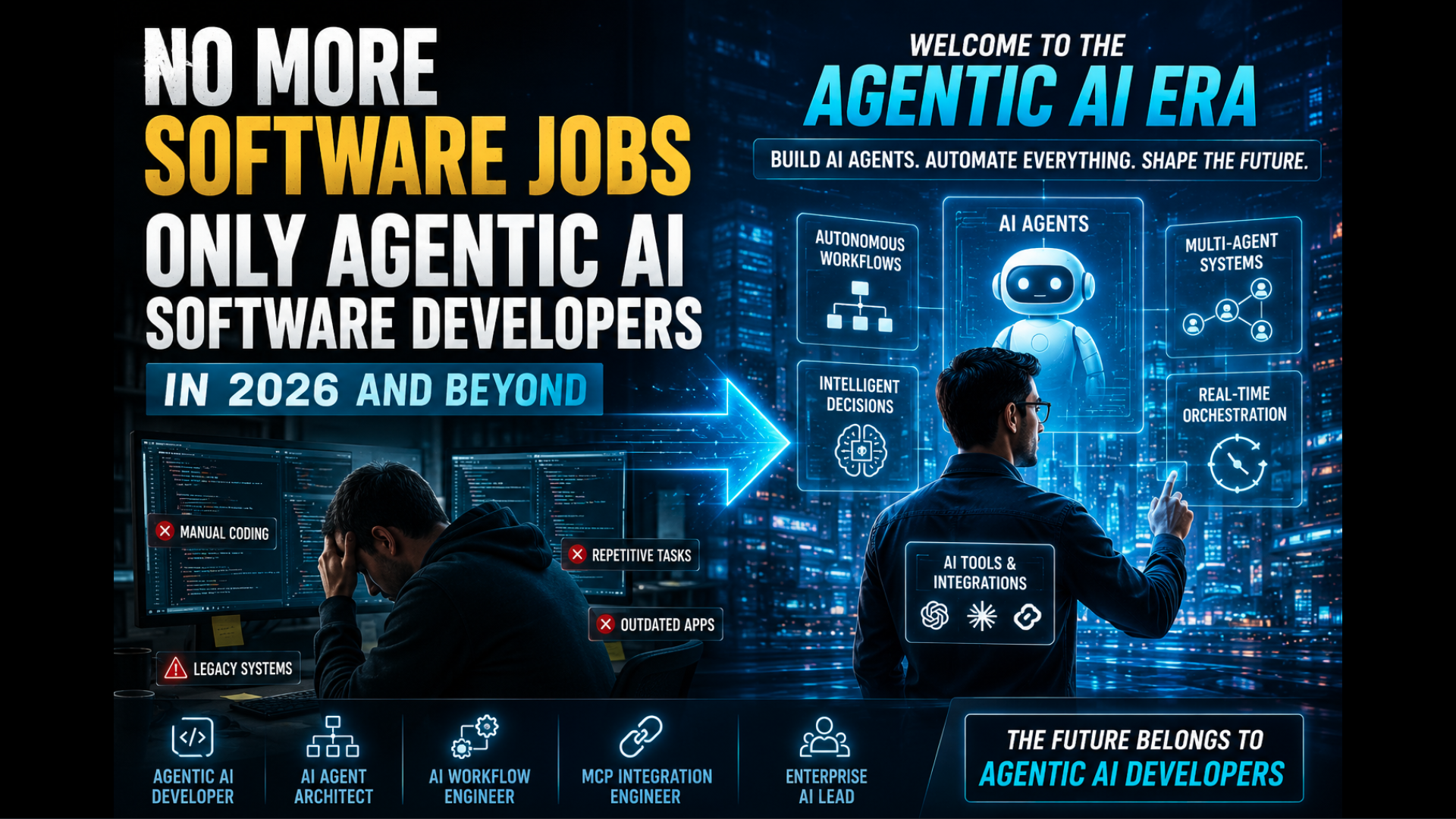
No More Traditional Software Jobs - Only Agentic AI Software Developers in 2026 and Beyond
Read this MyExamCloud Blog article for practical insights on Agentic AI. Explore more blog categories, search related topics in blog search, or return to the MyExamCloud Blog home.
The software industry is entering the most disruptive transformation in its history.
For decades, software engineering careers revolved around:
-
frontend development
-
backend APIs
-
CRUD applications
-
dashboards
-
forms
-
mobile apps
-
database-driven enterprise systems
Entire industries were built around creating traditional software applications.
But beginning in 2026, the definition of a software developer is rapidly changing.
The future is no longer centered around traditional app development.
The future belongs to Agentic AI Software Developers.
And many developers still do not realize how fast this transformation is happening.
The End of the Traditional Software Era
For years, businesses hired developers to:
-
build user interfaces
-
create workflows
-
connect APIs
-
move data between systems
-
automate repetitive business logic
But now AI systems are becoming capable of performing many of these tasks automatically.
Modern AI can already:
-
generate code
-
debug applications
-
create APIs
-
design workflows
-
automate testing
-
optimize infrastructure
-
build UI components
-
integrate systems
This changes the economics of software development completely.
The old software model:
Human developers manually building every workflow
is evolving into:
AI-assisted autonomous software ecosystems
That means traditional software roles are being redefined at massive scale.
Software Is Becoming Intelligent
Traditional software applications were passive tools.
Humans had to:
-
click buttons
-
navigate menus
-
move information manually
-
coordinate systems
-
make operational decisions
But Agentic AI introduces a completely different model.
AI systems are now capable of:
-
reasoning
-
planning
-
memory
-
autonomous execution
-
workflow orchestration
-
dynamic decision making
-
multi-system collaboration
The software itself is becoming intelligent.
Instead of humans operating software:
Software is beginning to operate itself.
This is why the future software developer is no longer simply an “app builder.”
The future developer becomes:
-
an AI systems architect
-
workflow orchestrator
-
agent designer
-
AI ecosystem engineer
What Is an Agentic AI Software Developer?
An Agentic AI Software Developer builds intelligent autonomous systems instead of traditional applications.
Instead of focusing only on:
-
pages
-
forms
-
menus
-
dashboards
they focus on:
-
AI agents
-
memory systems
-
reasoning pipelines
-
orchestration workflows
-
tool integrations
-
autonomous decision systems
-
multi-agent collaboration
-
enterprise AI ecosystems
In simple terms:
Traditional Developers build applications.
Agentic AI Developers build intelligent digital workers.
That is a massive difference.
Why Companies Are Moving Toward Agentic AI
Modern enterprises are overwhelmed by software complexity.
Most companies already suffer from:
-
disconnected systems
-
fragmented workflows
-
too many applications
-
operational inefficiency
-
duplicated tasks
-
excessive human coordination
AI Agents solve these problems by acting as intelligent operational layers above software systems.
Instead of employees manually handling every step, AI Agents can:
-
coordinate workflows
-
execute tasks
-
monitor outcomes
-
make decisions
-
interact with tools automatically
This dramatically increases:
-
productivity
-
automation
-
scalability
-
operational speed
Which means companies now need developers capable of building these AI ecosystems.
The New Software Careers of 2026
A completely new category of software careers is emerging.
Agentic AI Developer
Builds autonomous AI systems and workflows.
AI Agent Architect
Designs enterprise-scale multi-agent ecosystems.
AI Workflow Engineer
Creates intelligent automation pipelines.
Autonomous Systems Engineer
Develops self-operating AI infrastructures.
MCP Integration Engineer
Connects AI systems with tools, APIs, and enterprise platforms.
Enterprise AI Lead
Guides AI transformation strategies inside organizations.
These roles barely existed a few years ago.
Now they are becoming some of the most valuable technology careers in the industry.
Traditional Coding Alone Is No Longer Enough
This is the uncomfortable truth many developers do not want to hear.
Knowing only:
-
frontend frameworks
-
backend APIs
-
database CRUD operations
may no longer be enough in the long term.
Because AI itself is increasingly capable of generating traditional software patterns automatically.
The value is shifting toward:
-
system intelligence
-
orchestration
-
reasoning
-
workflow automation
-
AI architecture
-
human-AI collaboration
Developers who ignore this shift may eventually struggle to stay competitive.
The Rise of AI-Native Software Companies
Future software companies may look completely different from today’s SaaS businesses.
Instead of selling:
-
dashboards
-
portals
-
forms
-
ticketing systems
future companies may provide:
-
AI Agents
-
autonomous workflows
-
intelligent copilots
-
digital employees
-
AI operating systems
This changes the entire software economy.
The “app era” is slowly evolving into the “agent era.”
AI Will Not Remove All Developers
One of the biggest misconceptions is:
“AI will eliminate software engineers.”
That is not fully accurate.
AI is transforming software careers — not simply deleting them.
The industry still needs:
-
architects
-
engineers
-
system designers
-
AI orchestrators
-
infrastructure experts
-
workflow specialists
But their responsibilities are changing dramatically.
The future belongs to developers who learn how to collaborate with AI systems instead of competing against them.
The Most Important Skill in 2026
The most valuable developers in 2026 may not be the people who can manually write the most code.
The most valuable professionals may be the people who understand:
-
AI orchestration
-
autonomous systems
-
Agentic AI workflows
-
enterprise AI integration
-
intelligent system architecture
-
human-AI collaboration
This is becoming the new software engineering foundation.
The Biggest Software Revolution Since the Internet
The software industry has already experienced multiple revolutions:
-
desktop era
-
internet era
-
mobile era
-
cloud era
-
generative AI era
But Agentic AI may become the most transformative shift yet because it changes the very nature of software itself.
Software is no longer static.
Software is becoming autonomous.
Final Thoughts
Beginning in 2026 and beyond, the software industry is moving away from traditional application-centric development toward intelligent AI-driven ecosystems.
The future software developer is no longer simply building screens and forms.
The future software developer is building:
-
AI Agents
-
autonomous workflows
-
intelligent enterprise systems
-
orchestration ecosystems
-
digital workers
The rise of Agentic AI is not just another technology trend.
It is the next evolution of software engineering itself.
Developers who adapt early will become the architects of the next digital revolution.
If you want to prepare for the future of software engineering, explore Agentic AI Certifications and become an:
-
Agentic AI Developer
-
AI Agent Architect
-
Enterprise AI Lead
The future no longer belongs to developers who only build apps.
The future belongs to developers who build intelligent AI ecosystems.
| Author | Ganesh P Certified Artificial Intelligence Scientist (CAIS) | |
| Published | 3 months ago | |
| Category: | Agentic AI | |
| HashTags | #Software #Architecture #AI #ArtificialIntelligence #genai #machinelearning #ml #career #generativeai #agenticai #rag |

