
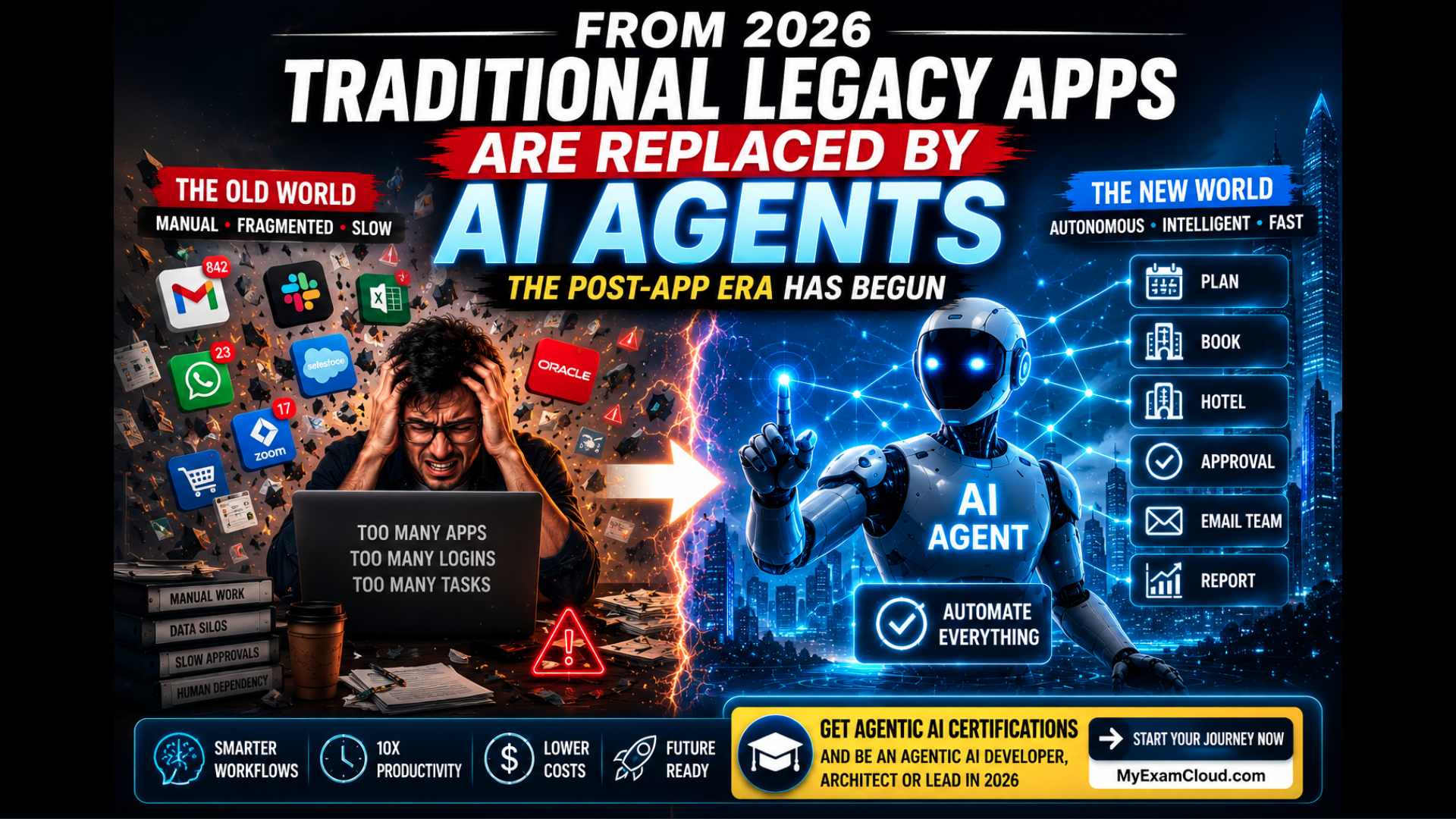
From 2026 Traditional Legacy Apps Are Replaced by AI Agents
Read this MyExamCloud Blog article for practical insights on Agentic AI. Explore more blog categories, search related topics in blog search, or return to the MyExamCloud Blog home.
For nearly two decades, the software industry has been built around one fundamental idea:
“There is an app for everything.”
Need transportation? Open Uber.
Need food? Open Swiggy.
Need customer support? Open a ticketing app.
Need approval from finance? Login to ERP software.
Need analytics? Open dashboards.
Need communication? Open Slack, Teams, Gmail, WhatsApp, Zoom, Jira, and ten more systems.
The modern enterprise became a jungle of disconnected applications.
But beginning in 2026, the software industry is entering its biggest transformation since the birth of cloud computing.
The era of traditional apps is slowly being replaced by AI Agents.
And most businesses still do not fully understand what this means.
The Real Problem With Traditional Apps
Traditional software applications were designed for a world where humans manually controlled workflows.
Humans:
-
click buttons
-
move data
-
fill forms
-
search dashboards
-
copy information
-
make decisions
-
trigger actions
In simple terms:
Humans became the operating system between apps.
This model worked for years because software was never intelligent. Applications only responded to commands.
But now large language models, reasoning systems, memory architectures, autonomous workflows, and Agentic AI are changing the entire definition of software.
The future is no longer:
Human → App → Action
The future is becoming:
Human → AI Agent → Autonomous Execution
That changes everything.
What Exactly Is an AI Agent?
Most people still confuse AI Agents with chatbots.
They are not the same.
A chatbot answers questions.
An AI Agent:
-
understands goals
-
reasons through tasks
-
plans workflows
-
uses tools
-
accesses systems
-
makes decisions
-
executes actions
-
monitors outcomes
-
adapts dynamically
An AI Agent behaves more like a digital employee than a software application.
Instead of opening five apps manually, a user may simply say:
“Plan my Singapore business trip next week within company budget.”
The AI Agent can:
-
check calendar availability
-
compare flight prices
-
reserve hotels
-
request approvals
-
create expense reports
-
update CRM systems
-
notify team members
-
schedule meetings
All without opening traditional applications individually.
The app disappears into the background.
The AI Agent becomes the interface.
The Post-App Era Has Already Started
This transformation is not science fiction anymore.
Major technology companies are already moving aggressively toward Agentic AI ecosystems.
Modern AI systems can now:
-
interact with APIs
-
browse systems
-
operate enterprise workflows
-
execute multi-step reasoning
-
automate business operations
-
integrate across disconnected software
Instead of building isolated applications, companies are beginning to build:
-
AI orchestration systems
-
autonomous workflow platforms
-
intelligent copilots
-
multi-agent ecosystems
-
context-aware business agents
The software architecture of the future is shifting from:
Frontend-driven applications
to:
Agent-driven intelligent systems
Why Legacy Enterprise Apps Are Becoming Obsolete
Most legacy applications suffer from major limitations:
1. Too Many User Interfaces
Modern employees spend hours navigating:
-
dashboards
-
forms
-
menus
-
reports
-
approvals
-
settings
AI Agents remove much of this complexity.
2. Workflow Fragmentation
Traditional enterprise systems are siloed.
CRM lives in one system.
Finance in another.
HR elsewhere.
Analytics somewhere else.
AI Agents unify workflows dynamically.
3. Human Dependency
Legacy apps depend heavily on manual operations.
AI Agents reduce operational friction through autonomous execution.
4. Poor Adaptability
Traditional software follows predefined workflows.
AI Agents adapt based on:
-
context
-
goals
-
priorities
-
historical memory
-
real-time data
Industries That Will Change First
The AI Agent revolution will impact almost every industry.
Enterprise Software
ERP, CRM, HRM, ticketing, reporting, approvals, analytics — all becoming AI-driven.
Banking
Autonomous financial analysis, compliance monitoring, fraud detection, intelligent customer operations.
Healthcare
AI medical workflow agents, patient coordination systems, intelligent diagnosis support.
Software Engineering
AI coding agents, testing agents, deployment agents, autonomous debugging systems.
Customer Support
Traditional support portals replaced by intelligent resolution agents.
E-Commerce
AI shopping agents purchasing products automatically based on user intent and preferences.
Film Production
AI filmmaking pipelines with automated:
-
scene planning
-
editing workflows
-
VFX coordination
-
asset generation
-
production scheduling
Developers Must Prepare Immediately
This shift will dramatically redefine software engineering careers.
The next generation developer will not simply build:
-
webpages
-
mobile apps
-
dashboards
Instead, developers will build:
-
AI workflows
-
agent orchestration systems
-
memory architectures
-
reasoning pipelines
-
autonomous ecosystems
-
tool-connected AI systems
The demand for Agentic AI skills is already exploding worldwide.
The New Architecture of Software
The future enterprise stack may look like this:
Old World
Frontend App
→ Backend APIs
→ Database
New Agentic World
AI Agent
→ Tools
→ Multi-Agent Collaboration
→ Dynamic Memory
→ Autonomous Workflows
→ Intelligent Decision Systems
This is why terms like:
-
MCP
-
Agentic AI
-
AI orchestration
-
workflow automation
-
AI memory systems
-
reasoning engines
are becoming critical skills in 2026.
Will Traditional Apps Completely Disappear?
Not immediately.
Legacy systems will continue to exist for years.
But their role is changing.
Applications are becoming:
-
infrastructure layers
-
data providers
-
execution engines
while AI Agents become:
-
the interface
-
the intelligence
-
the decision-making layer
The same way cloud transformed servers, Agentic AI will transform software applications.
The Biggest Shift Since the Internet
The software industry has experienced several major revolutions:
-
desktop computing
-
internet era
-
mobile era
-
cloud computing
-
generative AI
But Agentic AI may become the biggest transformation of all because it changes the very relationship between humans and software.
People no longer want:
-
complicated menus
-
endless dashboards
-
repetitive workflows
-
fragmented systems
They want outcomes.
AI Agents deliver outcomes.
Final Thoughts
Beginning in 2026, the world is moving toward a future where software no longer behaves like passive tools.
Software is becoming intelligent.
Traditional applications are slowly fading into the background while AI Agents emerge as autonomous digital operators capable of reasoning, planning, executing, and collaborating.
The companies that adapt early will dominate the next generation of software.
The developers who learn Agentic AI now will define the future of technology.
If you want to prepare for this transformation, start learning the technologies, workflows, and architectures behind modern Agentic AI systems.
Explore Agentic AI Certifications and become an:
-
Agentic AI Developer
-
Agentic AI Architect
-
Agentic AI Lead
Build future-ready skills in:
-
AI Agents
-
Agentic AI Architectures
-
AI Workflows
-
Autonomous Systems
-
MCP & Tool Integration
-
Enterprise AI Systems
The question is no longer:
“Will AI Agents replace traditional apps?”
The real question is:
“How fast will the world adopt them?”
| Author | Ganesh P Certified Artificial Intelligence Scientist (CAIS) | |
| Published | 3 months ago | |
| Category: | Agentic AI | |
| HashTags | #Software #Architecture #AI #ArtificialIntelligence #agenticai #rag |

