
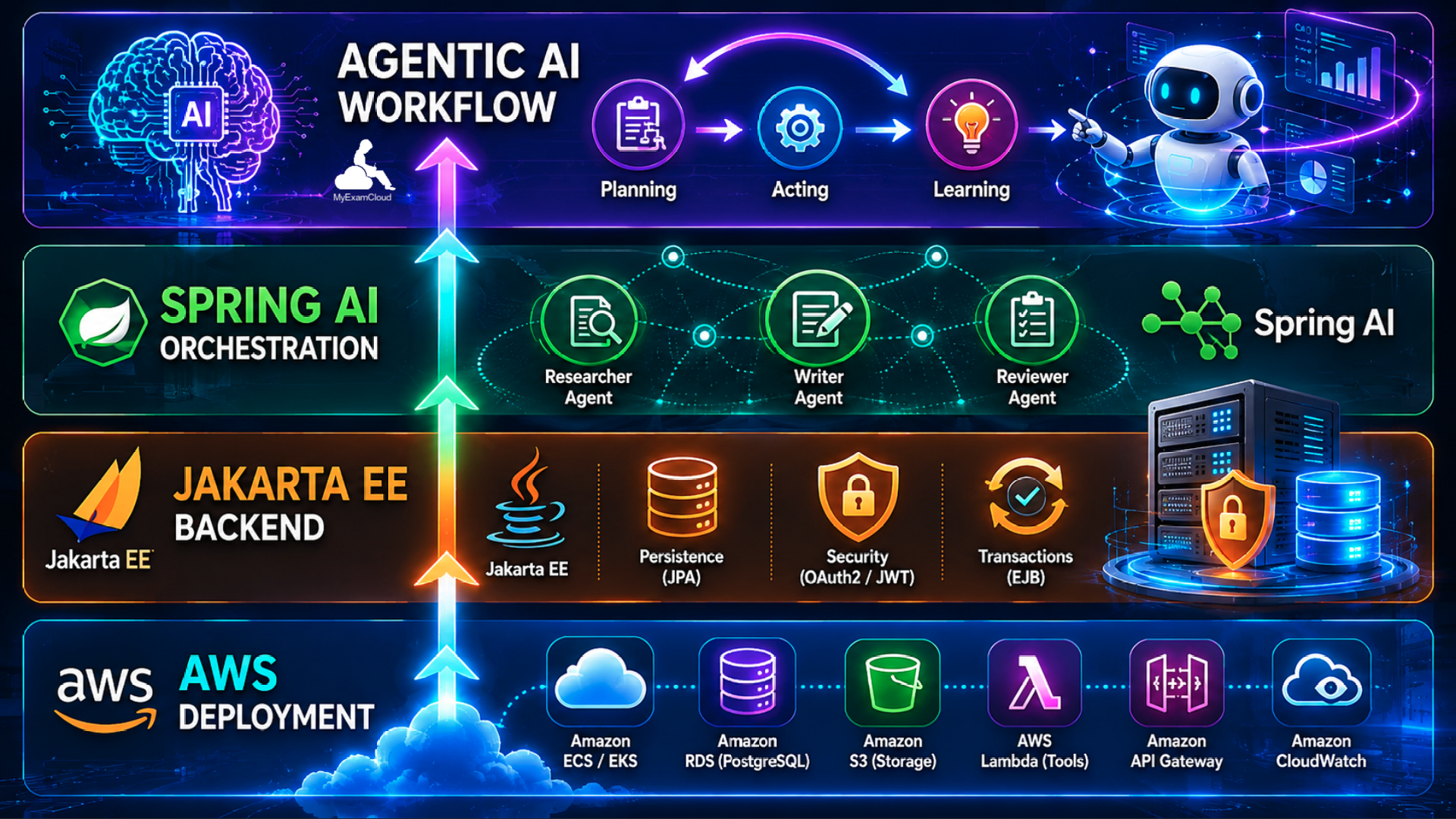
How to Code and Deploy Your Agentic AI Jakarta EE Spring AI Enterprise Application on AWS
Read this MyExamCloud Blog article for practical insights on Agentic AI. Explore more blog categories, search related topics in blog search, or return to the MyExamCloud Blog home.
Building Enterprise-Grade Agentic AI Systems — Complete Architecture Guide 2026
WHAT WE ARE BUILDING
In 2026, enterprise applications are no longer just CRUD systems. They are intelligent, autonomous, and agentic. This article walks through building a production-ready Agentic AI system using:
- Jakarta EE — Enterprise backend (transactions, security, data persistence)
- Spring AI — Agent orchestration and LLM integration
- AWS — Cloud deployment (compute, database, AI services)
- Agentic AI Workflow — Multi-agent planning, reasoning, and acting
Real-world example: An intelligent customer support system where AI agents autonomously handle refunds, update orders, escalate complex issues, and learn from outcomes — all backed by a rock-solid Jakarta EE enterprise backend and deployed on AWS.
ARCHITECTURE OVERVIEW
The architecture follows a clean separation of concerns with five distinct layers:
- Presentation Layer: REST APIs (Jakarta RESTful Web Services) + React/Angular frontend
- Agent Orchestration Layer: Spring AI + LangChain4j for multi-agent workflows
- Enterprise Backend Layer: Jakarta EE (EJB, JPA, CDI, Bean Validation, Security)
- Data Layer: PostgreSQL (AWS RDS) + Vector Database (pgvector / Pinecone)
- AWS Infrastructure: ECS/EKS, S3, Bedrock, Lambda, API Gateway, CloudFront
Data Flow:
- User request → API Gateway → Jakarta EE REST endpoint
- Backend validates and routes to Spring AI orchestrator
- Orchestrator creates agent team (Planner → Executor → Reviewer)
- Agents use RAG to retrieve context from vector database
- Agents call tools (order API, refund API, email service)
- Results return to Jakarta EE for transaction commit
- Response sent back to user
- Full audit log stored in RDS
REQUIRED TOOLS
Development Tools
- JDK 21+ (Jakarta EE 10 requires Java 17+ but Java 21 recommended)
- IntelliJ IDEA Ultimate or Eclipse IDE for Enterprise Java
- Apache Maven (dependency management and builds)
- Git + GitHub/GitLab for version control
- Docker Desktop (local container testing)
- Postman (API testing)
Frameworks & Libraries
- Jakarta EE 10 Core (Jersey, JPA/Hibernate, CDI, EJB, Bean Validation)
- Spring AI (LLM integration and agent orchestration)
- LangChain4j (Java-native Agentic AI framework)
- Payara / WildFly (Jakarta EE application servers)
- PostgreSQL + pgvector extension
- Lombok (boilerplate reduction)
AWS Services
- AWS ECS or EKS (container orchestration)
- AWS RDS PostgreSQL with pgvector
- AWS Bedrock (foundation models — Claude, Llama, Titan)
- AWS Lambda (serverless tool functions)
- API Gateway (REST endpoint management)
- S3 (document storage for RAG)
- CloudFront (CDN + caching)
- CloudWatch (logging and monitoring)
- IAM (security and permissions)
JAKARTA EE ENTERPRISE BACKEND
Jakarta EE provides the enterprise-grade foundation — transactions, security, persistence, and business logic — that Agentic AI workflows need.
Key Jakarta EE Components Used
- Jakarta RESTful Web Services (JAX-RS): Exposes Agentic AI capabilities as REST endpoints
- Jakarta Persistence (JPA): Maps agent decisions, audit logs, and business data to PostgreSQL
- Jakarta Enterprise Beans (EJB): Container-managed transactions for multi-step agent workflows
- Jakarta Contexts and Dependency Injection (CDI): Injects Spring AI beans into Jakarta components
- Jakarta Bean Validation: Validates incoming requests before agent processing
- Jakarta Security: OAuth2 / JWT authentication for API access
Sample Code Structure
Jakarta REST Endpoint (JAX-RS):
@Path("/agentic")
@ApplicationScoped
public class AgenticResource {

    @Inject
    private AgentOrchestratorService agentService;

    @POST
    @Path("/execute")
    @Consumes(MediaType.APPLICATION_JSON)
    @Produces(MediaType.APPLICATION_JSON)
    public Response executeAgentTask(@Valid AgentRequest request) {
        AgentResult result = agentService.orchestrate(request);
        return Response.ok(result).build();
    }
}
Enterprise Bean (EJB) with Transaction:
@Stateless
@TransactionAttribute(TransactionAttributeType.REQUIRED)
public class AuditService {

    @PersistenceContext
    private EntityManager em;

    public void logAgentAction(AgentAudit audit) {
        em.persist(audit);  // Saved only if entire agent workflow succeeds
    }
}
SPRING AI AGENT LAYER
Spring AI integrates Large Language Models into Spring-based applications. For Jakarta EE projects, Spring AI runs alongside Jakarta EE (using CDI to bridge the two worlds).
Spring AI Components
- ChatClient: Abstraction for interacting with LLMs (OpenAI, Anthropic, AWS Bedrock)
- Prompt Templates: Reusable prompt structures with variable substitution
- Output Parsers: Converts LLM responses into Java objects
- Vector Store Integration: Connects to pgvector, Pinecone, or Redis for RAG
- Function Calling: Allows LLM to invoke backend services (order API, refund API)
- Advisors: Adds RAG, logging, or safety checks to chat requests
Agent Orchestration with LangChain4j
For Java-native agentic workflows, LangChain4j works alongside Spring AI:
@Service
public class AgentOrchestratorService {

    @Autowired
    private ChatLanguageModel model;  // AWS Bedrock Claude

    public AgentResult orchestrate(AgentRequest request) {
        // 1. Planner Agent
        AiService planner = AiServices.builder(PlannerAgent.class)
            .chatLanguageModel(model)
            .build();
        Plan plan = planner.createPlan(request.getGoal());

        // 2. Executor Agent with tool calling
        ToolExecutor executor = new ToolExecutor(orderService, refundService);
        ExecutionResult result = executor.execute(plan);

        // 3. Reviewer Agent (Reflexion loop)
        ReviewerAgent reviewer = new ReviewerAgent(model);
        if (reviewer.needsRevision(result)) {
            return orchestrator.retry(plan, result.getFeedback());
        }

        return new AgentResult(result.getOutput());
    }
}
RAG / TOOL-CALLING FLOW
Agentic AI is useless without real data and real actions. RAG provides the data. Tool calling provides the actions.
RAG (Retrieval-Augmented Generation) Flow
- User asks: "What's our return policy for electronics?"
- Query is embedded using AWS Titan or Cohere embedding model
- Vector search in PostgreSQL pgvector finds relevant policy documents
- Retrieved chunks are injected into LLM prompt
- LLM generates answer grounded in actual policy (no hallucinations)
- Answer returned to user with citations
Tool Calling Flow
- User asks: "Refund my last order #ORD-1234"
- Agent identifies required tool: refundOrder(orderId, reason)
- LLM generates function call with parameters
- Spring AI executes the actual Java method
- Method calls Jakarta EE service (with transaction and security checks)
- Result returned to LLM
- LLM generates natural language confirmation
- Entire action logged for audit
Sample Tool Definition (Spring AI)
@Configuration
public class ToolConfig {

    @Bean
    @Description("Process refund for an order. Requires orderId and reason.")
    public Function<RefundRequest, RefundResult> refundOrder(OrderService orderService) {
        return request -> orderService.processRefund(request.orderId(), request.reason());
    }
}
AWS DEPLOYMENT ARCHITECTURE
Production AWS Setup
- Compute: AWS ECS (Fargate) or EKS for Jakarta EE + Spring AI containers
- Database: AWS RDS PostgreSQL with pgvector extension enabled
- Vector Storage: pgvector (in same RDS) or Pinecone for larger scale
- LLM Access: AWS Bedrock (Claude 3.5, Llama 3, Amazon Titan)
- Document Storage: S3 buckets for PDFs, docs, knowledge bases
- API Management: API Gateway + Cognito for auth
- Content Delivery: CloudFront for static assets and API caching
- Background Jobs: SQS + Lambda for async agent tasks
- Container Registry: Amazon ECR (store Docker images)
Deployment Architecture Diagram
User → CloudFront → API Gateway → Cognito Auth
                ↓
         Application Load Balancer
                ↓
    ECS Cluster (Jakarta EE + Spring AI)
                ↓
    ┌───────────┼───────────┐
    ↓           ↓           ↓
  RDS        Bedrock       S3
(pgvector)    (LLMs)     (Docs)
CI/CD DEPLOYMENT
Pipeline Stages
- Source: GitHub/GitLab webhook triggers pipeline
- Build: Maven compile, run unit tests, package WAR/JAR
- Container Build: Docker build with multi-stage (small production image)
- Push: Push image to Amazon ECR
- Deploy Staging: Deploy to ECS staging environment, run integration tests
- Deploy Production: Blue/green deployment to ECS production
Sample Pipeline (GitHub Actions)
name: Deploy to AWS ECS
on:
  push:
    branches: [main]
jobs:
  deploy:
    runs-on: ubuntu-latest
    steps:
      - uses: actions/checkout@v4
      - name: Set up JDK 21
        uses: actions/setup-java@v3
        with:
          java-version: '21'
      - name: Build with Maven
        run: mvn clean package
      - name: Build Docker image
        run: docker build -t myapp .
      - name: Push to ECR
        run: aws ecr push
      - name: Deploy to ECS
        run: aws ecs update-service --cluster prod --service myapp
SECURITY AND MONITORING
Security Measures
- Authentication: Amazon Cognito + JWT tokens
- Authorization: Jakarta Security with role-based access (ADMIN, AGENT, USER)
- API Security: API Gateway with rate limiting and WAF
- Data Encryption: RDS encryption at rest + TLS in transit
- Secrets Management: AWS Secrets Manager (API keys, DB passwords)
- Agent Safety: Human-in-the-loop for high-risk actions (refunds > $500)
- Audit Trail: Every agent decision logged in RDS with user and timestamp
Monitoring & Observability
- Application Logs: CloudWatch Logs with structured logging (JSON)
- Metrics: CloudWatch Metrics + custom business metrics (agent success rate, response time)
- Tracing: AWS X-Ray for end-to-end request tracing across services
- Alerts: CloudWatch Alarms on error rate, latency, agent failure
- Dashboards: Grafana (or CloudWatch Dashboard) for real-time agent performance
- LLM Monitoring: Bedrock Model Invocation logging and cost tracking
CERTIFICATIONS TO LEARN THIS PATH
Mastering this architecture requires skills across Jakarta EE, Spring AI, AWS, and Agentic AI. The following certifications validate each competency. All practice tests are available on MyExamCloud.
Java / Jakarta EE Certifications
- Java Certification Practice Tests – OCA, OCP Programming & Spring Developer (2026)
- Oracle Certified Professional Java SE 21 Developer (1Z0-830) Practice Tests
- Java SE 17 Developer (OCPJP) Practice Tests
- Java EE / Jakarta EE Certification Practice Tests
Spring AI & Agentic AI Certifications
- Spring Certified Professional Practice Tests
- Agentic AI Certification Practice Tests – Developer, Architect, Lead (2026)
- Generative AI Certification – LLMs, Prompt Engineering & AI Workflows
- AI & Machine Learning Certification – GenAI, ML & Data
AWS Certifications
- AWS Cloud Practitioner (CLF-C02) Practice Tests
- AWS Solutions Architect Associate (SAA-C03) Practice Tests
- AWS Developer Associate (DVA-C02) Practice Tests
- AWS Certified Generative AI Developer Professional (AIP-C01) Practice Tests
- AWS Certified AI Practitioner (AIF-C01) Practice Tests
- DevOps Certification Practice Tests – Docker, Kubernetes, Terraform
Python & Data Certifications (For RAG & AI Logic)
- Python Certification Practice Tests – PCEP, PCAP, PCPP (2026)
- Databricks Certified Generative AI Engineer Associate Practice Tests
FINAL THOUGHTS
Building enterprise Agentic AI systems requires combining four distinct disciplines:
- Jakarta EE provides the transactional, secure, enterprise-grade backend
- Spring AI + LangChain4j deliver agent orchestration and LLM integration
- AWS offers scalable, production-ready cloud infrastructure
- Agentic AI Workflows enable autonomous planning, acting, and learning
In 2026, this stack is becoming the standard for companies building intelligent automation. Traditional developers who master this architecture will command premium salaries and lead the next generation of software engineering.
Your next step: Start with Java certification, then add AWS, then master Agentic AI. MyExamCloud provides all the practice tests and mock exams you need for every certification on this path.
Related Articles
Enterprise AI Architecture Is Outdated — Move to Enterprise Agentic AI Architecture
Can AWS AI Replace Traditional Developers? The Real Future of Software Engineering in 2026
| Author | Ganesh P Certified Artificial Intelligence Scientist (CAIS) | |
| Published | 3 months ago | |
| Category: | Agentic AI | |
| HashTags | #Java #AWS #Programming #CloudComputing #Software #Architecture #AI #JavaCertification #spring #springboot #rag |

