
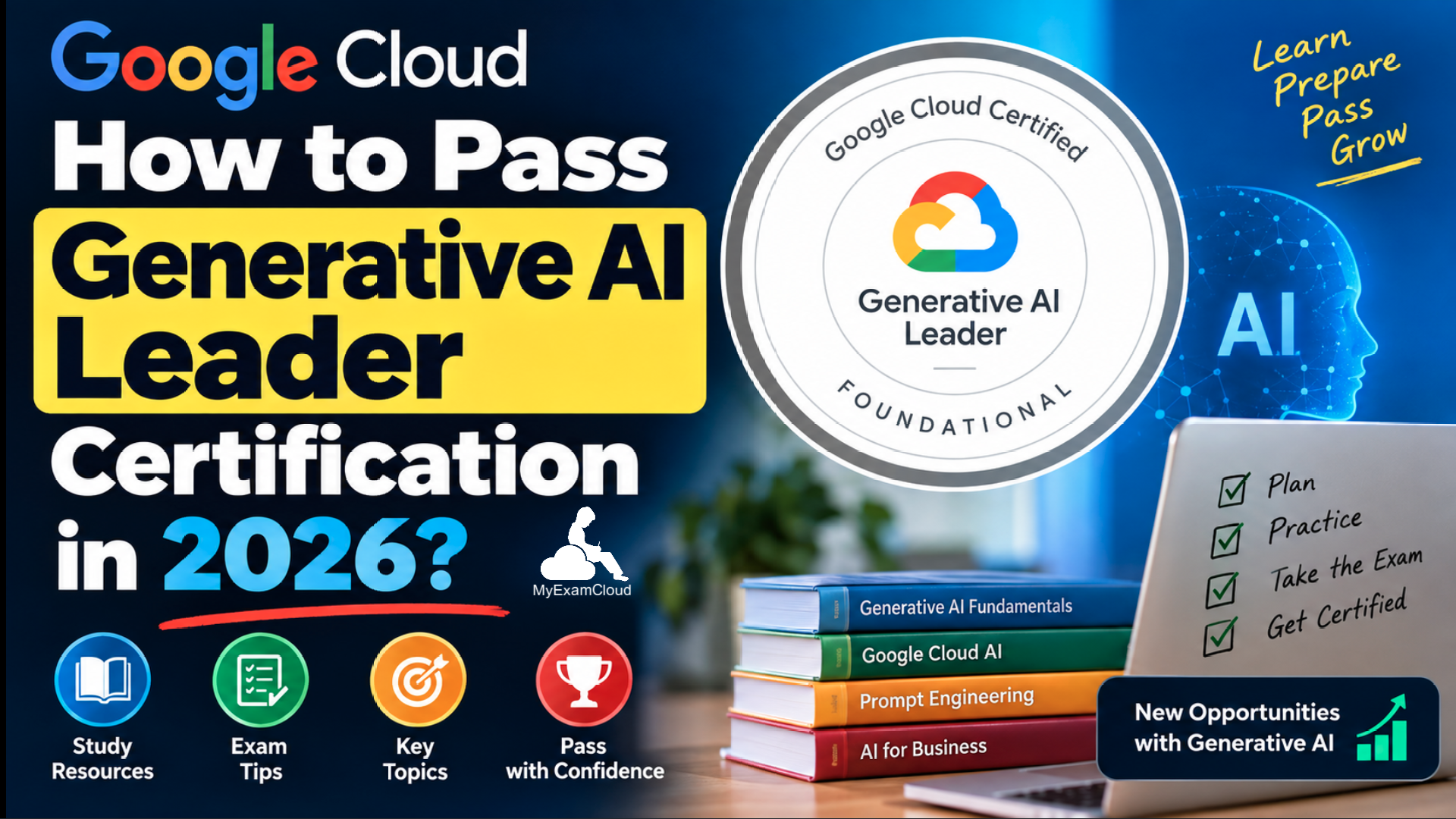
How to Pass Generative AI Leader Certification in 2026?
Read this MyExamCloud Blog article for practical insights on Google Cloud Certification. Explore more blog categories, search related topics in blog search, or return to the MyExamCloud Blog home.
Generative AI has moved from an emerging technology to a business priority, and professionals across technical and non-technical roles are increasingly expected to understand how it works and how organizations can use it effectively.
If you are looking for a beginner-friendly AI certification that does not require extensive programming or hands-on cloud engineering experience, the Google Cloud Generative AI Leader certification is worth considering.
But how do you actually prepare for and pass the Generative AI Leader exam in 2026?
The good news is that you do not necessarily need an advanced machine learning background. A focused understanding of generative AI fundamentals, Google Cloud's AI offerings, techniques for improving AI output, and business applications can take you a long way.
This guide explains what to expect from the exam, what topics to study, which resources to prioritize, and how to build an effective preparation strategy.
What Is the Google Cloud Generative AI Leader Certification?
The Generative AI Leader certification is a foundational-level Google Cloud certification focused on generative AI concepts, technologies, Google Cloud's generative AI ecosystem, and business applications of AI.
Unlike certifications designed specifically for cloud engineers, developers, or machine learning specialists, this certification is intended for a much broader audience.
You can approach the exam without extensive hands-on technical experience.
That makes it particularly relevant for:
-
Business professionals
-
Product managers
-
Project managers
-
IT professionals
-
Sales and marketing professionals
-
Cloud professionals
-
Managers and team leaders
-
Consultants
-
AI enthusiasts
-
Professionals transitioning into AI-related roles
The certification is designed to assess whether you understand what generative AI is, how it can be used, how to improve AI-generated results, what Google Cloud offers for generative AI, and how organizations can successfully adopt generative AI solutions.
Generative AI Leader Exam at a Glance
Here are the key exam details to understand before beginning your preparation:
| Exam Feature | Details |
|---|---|
| Certification | Google Cloud Generative AI Leader |
| Level | Foundational |
| Exam Format | Multiple-choice |
| Exam Duration | 90 minutes |
| Questions | Approximately 50–60 |
| Exam Fee | $99 |
| Certification Validity | 3 years |
| Delivery | Online proctored or test center |
| Experience Required | No extensive hands-on technical experience required |
The exact exam experience can vary, so candidates should always check the current official Google Cloud certification information before scheduling their exam.
What Does the Generative AI Leader Exam Cover?
One of the most important things you can do before studying is understand the official exam domains.
The Generative AI Leader exam is divided into four major areas.
1. Fundamentals of Generative AI — 30%
The first domain focuses on the fundamental concepts behind generative AI.
You should understand concepts such as:
-
What generative AI is
-
How generative AI differs from traditional AI
-
Large language models
-
Foundation models
-
Multimodal AI
-
Generative AI use cases
-
AI model capabilities and limitations
-
Responsible AI
-
Common generative AI terminology
You do not necessarily need to become an AI researcher.
Instead, focus on understanding the concepts well enough to recognize how different technologies and approaches are used in real-world scenarios.
This section represents approximately 30% of the exam, making it an important foundation for the rest of your preparation.
2. Google Cloud's Generative AI Offerings — 35%
This is the largest domain in the exam, accounting for approximately 35% of the questions.
Therefore, candidates preparing for the Generative AI Leader certification should pay particular attention to Google's generative AI ecosystem.
You should become familiar with Google's major AI and cloud offerings and understand what they are designed to accomplish.
Depending on the current exam guide, your preparation may involve concepts around areas such as:
-
Gemini
-
Google Cloud AI services
-
Vertex AI
-
Generative AI development
-
AI model access
-
Enterprise AI solutions
-
Data and AI integration
-
Retrieval-augmented generation (RAG)
-
AI application development
The key is not simply memorizing product names.
You should understand which Google Cloud service or capability would make sense in a particular business scenario.
For example, an exam question may present a business requirement and ask you to identify an appropriate Google Cloud AI approach.
That means scenario-based understanding is more valuable than memorizing isolated definitions.
3. Techniques to Improve Generative AI Model Output — 20%
Generative AI does not always produce perfect results.
This domain focuses on techniques that can improve the quality, relevance, reliability, and usefulness of generated output.
Topics worth understanding include:
-
Prompt engineering
-
Prompt design
-
Context
-
Grounding
-
Retrieval-augmented generation
-
Model limitations
-
Output quality
-
Hallucinations
-
Evaluation
-
Responsible AI considerations
You should understand why these techniques are used rather than simply memorizing terminology.
For example, if a generative AI application consistently produces responses that lack relevant organizational information, you should be able to reason about how providing better context or grounding the model with trusted information could improve the result.
4. Business Strategies for Successful Generative AI Solutions — 15%
The final domain focuses on the business side of generative AI.
This is particularly important because the certification is designed for professionals beyond traditional technical roles.
You should understand topics such as:
-
Identifying suitable AI use cases
-
Business value
-
AI adoption
-
Organizational transformation
-
AI implementation strategies
-
Risks and limitations
-
Responsible AI
-
Measuring business outcomes
-
Change management
-
AI governance
Think beyond the question:
"Can we build this AI application?"
Instead, think:
"Should the organization build this AI application, and how can it create measurable value?"
That distinction is important for a leadership-oriented certification.
The Best Way to Prepare for the Generative AI Leader Exam
One of the biggest lessons from successful preparation is that you don't need to collect dozens of resources.
In fact, using too many courses, videos, practice tests, and study guides can make preparation unnecessarily complicated.
A better strategy is to start with the official learning resources and build your knowledge systematically.
Resource #1: Google Cloud Skills Boost Generative AI Leader Learning Path
The Google Cloud Skills Boost Generative AI Leader learning path should be one of your primary preparation resources.
The learning path is specifically aligned with the certification and covers the concepts candidates are expected to understand.
The path includes courses covering areas such as:
-
Generative AI beyond chatbots
-
Foundational generative AI concepts
-
The generative AI landscape
-
Using generative AI to transform work
-
Transforming organizations with generative AI
The biggest advantage is that you are not studying random generative AI material.
You are learning concepts specifically relevant to Google's certification ecosystem.
Don't Just Watch the Courses
One mistake candidates make is treating a learning path like a video playlist.
Instead, actively study the material.
For each course, ask:
What is the concept?
Why does it matter?
When would an organization use it?
Which Google Cloud product or capability supports it?
This approach helps you prepare for scenario-based questions.
Resource #2: Introduction to Generative AI
If you are relatively new to generative AI, consider completing Google's introductory generative AI learning material as well.
This can help establish the basic vocabulary and concepts required for the certification.
It is particularly useful if terms such as:
-
Foundation model
-
Large language model
-
Prompt engineering
-
Responsible AI
-
Grounding
-
Multimodal AI
-
RAG
are still relatively new to you.
Some material may overlap with the Generative AI Leader learning path, but the additional foundation can make the certification material easier to understand.
Don't Ignore Responsible AI
Responsible AI deserves special attention during your preparation.
Generative AI is not only about producing impressive outputs.
Organizations also have to consider:
-
Accuracy
-
Bias
-
Privacy
-
Security
-
Transparency
-
Safety
-
Appropriate use of AI
-
Human oversight
Understanding Google's approach to responsible AI can help you reason through business and technology scenarios presented in the exam.
If you're completely new to AI, don't treat responsible AI as an optional topic.
Make it part of your core preparation.
Should You Get Hands-On Experience?
For a foundational certification, extensive hands-on engineering experience is not necessarily required.
However, practical exposure can significantly improve your understanding.
For example, experimenting with:
-
Gemini
-
Prompt engineering
-
Google Cloud AI services
-
Vertex AI
-
RAG concepts
-
AI application workflows
can make abstract concepts much easier to understand.
You don't have to build a sophisticated production AI platform.
Even small experiments can help.
For example, take the same question and modify the prompt by adding:
-
A clear role
-
Relevant context
-
Specific instructions
-
Output requirements
-
Examples
Then compare the results.
You'll quickly understand why prompt design and context matter.
Do You Need to Take Practice Tests?
Practice questions can be useful, but they shouldn't replace learning the underlying concepts.
The certification preparation experience described in the source video relied primarily on the Google Cloud Skills Boost learning paths rather than extensive practice testing.
That is an important point for candidates who feel overwhelmed by the number of unofficial practice exams available online.
Before spending hours memorizing answers from third-party question banks, make sure you can explain the concepts yourself.
A good test is:
If you see a new scenario that you've never encountered before, can you reason out the most appropriate answer?
If the answer is yes, you're in a much stronger position than someone who has simply memorized practice questions.
Create Your Own Generative AI Notes
Taking notes can make a significant difference when preparing for a foundational certification.
Don't try to copy entire courses into your notebook.
Instead, create concise notes around the four exam domains.
For example:
Generative AI Fundamentals
-
Generative AI definition
-
Foundation models
-
LLMs
-
Multimodal models
-
AI limitations
-
Responsible AI
Google Cloud AI
-
Gemini
-
Vertex AI
-
Google Cloud AI capabilities
-
Enterprise AI use cases
-
RAG
-
Data integration
Improving AI Output
-
Prompt engineering
-
Context
-
Grounding
-
RAG
-
Evaluation
-
Hallucinations
Business Strategy
-
AI use-case identification
-
Business value
-
Adoption
-
Governance
-
Risk
-
Organizational transformation
Your notes should function as a revision map, not another textbook.
Use Mind Maps for Faster Revision
Mind maps can be particularly effective for this certification because many concepts are interconnected.
You can create one central topic:
Generative AI Leader
Then branch it into:
Fundamentals → Google Cloud → Output Improvement → Business Strategy
From there, add the most important concepts under each branch.
This gives you a visual overview of the certification and makes last-minute revision much easier.
A 4-Week Generative AI Leader Study Plan
If you're starting from scratch, here's a practical four-week preparation plan.
Week 1: Learn Generative AI Fundamentals
Focus on:
-
Generative AI basics
-
Foundation models
-
LLMs
-
Multimodal AI
-
Common terminology
-
Generative AI use cases
-
AI limitations
-
Responsible AI
At the end of the week, you should be able to explain generative AI to a non-technical colleague.
Week 2: Study Google Cloud's AI Ecosystem
This is the largest exam domain, so dedicate significant time to it.
Study:
-
Gemini
-
Vertex AI
-
Google Cloud AI offerings
-
Generative AI application development
-
Enterprise AI
-
RAG
-
Relevant Google Cloud services
Don't just memorize product descriptions.
Practice thinking in terms of:
Business requirement → Technical capability → Appropriate Google Cloud solution
Week 3: Master Output Improvement and Business Strategy
Study techniques such as:
-
Prompt engineering
-
Context
-
Grounding
-
RAG
-
Evaluation
-
Hallucination mitigation
Then move into:
-
AI adoption
-
Business value
-
Use-case selection
-
Governance
-
Responsible AI
-
Organizational transformation
Try to connect the technical concepts with business scenarios.
Week 4: Revision and Scenario-Based Practice
Use the final week for:
-
Reviewing your notes
-
Revisiting weak areas
-
Reviewing the official exam guide
-
Reviewing Google Cloud offerings
-
Revising responsible AI
-
Solving practice questions if available
-
Testing yourself with scenario-based questions
Avoid trying to learn completely new topics at the last minute.
Your goal during the final week should be confidence and recall.
How to Approach Questions on Exam Day
The Generative AI Leader exam is not simply about remembering definitions.
You may encounter questions where several answers appear technically reasonable.
When that happens, look for the answer that best matches the stated business requirement.
Ask yourself:
1. What is the question actually asking?
Don't get distracted by technical terminology.
2. What is the business objective?
Is the organization trying to improve productivity, customer experience, automation, knowledge retrieval, decision-making, or something else?
3. What constraint is mentioned?
Look for clues involving:
-
Cost
-
Security
-
Data
-
Accuracy
-
Scalability
-
Privacy
-
Existing infrastructure
-
User experience
4. Which solution best fits the scenario?
The correct answer is often the one that satisfies the complete set of requirements rather than the one that sounds the most technically sophisticated.
Manage Your 90 Minutes Wisely
With approximately 50–60 questions and 90 minutes, you have enough time to work through the exam without rushing.
A useful approach is:
First pass: Answer questions you're confident about.
Second pass: Return to questions requiring more thought.
Final review: Check flagged questions and make sure you haven't overlooked wording such as "best," "most appropriate," or "least effort."
Don't spend several minutes fighting with a single question early in the exam.
Keep moving.
What Is the Online Proctored Exam Experience Like?
Candidates choosing online proctoring should prepare their environment in advance.
You may need to:
-
Clear your desk
-
Remove books and notes
-
Disconnect unnecessary devices
-
Ensure your testing environment meets the requirements
-
Follow the proctor's instructions
-
Keep your workspace free of unauthorized materials
Don't wait until exam day to discover that your desk or equipment needs to be rearranged.
Do a complete setup check beforehand.
How Long Does the Exam Take?
Although the exam gives you 90 minutes, you don't necessarily have to use every minute.
One reported exam experience took around 65 minutes, with approximately 55–56 questions.
Your experience may be different, of course.
The important point is that the allocated time should be sufficient if you've prepared properly.
What Happens After You Pass?
After completing the exam, candidates can receive an immediate indication of the result, while the certification result may still be subject to Google's post-exam processing.
Successful candidates can also receive a Credly digital badge, which can be used to showcase the certification on professional platforms such as LinkedIn.
The certification is reported as valid for three years.
Is Generative AI Leader Worth Getting in 2026?
For professionals who want an entry point into Google's generative AI ecosystem, the certification can be a useful credential.
Its biggest advantage is accessibility.
You don't need to be a machine learning engineer to start learning about:
-
Generative AI
-
Gemini
-
Google Cloud AI
-
AI adoption
-
Responsible AI
-
Business applications of AI
However, the certification should not be treated as proof that you can independently build advanced AI systems.
It demonstrates foundational knowledge.
For technical professionals, it can be a starting point before pursuing deeper cloud, AI, data, or machine learning certifications.
For business professionals, it can provide a structured way to understand the technology that increasingly influences products, operations, and strategy.
Final Generative AI Leader Certification Preparation Strategy
If you want the simplest possible preparation strategy, follow this sequence:
Step 1: Read the official exam guide.
Step 2: Understand the four exam domains and their weightings.
Step 3: Complete the Google Cloud Skills Boost Generative AI Leader learning path.
Step 4: If you're new to AI, complete introductory generative AI learning material.
Step 5: Pay particular attention to Google's generative AI offerings because this is the largest exam domain.
Step 6: Practice prompt engineering, grounding, RAG, and other techniques for improving AI output.
Step 7: Study responsible AI and business adoption.
Step 8: Create concise revision notes or a mind map.
Step 9: Use practice questions to test understanding rather than memorize answers.
Step 10: Review weak areas and take the exam when you can confidently reason through unfamiliar scenarios.
Final Thoughts
The Google Cloud Generative AI Leader certification is designed differently from advanced technical AI certifications.
You don't need to spend months learning machine learning mathematics or becoming an expert programmer.
Instead, focus on understanding generative AI fundamentals, Google's AI ecosystem, techniques for improving AI output, and how businesses can successfully adopt generative AI.
The exam's four domains provide a clear roadmap:
30% Generative AI Fundamentals
35% Google Cloud's Generative AI Offerings
20% Techniques to Improve Generative AI Output
15% Business Strategies for Successful Generative AI Solutions
If you build a strong understanding across these four areas and use Google Cloud's official learning resources as the foundation of your preparation, you can approach the 2026 Generative AI Leader exam with much greater confidence.
The goal isn't to memorize AI terminology. The goal is to understand how generative AI works, what Google Cloud provides, and when those capabilities make sense for a real business.
That is the mindset that can make your Generative AI Leader preparation much more effective.
Generative AI Leader Certification Preparation Resources
Preparing with the right resources can make your Generative AI Leader certification journey much more structured. Along with the official Google Cloud learning resources discussed earlier, you can use MyExamCloud for additional practice and explore related AI certification and career guides.
Generative AI Leader Certification Practice Tests
If you want to test your understanding before taking the actual exam, MyExamCloud provides Generative AI Leader Certification Practice Tests with 19 mock exams. These practice tests can help you identify knowledge gaps, become familiar with certification-style questions, and build confidence before exam day.
Generative AI Leader Certification Practice Tests – 19 Mock Exams
Explore More Generative AI Certification Resources
If you are considering additional generative AI certifications or want to understand the broader certification landscape, the following MyExamCloud resource is also useful:
Generative AI Certification Practice Tests & Mock Exams – LLMs, Prompt Engineering & AI Workflows
This can be useful if you plan to move beyond a foundational Generative AI Leader certification toward more technical generative AI credentials.
Related AI and Certification Articles
Your Generative AI Leader preparation does not have to stop with one certification. Understanding the broader AI career landscape can help you decide what to learn next.
Understand the AI Certification Landscape
Artificial Intelligence Certifications Roadmap: Complete Guide 2026
A useful starting point if you want to understand different AI certification options and how they fit into a broader career path.
Best AI Certifications for Beginners in 2026
If you are new to AI, this guide can help you compare beginner-friendly certification options.
Top AI Certifications in 2026 for Developers and Engineers
A useful follow-up for software developers and engineers who want to progress from foundational AI knowledge toward more technical certifications.
Learn More About Generative AI
Exploring the Revolution of Generative AI: How It Works, Use Cases, Benefits, and Limitations
Before moving into advanced AI technologies, it is important to understand how generative AI works, where it can be used, and what its limitations are.
Understand AI Concepts 2026: LLM, RAG, AI Agents and Agentic AI Explained
This is particularly useful for understanding concepts such as LLMs, RAG, AI agents, and agentic AI that increasingly appear throughout the modern generative AI ecosystem.
Explore Google Cloud AI Certifications
Google Cloud AI vs AWS AI Certifications in 2026: Which Cloud AI Path Should You Choose?
If you are deciding whether to continue with Google Cloud or explore an AWS AI certification path, this comparison can help you understand the broader options.
Best Cloud Certifications for AI Engineers in 2026
This is a useful next step for candidates who want to move from foundational AI knowledge into cloud-based AI engineering.
Build Your AI Career
AI Career Path for Developers in 2026
If you're a developer preparing for the Generative AI Leader certification as the first step toward an AI career, this guide provides a broader roadmap.
AI Developer Roadmap 2026: Skills, Tools, and Certifications
This can help you identify the skills, technologies, and certifications to pursue after developing your foundational generative AI knowledge.
| Author | Ganesh P Certified Artificial Intelligence Scientist (CAIS) | |
| Published | 18 hours ago | |
| Category: | Google Cloud Certification | |
| HashTags | #Programming #GCP #CloudComputing #Software #Architecture #AI #ArtificialIntelligence #gcp #googlecloud #googlecloudcertification #generativeai |

