
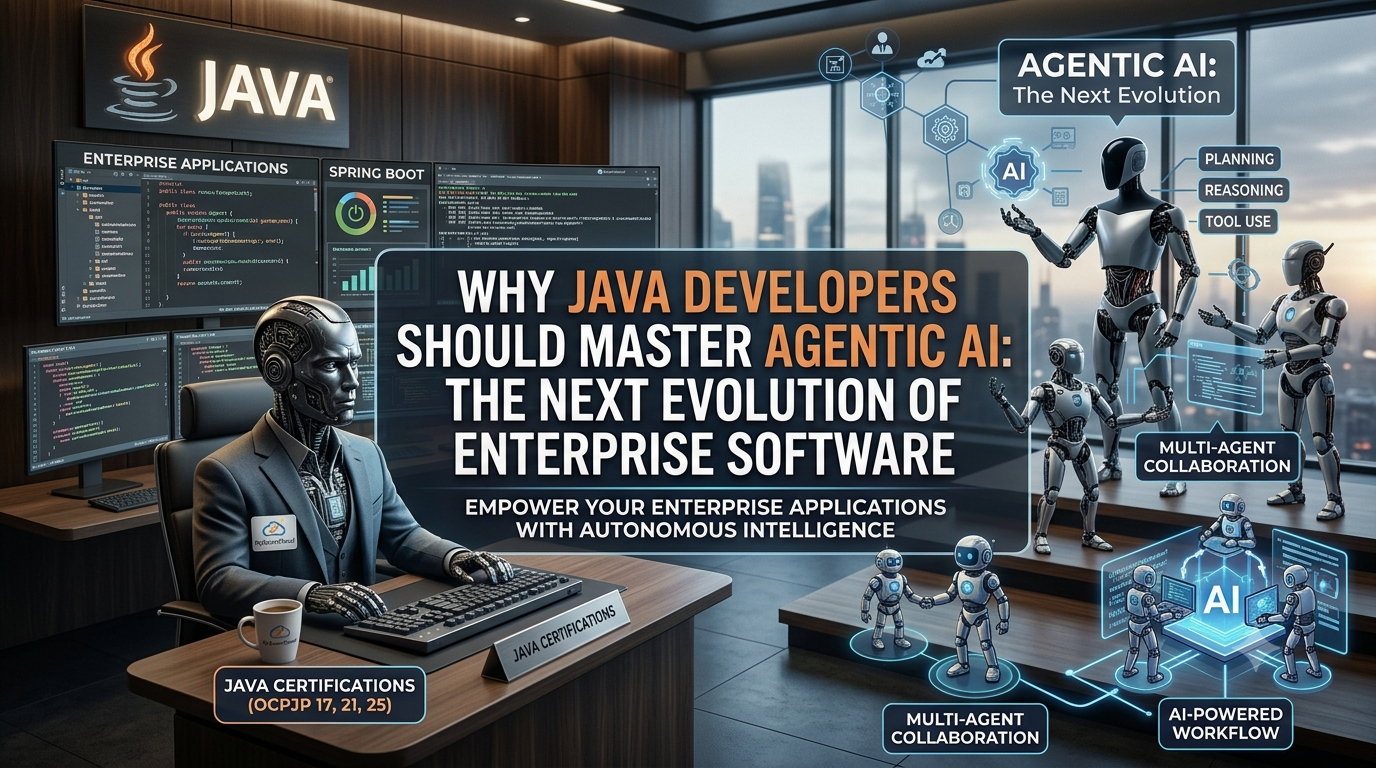
Why Java Developers Should Master Agentic AI: The Next Evolution of Enterprise Software
Read this MyExamCloud Blog article for practical insights on Agentic AI. Explore more blog categories, search related topics in blog search, or return to the MyExamCloud Blog home.
Artificial Intelligence has transformed software development, but one question continues to surface among enterprise developers:
Does AI mean every developer must switch to Python?
The answer is no.
For organizations running mission-critical enterprise systems, Java remains one of the most dominant technologies. Rather than replacing Java, AI is becoming another capability that enterprise applications must adopt. This makes Agentic AI with Java one of the most valuable skill sets for modern software engineers.
Java Has Powered Every Major Enterprise Technology Wave
Java has consistently been at the center of enterprise innovation:
- Big Data Era: Core technologies such as Hadoop were built directly on the Java ecosystem.
- Blockchain Wave: Enterprise platforms like Hyperledger Fabric relied heavily on Java.
- The Agentic AI Era: Enterprises are once again turning to Java—not because it's the primary language for AI research, but because millions of existing enterprise applications already run on Java.
Instead of rewriting multi-million-dollar systems from scratch, organizations want to embed AI capabilities directly into their existing Java infrastructure. This creates tremendous opportunities for Java developers.
From AI Integration to Intelligent Agents
The first generation of AI integration focused primarily on basic chatbots and simple API calls. The next generation looks fundamentally different. Modern enterprise applications require:
- Autonomous AI agents
- Multi-agent collaboration
- AI-powered workflows
- Intelligent automation
- Context-aware decision making
- Human-in-the-loop validation
This new paradigm is known as Agentic AI. Instead of merely generating responses, AI agents can plan, reason, use tools, communicate with other agents, and complete complex business workflows autonomously.
Building a Strong AI Foundation
Before jumping directly into Agentic AI frameworks, developers must understand the core fundamentals of AI engineering:
- Natural Language Understanding (NLU)
- Agentic AI fundamentals
- Deep learning basics
- Transformer architecture
- Large Language Models (LLMs)
- Tokens and token pricing
- Hallucinations and mitigation strategies
- The Hugging Face ecosystem
Mastering these concepts enables software architects and developers to make significantly better architectural decisions when building enterprise AI applications.
Why Java Developers Don't Need to Leave Their Ecosystem
One of the biggest misconceptions in AI is that everything revolves around Python.
While Python dominates AI research and model training, enterprise software tells a different story. Large organizations have invested years in Java-based systems. Rather than rebuilding them, businesses are extending these applications with AI features using mature, production-ready Java frameworks.
Key Frameworks Powering Java AI
1. Spring AI: Bringing AI into Enterprise Applications
Spring Boot already powers thousands of enterprise applications. Spring AI extends that familiar ecosystem, enabling seamless integration with modern LLM providers (both cloud-based and local).
Developers can build applications featuring:
- AI chat capabilities & Prompt Engineering
- Advisors & Retrieval-Augmented Generation (RAG)
- Vector Database integration
- Model Context Protocol (MCP)
- Audio, image, and multimodal AI support
2. Google ADK for Agent Development
Agentic AI often requires more than simple prompt execution. Google Agent Development Kit (Google ADK) introduces production capabilities such as:
- Agent architecture & workflow orchestration
- Tool integration
- Agent-to-Agent (A2A) communication
- Cloud deployment
3. LangChain4j: Bringing LangChain Concepts to Java
LangChain4j brings the popular concepts of LangChain into the Java ecosystem, supporting:
- Agent workflows & memory management
- Tool calling
- Human-in-the-loop interactions
- Enterprise-ready Java integrations
Beyond Development: Preparing AI for Production
Building an AI prototype is only the beginning. Enterprise AI systems require production-grade capabilities:
- Model evaluation & fine-tuning strategies
- Performance & cost optimization
- Observability using Grafana and Prometheus
- Fact-checking and response validation
Retrieval-Augmented Generation (RAG)
One of the most valuable enterprise AI techniques is Retrieval-Augmented Generation (RAG). Instead of relying solely on an LLM's pre-trained knowledge, RAG retrieves relevant business documents and supplies them as context before generating responses.
This significantly improves:
- Accuracy and domain relevance
- Freshness of information
- Trustworthiness of AI-generated outputs
Combined with vector databases, RAG is a cornerstone of modern enterprise AI architecture.
Real-World Enterprise Projects
Learning concepts alone isn't enough. Enterprise developers benefit most by implementing complete applications that demonstrate practical AI integration.
For example, an e-commerce platform can be enhanced with:
- Intelligent product search & AI shopping assistants
- Autonomous customer support agents
- Automated workflow & operational monitoring
- Contextual recommendation systems
Human Wisdom Still Matters
Despite rapid advances in AI, humans remain an essential component of enterprise software.
Modern AI architectures increasingly embrace the concept of Human-in-the-Loop (HITL), where AI performs autonomous tasks while human operators provide oversight, validation, and final decision-making.
Why Java Certifications Still Matter in the AI Era
Many developers assume that AI skills alone are enough to advance their careers. In reality, enterprises continue to value strong Java fundamentals because AI capabilities are being integrated into existing systems—not replacing them.
Earning an Oracle Java Certification demonstrates that you possess the core language, OOP, collections, concurrency, streams, modules, and modern JDK features required to build reliable enterprise applications.
Key Certifications to Consider
- Oracle Certified Professional Java SE 17 Developer (1Z0-829) – Validates professional-level Java development skills across enterprise organizations.
- Oracle Certified Professional Java SE 21 Developer (1Z0-830) – Covers modern Java features including functional programming, concurrency, records, sealed classes, virtual threads, and pattern matching.
- Oracle Certified Professional Java SE 25 Developer (1Z0-831) – Prepare for the next generation of Java by mastering the latest JDK features and language enhancements.
Benefits Beyond the Exam
- Strengthens core Java programming concepts.
- Builds confidence for technical interviews.
- Improves credibility with recruiters and hiring managers.
- Opens opportunities for Senior Developer, Lead Engineer, and Solution Architect roles.
- Provides a solid foundation before diving into Spring Boot, Microservices, and Agentic AI frameworks.
The Perfect Career Progression
A future-ready Java career roadmap looks like this:
Java Fundamentals → Oracle Java Certification → Spring Boot → Microservices
Cloud Technologies → AI Engineering → Agentic AI → Enterprise AI Architect
6-Week Agentic AI with Java Roadmap
Week 1: Spring AI Foundations & Prompt Engineering
Build your first enterprise AI applications using Spring AI.
- Introduction to Generative AI
- Spring AI Architecture
- AI Model Providers (OpenAI, Gemini, Claude, Ollama, Azure OpenAI)
- Spring Boot Integration
- Building Your First AI Application
- ChatClient API
- Prompt Templates
- Prompt Engineering
- Prompt Chaining
- System, User & Assistant Messages
- Conversation Memory
- Advisors
- Open Source Models (Ollama, Llama, Mistral, DeepSeek, Gemma, Qwen)
- Local AI Development
- Best Practices
Week 2: RAG, Vector Databases & Multimodal AI
Build production-ready knowledge assistants.
- Vector Embeddings
- Text Chunking
- Semantic Search
- Vector Databases
- PGVector
- Redis Vector Store
- Similarity Search
- Retrieval-Augmented Generation (RAG)
- Advanced RAG
- GraphRAG
- Agentic RAG
- Self-RAG
- Corrective RAG (CRAG)
- Output Converters
- Structured JSON Output
- Multimodality (Images)
- Multimodality (Audio)
Week 3: Enterprise AI Development
Learn production AI development using Spring AI.
- Tool Calling
- Function Calling
- REST API Integration
- Database Integration
- Model Context Protocol (MCP)
- MCP Clients & Servers
- AI Model Evaluation
- Fine-tuning Concepts
- Cloud AI Platforms (Azure OpenAI, Google Vertex AI, AWS Bedrock)
- Streaming Responses
- Observability
- OpenTelemetry
- Langfuse
- Grafana & Prometheus
- Production Deployment
- Enterprise AI Best Practices
Week 4: Google ADK – Enterprise Agent Development
Build enterprise-grade autonomous AI agents.
- Google ADK Introduction
- Architecture
- Building Your First Agent
- Tools & Function Calling
- Sessions
- State Management
- Memory
- Workflow Agents
- Event-Driven Agents
- Human-in-the-Loop
- Multi-Agent Systems
- Supervisor Agents
- Agent Collaboration
- Guardrails
- Callbacks
- Artifacts
- Observability
- Production Deployment
Week 5: LangChain4j for Enterprise AI
Master enterprise Java AI development with LangChain4j.
- LangChain4j Architecture
- AI Services
- Prompt Templates
- Memory
- Streaming
- Tool Calling
- Function Calling
- MCP Integration
- RAG
- Vector Databases
- Document Loaders
- Spring Boot Integration
- AI Testing
- Enterprise Integration Patterns
Week 6: Agentic AI Architecture & Capstone Project
Design, build, and deploy production-ready AI agents.
- Agentic AI Fundamentals
- Planning & Reasoning
- Reflection
- Autonomous Decision Making
- Supervisor Pattern
- Planner-Executor Pattern
- Multi-Agent Collaboration
- AI Security
- AI Governance
- Cost Optimization
- Enterprise AI Architecture
- Production Deployment
- Performance Optimization
- End-to-End Enterprise AI Project
- Capstone: Build a Production-Ready Multi-Agent AI System using Spring AI, Google ADK & LangChain4j
Outcome: By the end of six weeks, you'll be able to design, develop, deploy, monitor, and scale enterprise-grade Agentic AI applications using Spring AI, Google ADK, LangChain4j, RAG, MCP, Vector Databases, and modern Java.
Conclusion: The Future of Enterprise Java
Java has survived—and thrived—through every major technology transformation.
Organizations are not replacing their Java platforms; they are making them intelligent. For Java developers, mastering AI engineering, Spring AI, Google ADK, LangChain4j, RAG, Vector Databases, and production-ready AI architecture is no longer optional—it is a key competitive advantage.
The future belongs to developers who can combine the reliability of enterprise Java with the intelligence of autonomous AI systems.
| Author | Ganesh P Certified Artificial Intelligence Scientist (CAIS) | |
| Published | 1 month ago | |
| Category: | Agentic AI | |
| HashTags | #Java #Programming #Software #Architecture #AI #ArtificialIntelligence #JavaCertification #generativeai #spring #springboot #agenticai #rag |

