
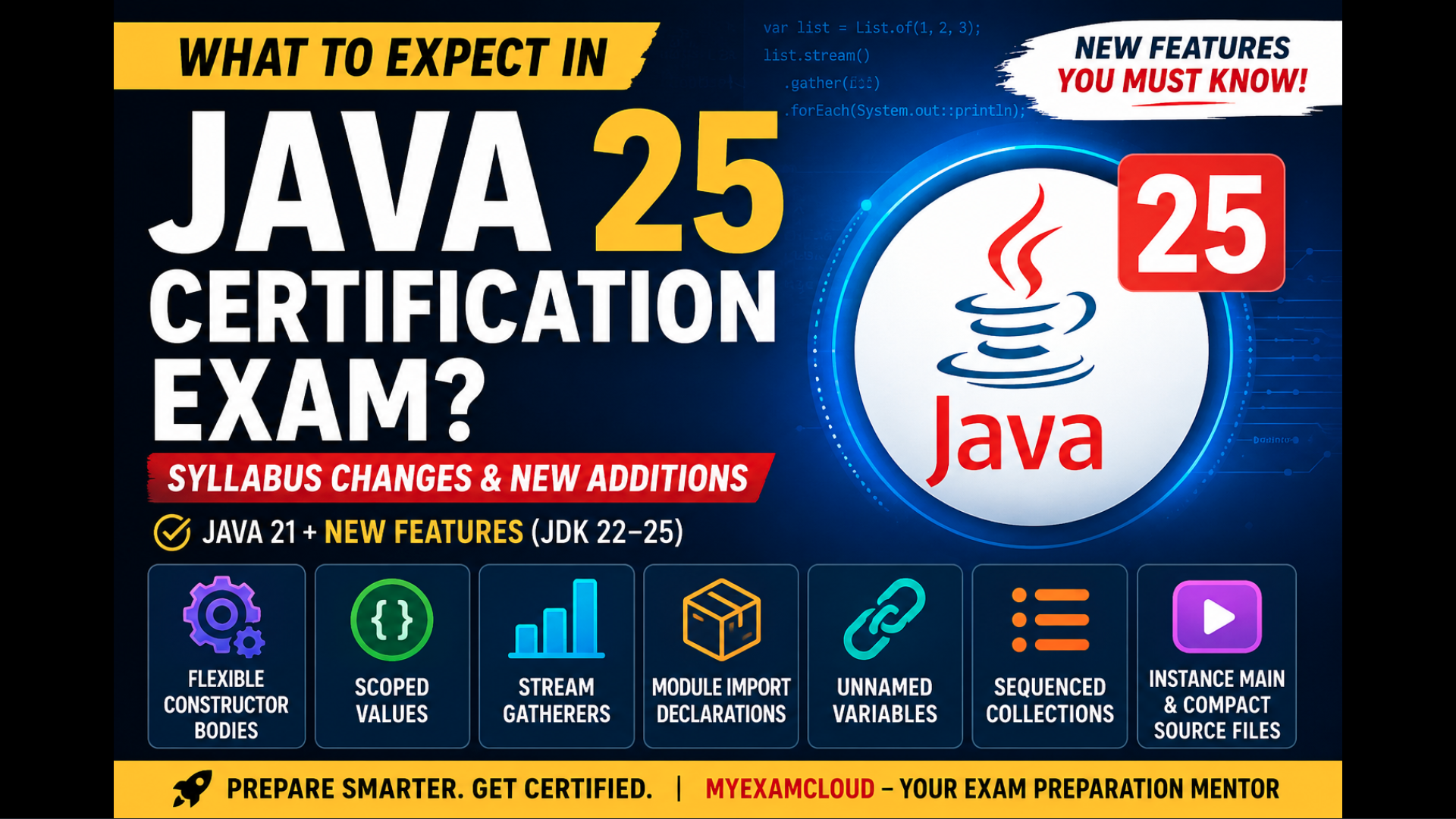
What to Expect in Java 25 Certification Exam?
Read this MyExamCloud Blog article for practical insights on Java Certification. Explore more blog categories, search related topics in blog search, or return to the MyExamCloud Blog home.
The Oracle Java 25 certification exam is not a completely new exam pattern. It is more like the Java 21 certification exam with additional modern Java features introduced in recent JDK releases.
If you already prepared for the Java 21 certification, most exam topics will look familiar. The core areas such as OOP, collections, streams, modules, exceptions, I/O, localization, and concurrency are still important. However, Java 25 adds new exam focus areas such as flexible constructor bodies, scoped values, stream gatherers, unnamed variables, module import declarations, sequenced collections, compact source files, and instance main methods.
For complete Java certification preparation, visit Java Certification Practice Tests.
Java 25 Certification vs Java 21 Certification
The Java 25 certification exam can be understood as:
Java 21 Certification + New Java 22 to Java 25 Features
Most Java 21 topics are still relevant. The difference is that Oracle now expects candidates to understand newer Java language improvements, modern concurrency, advanced stream processing, and simplified Java program execution.
Major New Topics Expected in Java 25 Certification
1. Flexible Constructor Bodies
Flexible constructor bodies allow statements before calling super() or this() in a constructor. This is useful for validating constructor arguments before passing them to the superclass constructor.
class Employee {

    Employee(String name) {
        System.out.println("Employee: " + name);
    }
}

class Manager extends Employee {

    Manager(String name) {

        if (name == null || name.isBlank()) {
            throw new IllegalArgumentException("Invalid name");
        }

        super(name);
    }
}
Expected exam focus:
- Constructor execution order
- Validation before constructor chaining
- Legal and illegal constructor statements
- Use of
super()andthis()
2. Scoped Values
Scoped values are used to share immutable data safely within a limited execution scope. They are especially useful with virtual threads and modern concurrent applications.
public class ScopedValueExample {

    static final ScopedValue<String> USER =
            ScopedValue.newInstance();

    public static void main(String[] args) {

        ScopedValue.where(USER, "Ganesh")
                .run(() -> printUser());
    }

    static void printUser() {
        System.out.println(USER.get());
    }
}
Expected exam focus:
- ScopedValue lifecycle
- Immutable context sharing
- Difference between
ScopedValueandThreadLocal - Use with virtual threads
3. Stream Gather Operations
Stream gather operations are one of the most important additions for Java 25 certification. Gatherers allow advanced custom stream processing.
import java.util.stream.Gatherers;
import java.util.stream.Stream;

public class GatherExample {

    public static void main(String[] args) {

        Stream.of("Java", "Spring", "AI", "Cloud")
                .gather(Gatherers.windowFixed(2))
                .forEach(System.out::println);
    }
}
Expected exam focus:
Stream.gather()- Gatherers API
- Sequential and parallel stream behavior
- Stateful stream transformations
4. Module Import Declarations
Java 25 certification also includes module import declarations. This feature allows importing all exported packages from a module.
import module java.base;
import java.util.List;

public class ModuleImportExample {

    public static void main(String[] args) {

        List<String> names =
                List.of("Java", "Oracle");

        System.out.println(names);
    }
}
Expected exam focus:
- Module import syntax
- Module readability
- Package visibility
- Module dependency rules
5. Unnamed Variables
Unnamed variables allow developers to ignore values that are required syntactically but not used in the program logic.
import java.util.List;

public class UnnamedVariableExample {

    public static void main(String[] args) {

        for (String _ : List.of("A", "B", "C")) {
            System.out.println("Item found");
        }
    }
}
Expected exam focus:
- Use of underscore as unnamed variable
- Compiler restrictions
- Loops and try-with-resources
- Discarding unused values
6. Sequenced Collections
Sequenced collections provide a common way to access the first and last elements of ordered collections.
import java.util.LinkedHashSet;
import java.util.SequencedSet;

public class SequencedCollectionExample {

    public static void main(String[] args) {

        SequencedSet<String> skills =
                new LinkedHashSet<>();

        skills.add("Java");
        skills.add("Spring");
        skills.add("AI");

        System.out.println(skills.getFirst());
        System.out.println(skills.getLast());
        System.out.println(skills.reversed());
    }
}
Expected exam focus:
SequencedCollectionSequencedSetSequencedMapgetFirst()andgetLast()- Reversed collection views
7. Instance Main Methods
Java now supports simpler main methods. Candidates should understand how instance main methods work.
class HelloJava {

    void main() {
        System.out.println("Hello from Java 25");
    }
}
Expected exam focus:
- Instance main method syntax
- Program launch rules
- Difference from traditional
public static void main(String[] args)
8. Compact Source Files
Compact source files make Java easier for beginners by reducing boilerplate code.
void main() {
    System.out.println("Java is becoming simpler");
}
Expected exam focus:
- Compact source file structure
- Implicit classes
- Source-code program execution
- Multi-file source-code programs
Topics That Remain Mostly the Same
The following topics remain important and are mostly similar to Java 21 certification:
- Primitive types and wrapper classes
- String, StringBuilder, and text blocks
- Date-Time API
- Decision making and loops
- Object-oriented programming
- Records and sealed classes
- Interfaces and enums
- Exception handling
- Arrays and collections
- Streams and lambdas
- Modules
- Virtual threads and executors
- Java I/O and NIO
- Localization and resource bundles
Most Important Java 25 Topics to Prepare
- Streams and Gatherers
- Scoped Values and Virtual Threads
- Flexible Constructor Bodies
- Module Import Declarations
- Sequenced Collections
- Unnamed Variables
- Compact Source Files and Instance Main Methods
Final Thoughts
The Java 25 certification exam is best understood as an upgraded version of the Java 21 certification. Candidates should not ignore Java 21 topics, because most of the exam still comes from core Java concepts. However, the new Java 25 additions are important because they are likely to appear as direct exam questions.
If you are preparing for the Java 25 certification, focus on both strong Java fundamentals and the latest modern Java features. This exam is designed to validate whether developers are ready for modern enterprise Java development.
Prepare smarter with MyExamCloud, your My Exam Preparation Mentor.
Start your preparation with Java Certification Practice Tests and Mock Exams .
Related Articles
| Author | Ganesh P Certified Artificial Intelligence Scientist (CAIS) | |
| Published | 3 months ago | |
| Category: | Java Certification | |
| HashTags | #Java #Programming #Software #Architecture #JavaCertification |

