
Top Web Frameworks and Web Application Frameworks for Full-Stack Developers in 2024
Read this MyExamCloud Blog article for practical insights on Programming. Explore more blog categories, search related topics in blog search, or return to the MyExamCloud Blog home.
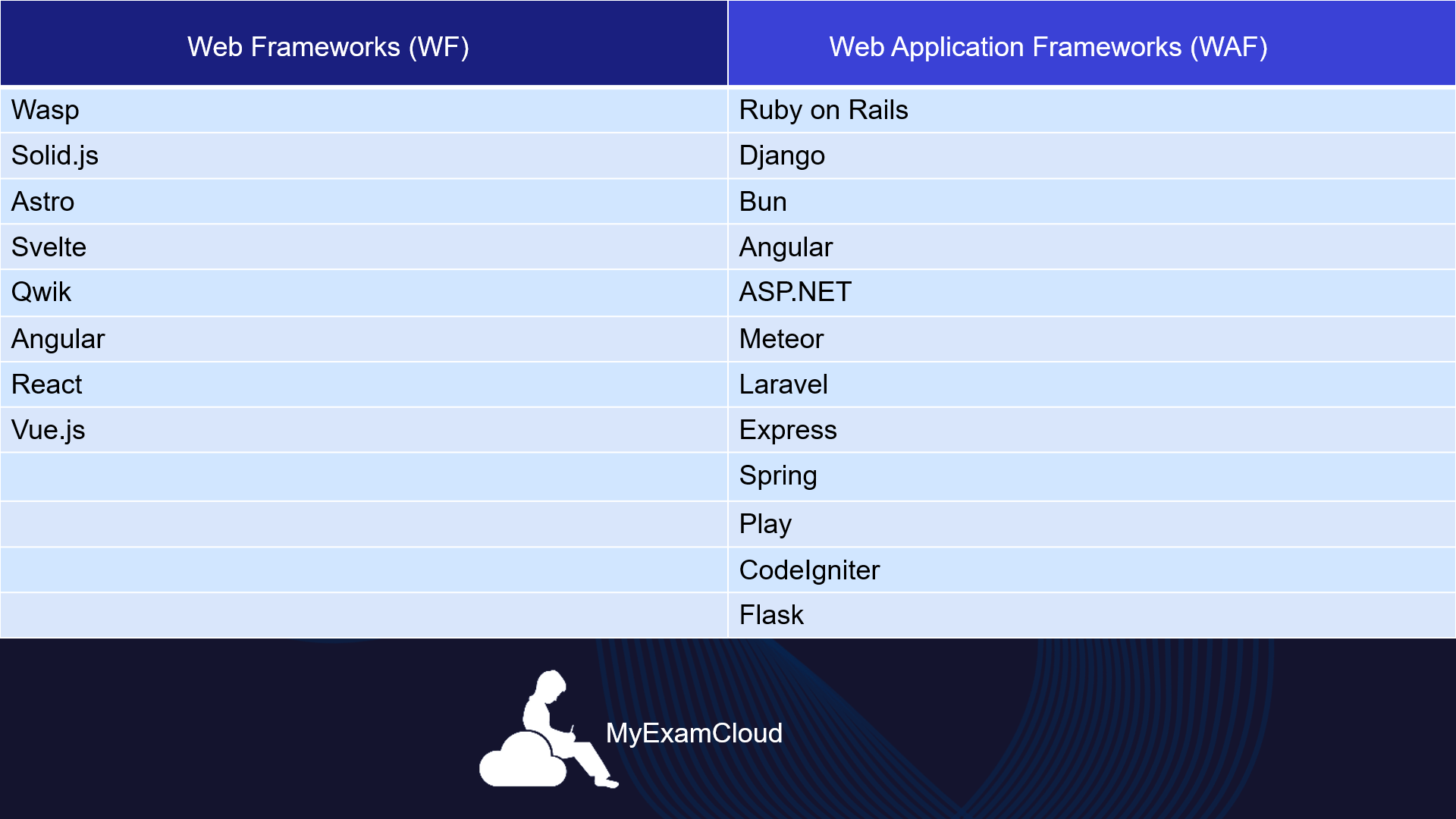
As technology continues to advance and evolve, so do the tools and frameworks used by full-stack web developers. These frameworks enable developers to build robust, efficient, and highly performant web applications. With the constantly changing landscape of web development, it's important for developers to stay updated on the latest and most effective tools available. Here are the top web frameworks that every full-stack developer should know by 2024.
A web framework, also known as a front-end framework, is a collection of tools, libraries, and utilities that help build and structure the user interface of a web application. It provides a standard structure for web development and often includes features such as site templates, layout options, and reusable components. These frameworks are primarily focused on the client-side, meaning they are responsible for the user-facing portion of the website.
On the other hand, a web application framework, also known as a back-end framework, is a collection of software or tools used to build and deploy web applications. These frameworks often include features such as database management, user authentication, and server-side scripting. They handle the logic and functionality of a web application, often communicating with the front-end of the website to process and display data.
In simple terms, web frameworks are more focused on the visual aspect of a website, while web application frameworks handle the behind-the-scenes tasks and functionality. Both are essential in creating a robust and efficient web application, and developers often use a combination of both to build a complete and functional website.
Web Frameworks
1. Wasp
Wasp is an all-in-one solution for shipping full-stack applications quickly. It combines React and Node.js to create a powerful and efficient full-stack framework. Wasp offers pre-configured templates and Open SaaS options, making it easy for developers to get started on their projects. With features such as full-stack authentication, database schema management, and flexible deployment, Wasp streamlines the development process and allows developers to focus on building their applications.
2. Solid.js
Solid.js is a highly reactive web framework that shares similarities with React. It utilizes signals, memos, and effects for fine-grained reactivity, providing a more granular and efficient approach to handling changes in a web application. Solid.js also offers features such as file-based routing and API routes through its meta-framework Solid Start, making it easy for developers to get started and customize their projects.
3. Astro
Astro is a popular framework for building content-driven websites and CMS-heavy sites. It uses a unique Islands architecture, where each interactive component on a page functions independently but can also share state and communicate with other components. This allows for increased flexibility and scalability in web development. Astro also offers the ability to integrate different frontend frameworks, such as React and Vue, giving developers more options and customization capabilities.
4. Svelte
Svelte is a beginner-friendly framework that simplifies web development and promotes fast code execution. Its reactive properties allow developers to easily update the UI in real-time without re-rendering the entire component. Svelte is currently working on introducing runes, which will offer a more precise and performant way of handling reactivity. Svelte also has its own framework, SvelteKit, which offers features such as file-based routing and image optimization.
5. Qwik
Qwik is a framework that prioritizes performance by utilizing a concept called resumability. This approach delays the execution and downloading of JavaScript code unless it is necessary, resulting in faster loading times and lower bandwidth requirements. Qwik also offers a familiar environment for React-based developers through its use of JSX and functional components. It is also lightweight, making it an efficient choice for high-performance web applications.
6. Angular:
Angular is an open-source front-end web framework developed by Google. It is a modern and comprehensive framework that aims to simplify the development of single-page applications (SPAs). Angular uses HTML as its markup language and extends it with directives to build dynamic and interactive user interfaces. It also provides built-in support for data binding, dependency injection, and routing, which makes it easier to manage large and complex applications.
One of the standout features of Angular is its use of TypeScript, a superset of JavaScript that provides static typing, classes, interfaces and other advanced features. This makes Angular more structured and maintainable compared to other frameworks.
With its powerful features and components, Angular is suitable for building complex and advanced applications. It is also supported by a large community, providing extensive documentation, tutorials, and support for developers.
7. React:
React is a JavaScript library developed by Facebook for building user interfaces. It is a popular framework for front-end development because of its simplicity, flexibility, and performance. React uses a virtual DOM (Document Object Model) to efficiently update the user interface, making it faster than traditional frameworks.
React follows a component-based architecture, where each component has its own state and logic, which can be easily reused and composed to build complex UIs. It also supports the use of JSX, which allows developers to write HTML-like code within JavaScript, making it easier to work with.
React is often used in conjunction with other libraries and frameworks such as Redux, React Native, and Next.js to build full-scale applications. It has a large and active community, providing constant updates, tutorials, and support for developers.
8. Vue.js:
Vue.js is a progressive front-end JavaScript framework that is gaining popularity due to its simplicity, flexibility, and small size. It is ideal for building user interfaces and single-page applications. Vue uses a virtual DOM and reactive data binding, similar to React, to provide efficient and optimized rendering of the UI.
One of the standout features of Vue is its easy learning curve. It has a simple and intuitive syntax, making it easy to pick up for developers familiar with HTML and JavaScript. It also offers a high level of customization through its modular design, allowing developers to pick and choose only the features they need.
Vue is often compared to React in terms of features and performance, but it has a smaller size and faster load time, making it a good choice for building lightweight applications. It also has a growing community, providing valuable resources, tutorials, and support for developers.
Web Application Frameworks
1. Ruby on Rails
Ruby on Rails, created by David Heinemeier Hansson, is a highly productive web application framework. It follows the Model-View-Controller pattern and includes everything necessary to build a database-driven web application. Compared to traditional Java frameworks, Rails offers a faster development process. Companies such as Groupon, Airbnb, and GitHub use Ruby on Rails for their web applications.
2. Django
Django is a powerful framework for building web applications, known for its versatility and scalability. Developed to meet the demands of fast-paced newsrooms, Django also satisfies the needs of experienced developers with its speed and security. Websites like Disqus, Pinterest, and Instagram are built using Django.
3. Angular
Angular, originally developed by Google, has become a popular framework for building powerful web applications. It is known for its ability to quickly develop large-scale applications while remaining easy to maintain. Angular has been used to build websites such as YouTube on PS3, Weather, and Netflix.
4. ASP.NET
ASP.NET, created by Microsoft, is a robust framework for building web applications for both PC and mobile devices. It is a high-performance framework that offers developers power, productivity, and speed. Companies like GettyImages, TacoBell, and StackOverflow use ASP.NET for their web applications.
5. Meteor
Meteor, also known as MeteorJS, is a modern framework for building real-time mobile and web applications. It allows for rapid prototyping and produces cross-platform code for web, Android, and iOS. Its cloud platform, Galaxy, simplifies deployment and scaling. Websites such as HaggleMate, WishPool, and Telescope are built using Meteor.
6. Laravel
Laravel is a popular framework for building web applications, valued for its elegance, simplicity, and readability. It follows the Model-View-Controller pattern and offers a robust set of features for web development. Laravel also has a wealth of tutorials on its Laracasts platform, making it easy for developers to learn and use. Websites like Deltanet Travel and Neighbourhood Lender are built using Laravel.
7. Express
Express, also known as Expressjs, is a flexible and minimal framework for building efficient web and mobile applications. It offers many features as plugins, allowing for customization and streamlined development. Express also facilitates the rapid development of Node.js-based applications. Websites such as Storify, Myspace, and LearnBoost use Express for their web applications.
8. Spring
Spring is the most popular framework for enterprise Java, used by millions of developers worldwide. It helps create high-performance and versatile applications by leveraging the power of the JVM. Companies like Mascus and Allocine use Spring for their web applications.
9. Play
Play is a modern web application framework written in Java and Scala. It follows the Model-View-Controller architecture and aims to optimize developer productivity with its convention over configuration approach. Play is also highly scalable and offers features such as hot code reloading and error display in the browser. Websites like LinkedIn, Coursera, and LendUp are built using Play.
10. CodeIgniter
CodeIgniter is a simple yet powerful framework for building dynamic websites. It offers exceptional performance, zero-configuration, and compact libraries, making it a popular choice for web development. Websites like GettyImages and TacoBell use CodeIgniter for their web applications.
11. Flask:
Flask is a micro web framework written in Python. It is lightweight, flexible, and easy to use, making it a popular choice for building web applications and APIs. Flask follows a minimalist design, providing only the essential tools for web development, making it suitable for small and simple projects.
One of the standout features of Flask is its built-in development server, which allows developers to test their applications without the need for an external server. It also has a wide range of extensions and libraries, allowing developers to add additional functionality and features to their applications easily.
With its simple and modular design, Flask is ideal for beginners and developers looking for a lightweight and quick solution for web development. It has a growing community, providing extensive documentation, tutorials, and support for developers.
In conclusion, these are the top web frameworks that every full-stack developer should be familiar with by 2024. As technology continues to evolve, it's important for developers to stay updated and constantly improve their skillset with the latest and most effective tools and frameworks.
MyExamCloud Study Plans
Java Certifications Practice Tests - MyExamCloud Study Plans
Python Certifications Practice Tests - MyExamCloud Study Plans
AWS Certification Practice Tests - MyExamCloud Study Plans
Google Cloud Certification Practice Tests - MyExamCloud Study Plans
Aptitude Practice Tests - MyExamCloud Study Plan
| Author | JEE Ganesh | |
| Published | 2 years ago | |
| Category: | Programming | |
| HashTags | #Java #Python #Programming #Software #Architecture |

