
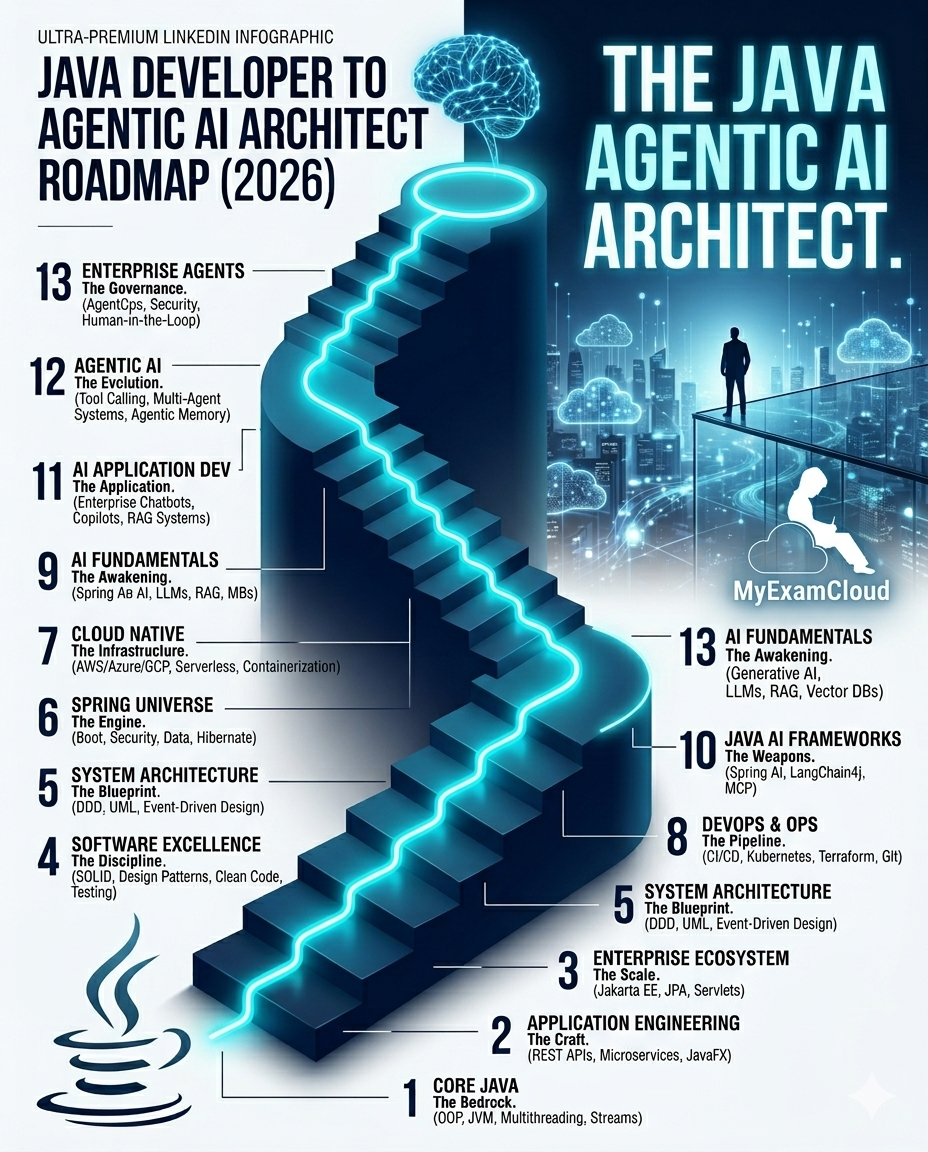
Java Developer to Agentic AI Architect: Complete 13-Step Roadmap for 2026
Read this MyExamCloud Blog article for practical insights on Agentic AI. Explore more blog categories, search related topics in blog search, or return to the MyExamCloud Blog home.
The future of software engineering is no longer just about writing code.
Modern enterprises are rapidly moving toward intelligent systems powered by AI, autonomous agents, cloud platforms, automation, and data-driven decision making.
For Java developers, this creates one of the most exciting career transformations in technology:
Java Developer → Enterprise Engineer → Cloud Engineer → AI Developer → Agentic AI Developer → Java Agentic AI Architect
This comprehensive roadmap explains the 13 stages required to evolve from a traditional Java developer into a next-generation Agentic AI Architect.
Step 1: Core Java — The Foundation
Every successful Java career starts with mastering the language fundamentals.
Key Topics
- Object-Oriented Programming (OOP)
- Collections Framework
- Exception Handling
- Generics
- Streams API
- Multithreading
- JVM Internals
Strong Java fundamentals make it easier to understand enterprise frameworks, distributed systems, cloud-native applications, and AI integrations later in your career.
Recommended Preparation: Oracle Java Foundations Certification, Oracle Java SE Developer Certification
Step 2: Java Application Development — Learning to Build
Before building enterprise systems, developers must understand how applications work from end to end.
Focus Areas
- Console Applications
- File Handling
- Input/Output Programming
- JavaFX and Swing
- REST APIs
- Microservices Basics
This stage teaches how software interacts with users, files, databases, and external services.
Step 3: Enterprise Java — Building at Scale
Enterprise applications require much more than coding knowledge.
Learn
- Jakarta EE
- Servlets
- JSP
- JPA
- Enterprise Integration
- Transaction Management
This stage introduces the large-scale systems used by banks, healthcare providers, governments, and telecommunications companies.
Recommended Preparation: Oracle Java EE Certification, Java EE 7 Application Developer
Step 4: Software Engineering Excellence — Writing Professional Code
Most developers write code. Great engineers build maintainable systems.
Master
- SOLID Principles
- GoF Design Patterns
- Clean Code
- Refactoring
- Unit Testing
- Integration Testing
Large enterprise systems survive because of architecture, standards, and maintainability—not because of clever code.
Step 5: Architecture & Design — Thinking Like an Architect
This is where developers begin thinking about entire systems instead of individual classes.
Topics
- UML
- Domain-Driven Design (DDD)
- System Design
- Event-Driven Architecture
- Distributed Systems
- Scalability Patterns
Architecture determines reliability, scalability, maintainability, and business success.
Step 6: Spring Ecosystem — Enterprise Development Engine
Spring dominates modern enterprise Java development.
Master
- Spring Framework
- Spring Boot
- Spring Security
- Spring Data JPA
- Hibernate
Most enterprise Java applications today are built using Spring technologies.
Recommended Preparation: Spring Certified Professional
Step 7: Cloud Native Development — Building for Modern Infrastructure
Applications are no longer deployed on a single server.
Learn
- AWS
- Microsoft Azure
- Google Cloud
- Serverless Computing
- Cloud Architecture Patterns
- API Gateway
Modern enterprise systems are cloud-first and increasingly cloud-native.
Recommended Certifications:
- AWS Certified Developer Associate
- AWS Certified Solutions Architect Associate
- Microsoft Azure Fundamentals (AZ-900)
- Google Associate Cloud Engineer
Step 8: DevOps & Platform Engineering — Automating Delivery
Modern developers must understand operations and deployment automation.
Learn
- Git
- CI/CD
- Docker
- Kubernetes
- Terraform
- Monitoring & Logging
Organizations increasingly expect engineers to own software delivery from development through production.
Recommended Certifications:
- Docker Certified Associate (DCA)
- Certified Kubernetes Application Developer (CKAD)
- Certified Kubernetes Administrator (CKA)
- HashiCorp Terraform Associate
Step 9: AI Fundamentals — Entering the AI Era
Now the transition from traditional software engineering to AI engineering begins.
Learn
- Artificial Intelligence
- Machine Learning
- Generative AI
- Large Language Models
- Prompt Engineering
- RAG
- Vector Databases
You must understand how AI systems work before integrating them into enterprise applications.
Recommended Preparation:
- Microsoft Azure AI Fundamentals (AI-900)
- AI & Machine Learning Certifications
- Generative AI Certifications
Step 10: Java AI Frameworks — Bringing AI into Java
This stage connects Java development with AI capabilities.
Learn
- Spring AI
- LangChain4j
- Model Context Protocol (MCP)
- AI Integration Patterns
These frameworks allow Java developers to build AI-powered systems while remaining within the Java ecosystem.
Step 11: AI Application Development — Building Intelligent Applications
Now you start building real-world AI products.
Create
- Enterprise Chatbots
- AI Assistants
- AI Copilots
- RAG Applications
- Multi-Modal Systems
This is where AI starts delivering measurable business value.
Recommended Preparation: AWS Certified Generative AI Developer Professional
Step 12: Agentic AI Development — From AI to Autonomous Systems
Traditional AI answers questions. Agentic AI performs tasks.
Learn
- AI Agents
- Tool Calling
- Agent Memory
- Workflow Agents
- Multi-Agent Systems
- Agent Orchestration
Agents can reason, plan, act, collaborate, and solve complex business problems autonomously.
Recommended Preparation: Agentic AI Certification Practice Tests
Step 13: Enterprise Agentic AI — Operating AI at Scale
Enterprise-grade AI requires governance, security, observability, and operational excellence.
Master
- AgentOps
- AI Governance
- Security
- Human-in-the-Loop
- AI Observability
- Compliance
- Enterprise Agent Platforms
Large organizations require control, monitoring, auditing, and governance for AI systems and autonomous agents.
The Final Destination: Java Agentic AI Architect
A Java Agentic AI Architect combines expertise in:
- Enterprise Architecture
- Cloud Computing
- Software Engineering
- AI Engineering
- Multi-Agent Systems
- Enterprise Governance
- AgentOps
Instead of building individual applications, they design intelligent enterprise ecosystems where humans, applications, cloud services, data platforms, and AI agents work together seamlessly.
The future of Java is not just software development.
The future of Java is orchestrating intelligence.
Java Developer → Enterprise Engineer → Cloud Engineer → AI Engineer → Agentic AI Developer → Java Agentic AI Architect
Recommended Certifications for Each Stage
- Oracle Certified Professional Java SE Developer
- Oracle Java Foundations Certification
- VMware Spring Professional Certification
- AWS Certified Developer Associate
- AWS Certified Solutions Architect Associate
- Google Associate Cloud Engineer
- Docker Certified Associate
- HashiCorp Terraform Associate
- Microsoft Azure AI Fundamentals (AI-900)
- Generative AI Certifications
- Agentic AI Developer Certification
- Microsoft Certified Agentic AI Business Solutions Architect (AB-100)
Learning Strategy
Do not try to learn all 13 stages simultaneously.
A practical progression is:
Java Fundamentals → Spring Ecosystem → Architecture → Cloud → DevOps → AI Fundamentals → AI Applications → Agentic AI → Enterprise AI Architecture
Build projects at every stage. Real-world implementation experience is significantly more valuable than collecting certifications.
Related Articles
- How to Become an Agentic AI Architect in 2026
- AI Didn't Replace Him. It Promoted Him: The Rise of the Java Agentic AI Architect
- Best AI Certifications for Freshers in 2026: AI, Generative AI, AI Agents and Agentic AI Career Roadmap
| Author | Ganesh P Certified Artificial Intelligence Scientist (CAIS) | |
| Published | 3 months ago | |
| Category: | Agentic AI | |
| HashTags | #Java #AWS #Programming #Software #Architecture #AI #ArtificialIntelligence #spring #agenticai |

