
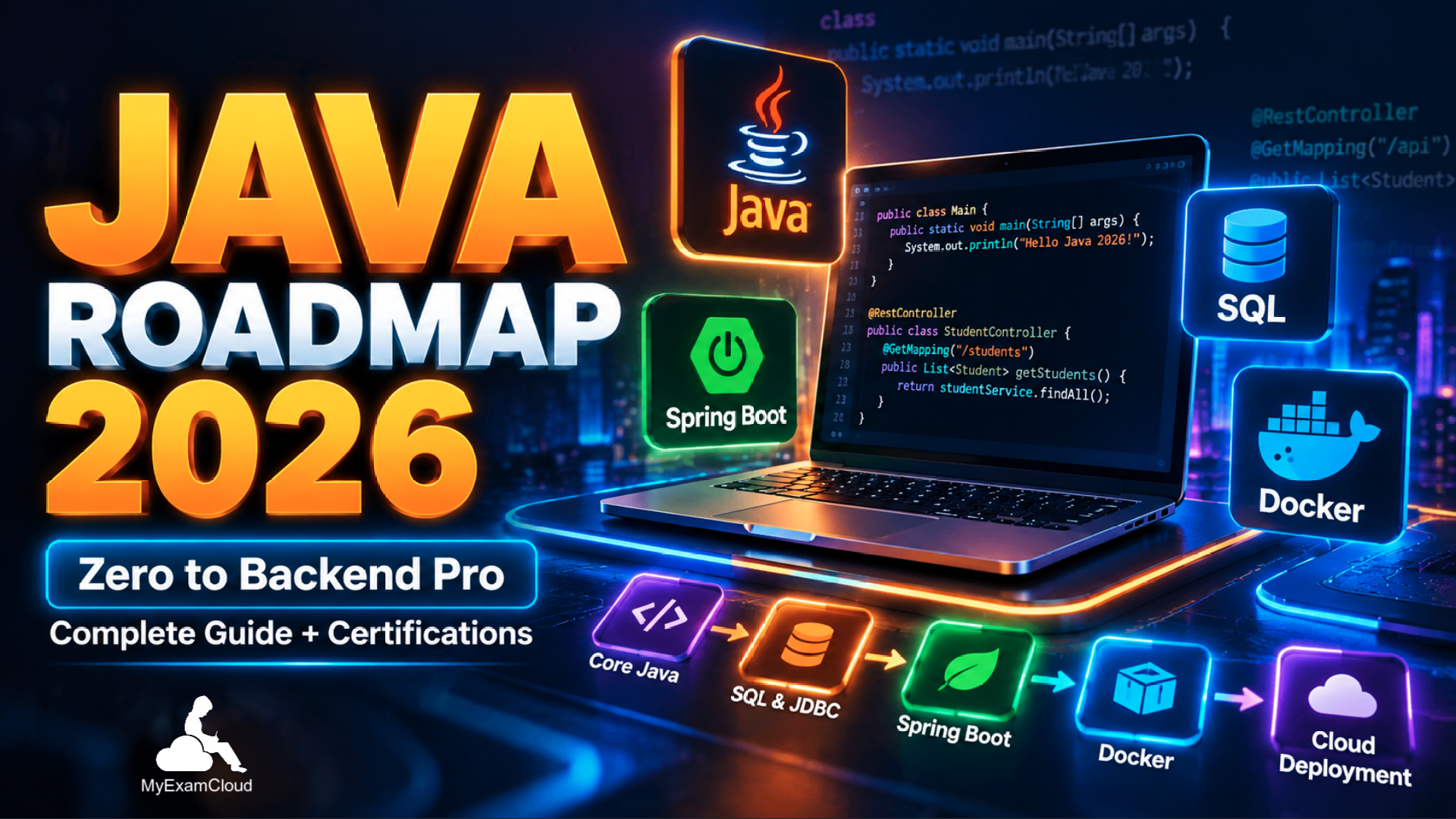
How to Learn Java in 2026: Complete Java Developer Roadmap & Certification Guide
Read this MyExamCloud Blog article for practical insights on Java Programming. Explore more blog categories, search related topics in blog search, or return to the MyExamCloud Blog home.
If you are a college student, aspiring software developer, or working professional trying to learn Java in 2026, you have probably already seen dozens of Java developer roadmaps.
The problem is that most roadmaps tell you what to learn, but rarely explain why you should learn it, what order to follow, when to build hands-on Java projects, and when you are ready to move to the next stage.
This comprehensive guide provides a practical, step-by-step Java learning roadmap for 2026 that takes you from basic programming fundamentals to building production-ready enterprise Java backend applications and passing Oracle Java certification exams.
The most important principle is simple:
Don't wait until you finish learning Java before you start building real-world software applications.
Build hands-on projects throughout your learning journey. Every project should reinforce Core Java concepts, object-oriented design, and framework mastery while exposing the exact areas where you need more practice.
Why Learn Java for Backend Development in 2026?
There is no universally "best" programming language. Every language has different strengths, performance characteristics, and enterprise use cases.
Java continues to be an essential programming language for modern software engineering due to its:
- Mature ecosystem and high-performance Java Virtual Machine (JVM)
- Exceptional stability, backward compatibility, and strong typing
- Scalability for high-throughput enterprise applications
- Large enterprise adoption across Fortune 500 companies
- Extensive backend ecosystem (Spring Boot, Hibernate, Microservices)
- Massive existing codebases requiring maintenance and modernization
- Active, globally supportive developer community
Java is widely used in enterprise software, cloud-native applications, banking and fintech systems, insurance platforms, e-commerce engines, telecommunications infrastructure, backend API services, and distributed systems.
However, your ultimate objective should not simply be to "learn Java syntax."
The real goal should be to become fully capable of designing, building, debugging, testing, and deploying scalable backend applications using Java, Spring Boot, and SQL databases.
Java is the programming language; professional software development is the overall engineering skill.
Complete Java Backend Developer Learning Roadmap for 2026
A practical, industry-aligned Java learning sequence looks like this:
Programming Fundamentals → Core Java → OOP Principles → Java Collections Framework → Exceptions & I/O File Handling → Multithreading & Concurrency → Core Java Portfolio Project → SQL & Relational Databases → JDBC → Java Servlets & Web Fundamentals → Full-Stack Web Project → Spring Core & Dependency Injection → Spring Boot → RESTful APIs → JPA / Hibernate ORM → Spring Security → Developer Tools (Git/Maven/Docker/Cloud) → Microservices Architecture → Production-Ready Portfolio Project
Phase 1: Master Computer Science & Programming Fundamentals
If you are completely new to software development, begin with basic computer science and software engineering concepts.
Understand key fundamental topics:
- How an operating system manages processes and memory
- Computer hardware, CPU, RAM, and software interaction
- How application source code executes on a machine
- File systems, environment variables, and directory structures
- Basic command-line tools and terminal usage
- How source code compiles into bytecode and runs on the JVM
However, don't spend weeks studying pure computer theory without typing code.
If you are already an engineering or computer science student, you likely know enough foundational logic to start coding right away.
The primary objective is to reach the point where you can start writing and running actual Java programs.
Phase 2: Master Core Java Fundamentals & Syntax
Start with the essential building blocks of Core Java programming.
Focus deeply on:
- Variables, constants, and literal values
- Primitive data types and wrapper classes
- Arithmetic, logical, bitwise, and relational operators
- Conditional control flow statements (if-else, switch expressions)
- Looping constructs (for, enhanced for-each, while, do-while)
- Methods, parameters, return types, and method overloading
- Arrays, multidimensional arrays, and memory allocation
- Standard I/O operations (Scanner, System.out)
- Basic Java syntax rules and naming conventions
- Java debugging techniques inside modern IDEs (IntelliJ IDEA, Eclipse)
- Algorithmic problem-solving techniques
This stage is not simply about memorizing Java language keywords. It is about developing strong algorithmic programming logic.
You should gradually become comfortable asking structural questions:
- How can I break this complex problem down into modular steps?
- Which conditional logic check is most efficient here?
- Should I iterate using a loop or process data using streams?
- What data structure or return type does this method require?
- How do I handle edge cases or invalid user input gracefully?
- How can I refactor and simplify this block of code?
These core programming principles apply across all software development domains. Syntax changes between languages, but concepts such as control flow, conditions, modular methods, recursion, and problem decomposition remain universal.
Practice Core Java with Small Console Programs
Don't only watch video courses or read tutorials. You must write hands-on Java code daily.
- Command-line calculator application
- Number guessing game with score tracking
- Student grade calculation and report generator
- Simple banking system console application
- Currency and unit converter
- Menu-driven console management system
Experiment actively with your code. Modify logic, force runtime errors, debug the stack trace, and fix the issues.
That iterative debugging process is where practical software engineering begins.
Phase 3: Master Object-Oriented Programming (OOP) in Java
Once you understand basic programming logic, dive deep into Object-Oriented Programming (OOP) design principles.
OOP is the core foundation of professional Java enterprise development.
Master these fundamental concepts:
- Classes and Objects
- Constructors and initialization blocks
- Encapsulation, access modifiers, and JavaBeans/Data Transfer Objects (DTOs)
- Inheritance, method overriding, and super keywords
- Polymorphism, dynamic binding, and runtime method dispatch
- Abstraction and abstract classes
- Interfaces, default methods, and static interface methods
- Java Records, Sealed Classes, and Pattern Matching
The order of learning matters greatly.
For example, fully understanding class inheritance makes runtime polymorphism and interface-driven design much easier to grasp.
Do not rush through OOP design principles just to jump ahead to Spring Boot.
Virtually every enterprise Java framework, design pattern, and software architecture relies heavily on these core object-oriented principles.
Start Thinking in Object-Oriented Architecture
Instead of only asking procedural questions like:
"What sequential code steps should I write?"
Start asking object-oriented architecture questions:
"What domain objects exist in this application, and what specific responsibilities and behaviors should each object encapsulate?"
For an e-commerce backend platform, for example, you would model distinct objects such as:
- Customer / User
- Product / Inventory
- ShoppingCart
- Order / OrderLineItem
- PaymentProcessor
- Invoice / Receipt
Learning how to model real-world domains into clean class structures and interfaces is a key requirement for any professional Java backend engineer.
Phase 4: Learn the Java Collections Framework (JCF)
Next, master the high-performance Java Collections Framework for managing in-memory data structures.
Focus deeply on core implementations:
- List interface: ArrayList, LinkedList
- Set interface: HashSet, LinkedHashSet, TreeSet
- Map interface: HashMap, LinkedHashMap, TreeMap, ConcurrentHashMap
- Queue & Deque interfaces: ArrayDeque, PriorityQueue, LinkedList
- Stack data structures and modern alternatives
Don't merely memorize theoretical definitions.
Focus on understanding the internal working mechanisms, time complexity (Big-O), and exact criteria for choosing each collection type.
Ask critical technical evaluation questions:
- Why select an ArrayList over a LinkedList for index-based access?
- How does a HashMap work internally (hashing, buckets, treeification)?
- Why does TreeSet guarantee sorted order while HashSet offers $O(1)$ lookups?
- When should you use ConcurrentHashMap in a thread-safe environment?
- Where do Queue and PriorityQueue fit into asynchronous job processing?
Master sorting and comparison contracts as well:
- Comparable interface (natural ordering)
- Comparator interface (custom sorting strategies)
- Equals and hashCode contract rules
Phase 5: Learn Exceptions, File Handling (I/O & NIO), and Java Concurrency
Java Exception Handling Architecture
Learn how to write resilient Java code that handles unexpected runtime errors:
- Try, catch, finally block execution flow
- Throw and throws declarations
- Checked vs. Unchecked (Runtime) exceptions
- Custom domain exceptions and exception hierarchy
- Try-with-resources statement for automatic resource management
File Handling & Java I/O / NIO2
Learn how Java applications interact with file systems, read/write streams, process JSON/XML, and manage buffers safely using modern java.nio.file APIs.
Modern Java Concurrency & Multithreading
Don't limit your multithreading knowledge to basic Thread classes and Runnable interfaces.
Master modern concurrent Java programming concepts:
- ExecutorService, ThreadPoolExecutor, and thread pool management
- Callable, Future, and CompletableFuture for asynchronous programming
- ReentrantLock, ReadWriteLock, and Atomic variables
- Concurrent collections and synchronization mechanisms
- Virtual Threads (Project Loom) introduced in modern Java LTS releases
You don't need to master low-level concurrent locks immediately, but understanding asynchronous task execution and thread safety is critical for backend microservices developer roles.
Phase 6: Build Your First Core Java Portfolio Project
This is where many tutorial-based Java learning roadmaps fail.
Do not wait until you finish studying Spring Boot, Hibernate ORM, SQL databases, REST APIs, Docker, and cloud platforms before building your first real software project.
Build a comprehensive project right after completing Core Java.
Your Core Java portfolio project should demonstrate:
- Clean Object-Oriented Design & SOLID principles
- Effective use of the Java Collections Framework
- Robust exception handling and logging
- File-based persistence (I/O, JSON, or CSV serialization)
- Multithreaded operations or async tasks where applicable
Core Java Project Ideas
- Inventory & Supply Chain Management System
- Console-Based Banking & Financial Transaction Application
- Library Management System with Search & Reservation
- Student Academic Information & Grading System
- Personal Finance & Expense Tracking System
Avoid simply copying code line-by-line from a tutorial video.
Architect the application independently. Encounter logic bugs, read error stack traces, debug execution lines, and refactor your code. That real-world debugging practice builds genuine software engineering confidence.
Phase 7: Learn SQL and Relational Databases
Once you master Core Java, move into backend data management by learning relational database management systems (RDBMS).
Start by learning standard SQL (Structured Query Language) using databases like PostgreSQL or MySQL.
Master these core SQL skills:
- Relational schema design, tables, data types
- Primary key and Foreign key constraints
- CRUD operations (INSERT, SELECT, UPDATE, DELETE)
- Filtering and sorting (WHERE, LIKE, IN, BETWEEN, ORDER BY)
- Data aggregation and grouping (GROUP BY, HAVING, COUNT, SUM, AVG)
- SQL Joins (INNER, LEFT, RIGHT, FULL OUTER, CROSS, SELF JOIN)
- Database Normalization (1NF, 2NF, 3NF)
- Transactions, ACID properties, and isolation levels
- Database indexing strategies for query performance tuning
Pay close attention to writing and optimizing SQL Joins and aggregate queries.
Do not skip pure SQL learning to rely solely on ORM frameworks. A strong foundation in SQL is essential for understanding how Object-Relational Mapping works behind the scenes.
Phase 8: Master Java Database Connectivity (JDBC)
After learning SQL, study JDBC (Java Database Connectivity) to connect your Java applications to relational databases.
Learn core JDBC components:
- DriverManager and DataSource connection configuration
- Connection pool management (HikariCP)
- Statement vs. PreparedStatement (preventing SQL injection vulnerabilities)
- CallableStatement for stored procedures
- ResultSet mapping and data retrieval
- Manual transaction management (commit, rollback, auto-commit settings)
- Handling SQLException hierarchies
JDBC bridges the gap between object-oriented Java code and relational SQL tables, showing you how raw database driver interactions function.
Phase 9: Learn JPA (Java Persistence API) and Hibernate ORM
Once you understand pure SQL and JDBC, transition to modern object-relational mapping using JPA and Hibernate.
Focus on mastering:
- JPA annotations (
@Entity,@Table,@Id,@GeneratedValue,@Column) - Entity relationship mappings (
@OneToOne,@OneToMany,@ManyToOne,@ManyToMany) - Cascading operations and orphan removal
- Persistence Context, entity states (Transient, Persistent, Detached, Removed)
- JPQL (Java Persistence Query Language) and Criteria API queries
- Lazy vs. Eager fetching strategies and solving the N+1 query problem
- First-level and Second-level caching strategies
- Transaction management (
@Transactional)
Because you already understand standard SQL and JDBC execution, ORM abstractions like Hibernate will make complete technical sense rather than feeling like magic.
Phase 10: Master HTTP Protocol & Java Servlets
To transition into Java web and API development, you must master the mechanics of web protocols and classic Java web components.
Understand key web concepts:
- HTTP request methods (GET, POST, PUT, DELETE, PATCH, OPTIONS)
- HTTP response status codes (2xx Success, 3xx Redirection, 4xx Client Error, 5xx Server Error)
- HTTP headers, request payloads, query parameters, and multi-part data
- Session management, Cookies, and Stateless HTTP architecture
- Servlet lifecycle (
init(),service(),destroy()) - HttpServletRequest and HttpServletResponse wrappers
- Servlet Filters and Listeners
Always keep this foundational web architecture question in mind:
What precise path does an HTTP request take from a web browser or API client through the server to execute backend Java logic and return a response?
Understanding the underlying Servlet architecture provides the groundwork for understanding Spring MVC and Spring Boot.
Phase 11: Build a Web Application with Servlets, JDBC & SQL
Before adopting high-level frameworks like Spring Boot, build a lightweight web application using fundamental Java web technologies:
Java + JDBC + SQL + Servlets
Your web application doesn't require a complex frontend interface. A simple HTML/CSS frontend or JSON response model is sufficient.
The goal is to master this end-to-end web data flow:
Client Request → HTTP Servlet → Service Layer → JDBC DAO → SQL Database → JDBC Result Processing → HTTP Response
Building this architectural loop without framework automation gives you a clear understanding of what Spring Boot abstracts behind auto-configurations.
Phase 12: Master Spring Framework Core Concepts
Now you are fully prepared to start learning the enterprise-standard Spring Framework ecosystem.
Before jumping into Spring Boot starter templates, master core enterprise Java engineering principles with Spring Core:
- Inversion of Control (IoC) principle
- Dependency Injection (DI) patterns (Constructor, Setter, Field injection)
- Spring ApplicationContext and BeanFactory containers
- Spring Bean lifecycle, scope definitions (Singleton, Prototype, Request, Session)
- Component scanning (
@Component,@Service,@Repository,@Controller) - Java-based configuration vs. Annotation-based configuration (
@Configuration,@Bean) - Aspect-Oriented Programming (AOP) for cross-cutting concerns (logging, security, transaction management)
Address this core architectural question:
"Why does the Spring Framework exist, and what enterprise development problems does Dependency Injection solve?"
As enterprise backend systems scale, manually instantiating, configuring, and connecting hundreds of service objects becomes unmaintainable. Spring automatically manages bean lifecycles and decouples application modules.
Phase 13: Build a Small Spring Core Project
Before jumping into full Spring Boot web development, create a clean, standalone Spring Core project.
Focus on verifying your understanding of:
- How Java classes are registered as Spring beans in the container
- How dependencies are injected via constructor injection
- How application properties files are loaded using
@Valueand@PropertySource - How Spring manages object scope and cleanup during application shutdown
Once Dependency Injection feels intuitive, you are ready to transition into Spring Boot.
Phase 14: Master Spring Boot & RESTful Web Services
Now move into full-stack microservices and web application development using Spring Boot.
Master these production-critical Spring Boot features:
- Spring Boot auto-configuration mechanism and starter dependencies
- Building RESTful Web Services with
@RestController,@RequestMapping,@GetMapping,@PostMapping,@PutMapping,@DeleteMapping - Request body parsing, path variables, query parameters, and JSON serialization using Jackson
- Data persistence with Spring Data JPA and automated repository generation (
JpaRepository) - Input validation using Jakarta Validation annotations (
@NotNull,@Size,@Email,@Valid) - Global exception handling using
@RestControllerAdviceand@ExceptionHandler - Application configuration with
application.yml/application.propertiesprofiles - Enterprise authentication and authorization using Spring Security (JWT, OAuth2, RBAC)
- Spring Boot Actuator for health checks, metrics, and production monitoring
Because you already possess a firm understanding of Core Java, SQL, JDBC, Servlets, and Dependency Injection, Spring Boot will feel like a natural productivity booster rather than a set of mysterious annotations.
Phase 15: Build a Full-Featured Spring Boot Backend Project
Build an enterprise-grade backend REST API service using modern Spring Boot patterns.
For example, a complete E-Commerce Platform API backend should implement:
- User registration, password hashing (BCrypt), and JWT authentication
- Role-Based Access Control (Admin, Merchant, Customer)
- Product catalog management with categories, search, and pagination
- Shopping cart management and checkout workflows
- Order processing, status updates, and transaction handling
- Relational database storage with Spring Data JPA and PostgreSQL
- Standardized JSON error responses and request validation
- Swagger / OpenAPI documentation endpoints
Alternative enterprise project ideas:
- Healthcare Management & Patient Booking API
- Learning Management System (LMS) Backend Service
- Banking & Financial Payment Gateway Integration Service
- Multi-Tenant Project Management & Task Tracking System
Phase 16: Master Essential Java Developer Tools & DevOps Basics
To succeed in a professional software development environment, you must master the build tools, version control systems, and deployment workflows used daily by software engineering teams.
Git Version Control & GitHub
Master modern collaborative software development workflows:
- Git branching strategies (GitFlow, feature branching)
- Committing, pushing, pulling, rebasing, and merging code
- Creating Pull Requests (PRs) and conducting peer code reviews
- Resolving merge conflicts safely
Build Tools: Apache Maven & Gradle
Understand build automation and dependency management:
- Structure of `pom.xml` and `build.gradle` build scripts
- Managing transitive project dependencies and versions
- Maven build lifecycles (clean, compile, test, package, install, deploy)
- Packaging applications into executable JAR and WAR artifacts
Containerization with Docker
Master modern application containerization:
- Containerization principles vs. Virtual Machines
- Writing multi-stage Dockerfiles for Java applications
- Building Docker images and running isolated containers
- Managing multi-container environments using Docker Compose (Java App + PostgreSQL + Redis)
Cloud Deployment & CI/CD Pipelines
Learn the basics of deploying backend services to cloud providers (AWS, Azure, Google Cloud Platform):
- Deploying containerized Java applications to cloud platforms (AWS Elastic Beanstalk, ECS, or Render)
- Setting up Continuous Integration & Continuous Deployment (CI/CD) pipelines using GitHub Actions
- Basic cloud database management (AWS RDS PostgreSQL)
You don't need to become a specialized DevOps engineer before applying for entry-level or junior Java backend developer roles. However, knowing how to build, containerize, and deploy your code provides a clear advantage during technical interviews.
Phase 17: Understand Microservices Architecture & Distributed Systems
After mastering monolithic backend application development, expand your skill set into modern distributed systems and microservices architecture.
Study key architectural concepts:
- Monolithic vs. Microservices architecture trade-offs
- Domain-Driven Design (DDD) and setting microservice boundaries
- Service-to-service communication: Synchronous (REST, gRPC) vs. Asynchronous (Event-Driven)
- API Gateway pattern (Spring Cloud Gateway)
- Service Discovery & Registration (Eureka)
- Distributed configuration management (Spring Cloud Config)
- Fault tolerance, Rate limiting, and Circuit Breaker patterns (Resilience4j)
- Distributed tracing and centralized logging (Zipkin, Micrometer, ELK Stack)
First focus on understanding the architectural challenges microservices address—such as domain isolation, independent scaling, and fault tolerance—before building distributed applications.
Phase 18: Explore Modern Java Innovations & Emerging Ecosystems
Once your Java backend development foundation is solid, explore high-demand modern innovations within the Java ecosystem:
- Spring AI: Integrating Generative AI models, vector databases, and LLM orchestration into enterprise Java applications
- Apache Kafka & RabbitMQ: Event-driven architecture, message streaming, and distributed pub/sub pipelines
- Reactive Programming: Non-blocking reactive streams using Spring WebFlux and Project Reactor
- GraalVM & Native Compilation: Compiling Spring Boot applications into fast, low-memory native executables for serverless environments
- Cloud-Native Java: Kubernetes deployment, Helm charts, and cloud-native observability
Approach these advanced subjects strategically. You don't need to master every tool before applying for your first backend engineering job, but staying informed on industry developments ensures long-term career growth.
Phase 19: Architect a Production-Grade Portfolio Project
Your capstone portfolio project should integrate all the major backend development skills you've acquired into a production-ready application.
An production-style backend system should incorporate:
- High-performance Java codebase built on the latest LTS release
- Spring Boot RESTful microservices or clean modular monolith
- Robust PostgreSQL database with JPA/Hibernate ORM and Liquibase/Flyway schema migrations
- Spring Security implementation featuring JWT or OAuth2 authentication
- Comprehensive input validation, custom exception handling, and structured JSON responses
- Automated unit and integration testing coverage using JUnit 5, Mockito, and Testcontainers
- Build automation with Maven or Gradle
- Multi-stage Docker containerization managed via Docker Compose
- Deployed live on cloud infrastructure (AWS/GCP) with automated CI/CD via GitHub Actions
During technical interviews, be ready to clearly articulate your architectural decisions:
- Why you chose this system architecture and domain model
- How you designed and normalized the database schema
- Why specific Java collections or data structures were chosen for critical algorithms
- How authentication and security authorizations are enforced across endpoints
- How HTTP requests flow through controller, service, repository, and database layers
- How you handled transactional boundary conditions and exception fallbacks
- How your application is packaged, containerized, and deployed in the cloud
- What performance bottlenecks or technical bugs you encountered and solved
This capstone application serves as tangible proof of your technical capabilities during job interviews.
Java Developer Learning Roadmap at a Glance
| Phase | Core Learning Focus | Recommended Practical Deliverable |
|---|---|---|
| 1 | Computer Science & Programming Fundamentals | Basic CLI execution and OS environment setups |
| 2 | Core Java Syntax, Data Types & Control Flow | Small interactive console programs (Calculator, Games) |
| 3 | Object-Oriented Programming (OOP) Principles | Object-oriented domain model application |
| 4 | Java Collections Framework & Data Structures | Data-driven in-memory management system |
| 5 | Exceptions, I/O File Handling & Concurrency | Robust multithreaded file processing application |
| 6 | Core Java Capstone Project | Console Management System (Library, Banking, Inventory) |
| 7 | SQL & Relational Database Management | Relational database schemas & complex SQL queries |
| 8 | JDBC (Java Database Connectivity) | Database persistence layer connecting Java to SQL |
| 9 | JPA & Hibernate Object-Relational Mapping | ORM persistence layer with entity relationships |
| 10 | HTTP Protocol, Web Mechanics & Java Servlets | Low-level web request/response handling |
| 11 | Full-Stack Web Application (Servlets + JDBC + SQL) | Web Application with persistence and database connectivity |
| 12 | Spring Core, IoC Container & Dependency Injection | Decoupled application using Spring dependency injection |
| 13 | Spring Boot Basics & Configuration | Spring Boot service handling application beans |
| 14 | Spring Boot RESTful APIs, Spring Data JPA & Security | Complete REST API platform with database persistence |
| 15 | Enterprise Tooling (Git, Maven, Docker, Cloud) | Containerized backend service deployed to the cloud |
| 16 | Microservices Architecture & Service Communication | Distributed microservices with API Gateway & Eureka |
| 17 | Modern Innovations (Spring AI, Kafka, Event Streaming) | Event-driven or AI-integrated enterprise backend service |
| 18 | Production-Grade Capstone Portfolio Project | Live, cloud-deployed, fully tested enterprise API backend |
Java Certification Recommendations for 2026
Earning an official Oracle Java Certification can reinforce your learning roadmap by offering a structured syllabus to validate your technical expertise with prospective employers.
To maximize its value, combine certification study with hands-on development experience. Work through mock practice exams while building real-world projects.
In 2026, select the Oracle Java certification path that aligns with your professional background and target Java LTS (Long-Term Support) version:
1. Java Foundations — 1Z0-811
If you are a complete beginner to computer science or programming, the Java Foundations (1Z0-811) exam provides an entry-level certification before progressing to professional developer credentials.
It is ideal for high school students, university undergraduates, and career switchers establishing foundational Java knowledge.
Explore Complete Java Certification Practice Courses on MyExamCloud
2. Oracle Certified Professional: Java SE 25 Developer — 1Z0-831
The Oracle Certified Professional: Java SE 25 Developer (1Z0-831) exam represents the newest LTS professional Java certification standard in 2026.
This path is suited for software engineers who want to validate their proficiency on the latest Java LTS release.
The 1Z0-831 exam objectives evaluate advanced Core Java capabilities, including object-oriented modular design, collections, functional streams, multithreading, concurrency, NIO file handling, modules, records, sealed classes, pattern matching, and recent JVM optimizations.
Java SE 25 Developer 1Z0-831 Practice Tests & Study Guide
MyExamCloud's dedicated Java SE 25 preparation course offers comprehensive topic-wise mock exams, study notes, and diagnostic tests designed specifically around the official 1Z0-831 objectives.
3. Oracle Certified Professional: Java SE 21 Developer — 1Z0-830
If your organization or target employer builds software on Java 21, the Oracle Certified Professional: Java SE 21 Developer (1Z0-830) certification is an excellent choice.
Java 21 added features like Virtual Threads, Record Patterns, and Sequenced Collections, making it a staple across modern enterprise infrastructure.
Java SE 21 Developer 1Z0-830 Practice Tests & Exam Simulator
4. Oracle Certified Professional: Java SE 17 Developer — 1Z0-829
For developers working in enterprise environments standardized on Java 17 LTS, preparing for the Oracle Certified Professional: Java SE 17 Developer (1Z0-829) certification ensures direct alignment with your workplace stack.
Java SE 17 Developer 1Z0-829 Practice Tests
5. Oracle Certified Professional: Java SE 11 Developer — 1Z0-819
Java 11 continues to power legacy enterprise software systems worldwide. If your responsibilities focus on maintaining or modernizing enterprise applications on Java 11, pursuing this certification path validates relevant legacy skills.
Java SE 11 Developer 1Z0-819 Practice Tests
Which Java Certification Path Should You Choose?
| Developer Background & Career Objective | Recommended Oracle Certification |
|---|---|
| Beginner or student looking for foundational validation | Java Foundations (1Z0-811) |
| Starting a new professional certification path in 2026 | Java SE 25 Developer (1Z0-831) |
| Working actively with modern Java 21 enterprise stacks | Java SE 21 Developer (1Z0-830) |
| Developing within Java 17 LTS production environments | Java SE 17 Developer (1Z0-829) |
| Maintaining or migrating Java 11 legacy infrastructure | Java SE 11 Developer (1Z0-819) |
Choose the certification that aligns best with your current experience level, target technology stack, and professional goals. You don't need to certify across every single version to demonstrate expertise.
When Should You Start Building Hands-On Java Projects?
Much earlier than most candidates assume.
You don't need to delay hands-on practice until you've mastered Spring Boot, Hibernate ORM, Microservices, Docker, and Cloud infrastructure.
Build software iteratively throughout your learning journey:
Project Tier 1 — Core Java Mastery
Focus: Core Java + OOP + Collections Framework + Exception Handling
Goal: Master core programming logic and object-oriented domain modeling without relying on external frameworks.
Project Tier 2 — Web Fundamentals & Persistence
Focus: Java + JDBC + SQL Databases + Java Servlets
Goal: Build an interactive web application that accepts HTTP requests, processes business logic, and manages database records.
Project Tier 3 — Enterprise Framework Architecture
Focus: Spring Core + Dependency Injection + ApplicationContext
Goal: Understand how Spring manages bean lifecycles, injects dependencies, and structures enterprise applications.
Project Tier 4 — RESTful Backend Services
Focus: Spring Boot + REST APIs + Spring Data JPA + PostgreSQL + JWT Security
Goal: Deliver a full-featured backend REST API platform with secure authentication, database persistence, and request validation.
Project Tier 5 — Production-Ready Cloud Architecture
Focus: Spring Boot + Microservices + Docker Containers + CI/CD + Cloud Deployment
Goal: Deploy a fully tested, containerized, cloud-hosted backend architecture complete with documentation and CI/CD pipelines.
Each tier expands your engineering capabilities and enhances your portfolio.
How to Accelerate Your Java Learning Process in 2026
The fastest route to software engineering proficiency isn't passively watching dozens of course videos.
Accelerate your growth by dramatically increasing the amount of active, hands-on programming you do daily.
Adopt this active learning workflow:
Learn Theory → Write Code → Break Execution → Debug Errors → Refactor Code → Deploy Application
For every technical concept you learn, ask yourself:
"What real-world feature or application can I build using this concept right now?"
If you cannot apply a concept in code, schedule additional hands-on practice to reinforce your understanding.
Avoid the "Learn Java in 30 Days" Fallacy
While you can memorize basic Java syntax rules relatively quickly, becoming a proficient software engineer requires time, deliberate practice, and persistent problem-solving.
Don't measure progress merely by the hours of video content you've watched.
Instead of thinking:
"I completed a 50-hour video course on Java."
A more meaningful benchmark is:
"I architected a custom Java backend, debugged performance issues, integrated a SQL database, secured REST endpoints, containerized the build with Docker, and deployed it to the cloud."
Focusing on practical deliverables builds genuine engineering competence.
Combine Oracle Java Certification with Real-World Project Development
A proven strategy for career preparation is pairing Oracle certification preparation with hands-on project development.
Use this structured preparation workflow:
- Master Core Java concepts through hands-on practice.
- Solve topic-specific code challenges and practice questions.
- Build a dedicated hands-on project utilizing those concepts.
- Review official Oracle Certification Exam objectives.
- Take structured practice tests to identify knowledge gaps.
- Study weak objective areas using targeted practice questions.
- Refactor your project codebase using those refined concepts.
- Complete full-length exam simulations under timed conditions.
This dual approach ensures your certification preparation stays connected to practical software development skills.
The Core Java Learning Principle
There is no single "secret" shortcut to becoming a successful software engineer.
What matters most is following a structured learning sequence where every step builds on the previous one.
The standard progression remains clear:
Fundamentals → OOP Design → Collections → Core Java Project → SQL & Relational Databases → JDBC Persistence → Servlets & Web Fundamentals → Spring Core → Spring Boot REST APIs → Essential Developer Tools → Cloud Deployment → Production-Ready Portfolio System
Notice that every milestone culminates in practical project implementation.
That structure is intentional.
Reading documentation teaches theoretical concepts.
Building real applications trains you to think, troubleshoot, and build like a professional engineer.
You will encounter unexpected runtime errors, spend time reading stack traces, evaluate alternative architectures, and refactor broken code until it works seamlessly.
That debugging process isn't an obstacle to learning. That process IS the learning.
Final Advice: Learn Java by Building Real Software
If you are beginning your Java journey in 2026, don't try to master every framework and tool at once.
Start with solid computer science and programming fundamentals.
Build a strong Core Java foundation.
Master Object-Oriented Programming and design principles.
Learn the Java Collections Framework deeply.
Practice exception handling, file I/O, and multithreading.
Build your first Core Java portfolio project.
Then master SQL database design, JDBC, and JPA/Hibernate ORM.
Understand the mechanics of web protocols and Java Servlets.
Transition into Spring Core Dependency Injection.
Adopt Spring Boot to build robust RESTful APIs.
Integrate application security, input validation, and automated testing.
Add Git, Maven, Docker, and basic cloud deployment to your workflow.
Finally, explore microservices architecture, event streaming with Kafka, and modern tools like Spring AI.
Above all else:
Focus on consistent, practical application over short-term shortcuts.
Don't expect to master modern framework ecosystems overnight, and don't evaluate your growth based solely on video completion metrics.
Master one concept at a time. Build a feature. Test it. Debug errors. Understand the execution flow thoroughly. Then move on to the next challenge.
By following this practical, project-driven approach, you won't just learn Java syntax—you will develop the analytical problem-solving, architectural design, and software engineering capabilities needed to succeed as a professional Java backend developer.
Explore Comprehensive Java Certification Preparation
When you're ready to validate your Java knowledge with structured, exam-focused preparation, explore the complete Java Certification Practice Tests collection on MyExamCloud.
If you are targeting the latest Java LTS release, begin with the Java SE 25 Developer 1Z0-831 Practice Tests & Study Guide.
For developers focusing on other active LTS releases, MyExamCloud provides dedicated preparation courses and exam simulators for Java SE 21 (1Z0-830), Java SE 17 (1Z0-829), and Java SE 11 (1Z0-819).
| Author | Ganesh P Certified Artificial Intelligence Scientist (CAIS) | |
| Published | 2 hours ago | |
| Category: | Java Programming | |
| HashTags | #Java #Programming #Software |

