
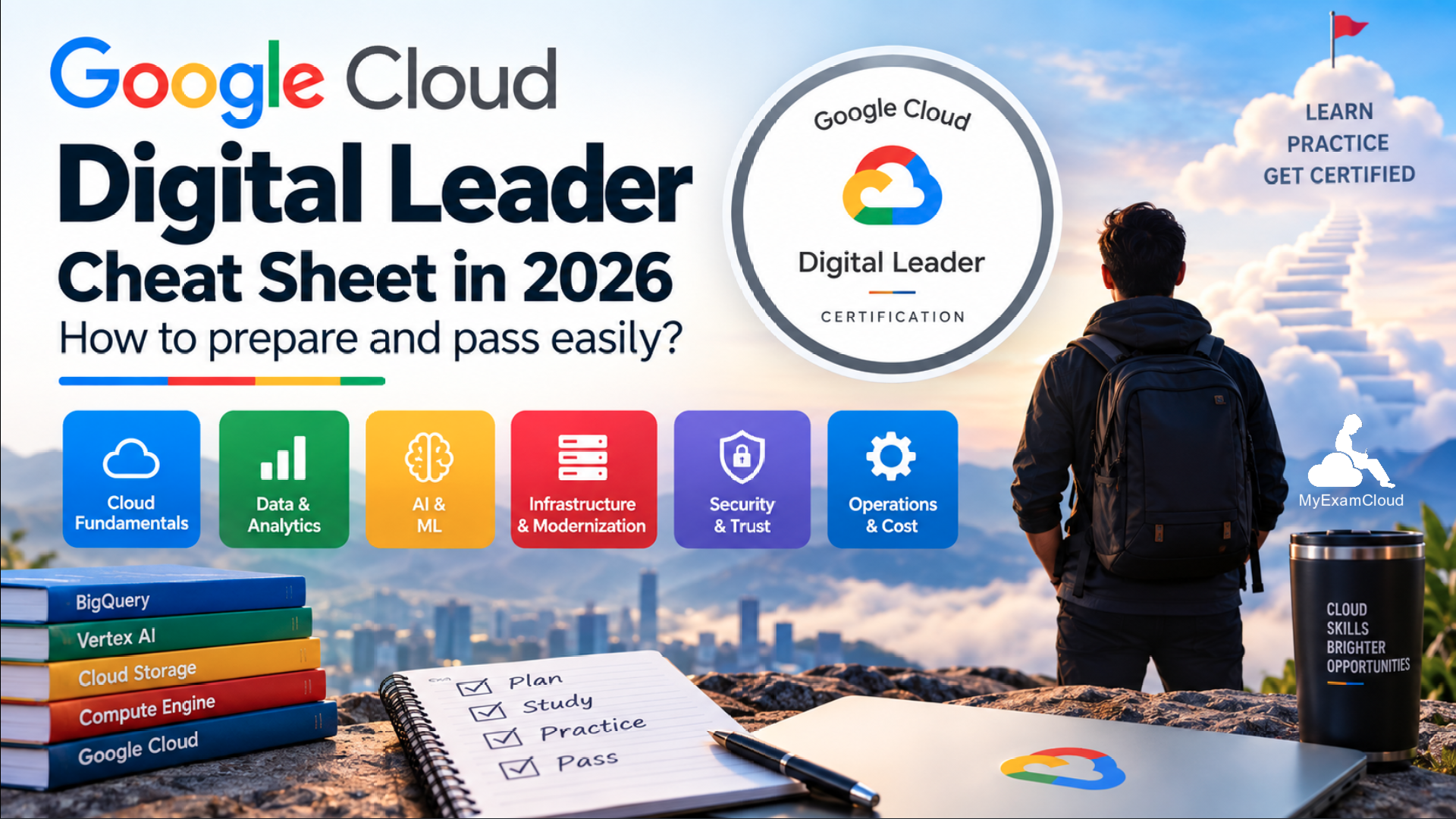
Google Cloud Digital Leader Cheat Sheet in 2026: How to Prepare and Pass Easily?
Read this MyExamCloud Blog article for practical insights on Google Cloud Certification. Explore more blog categories, search related topics in blog search, or return to the MyExamCloud Blog home.
Cloud computing has become an important part of modern digital transformation, and organizations increasingly need professionals who understand not only cloud technology but also how cloud services create business value.
The Google Cloud Digital Leader certification is designed to validate foundational knowledge of cloud computing, Google Cloud products and services, and common business use cases. Unlike technical Google Cloud Certification Mock Exams & Practice Tests that focus heavily on implementation, the Cloud Digital Leader focuses on understanding how cloud technology can support organizational goals.
In 2026, the certification covers six major areas: digital transformation, data transformation, artificial intelligence, infrastructure and application modernization, trust and security, and cloud operations.
This guide provides a practical Google Cloud Digital Leader cheat sheet, preparation roadmap, important Google Cloud services to remember, and exam-focused revision strategy.
What Is Google Cloud Digital Leader?
Google Cloud Digital Leader is a foundational Google Cloud certification for people who want to demonstrate their understanding of cloud concepts and how Google Cloud products and services can support business objectives.
Google describes the Cloud Digital Leader as someone who can articulate the capabilities of Google Cloud's core products and services, explain their organizational benefits, and describe common business use cases.
The certification does not require technical prerequisites. Google recommends experience collaborating with technical professionals, but previous hands-on Google Cloud experience is not required.
Google Cloud Digital Leader Exam in 2026
| Exam Feature | Current Details |
|---|---|
| Certification | Google Cloud Digital Leader |
| Level | Foundational |
| Exam duration | 90 minutes |
| Questions | 50–60 |
| Question types | Multiple choice and multiple select |
| Prerequisites | None |
| Validity | 3 years |
| Exam delivery | Online-proctored or onsite testing center |
| Registration fee | US$99 plus applicable tax |
These are Google's current published standard-exam details.
Important: Google does not currently publish a simple percentage passing score on the certification page. Therefore, preparation should focus on mastering the exam domains rather than targeting a particular unofficial passing percentage.
Google Cloud Digital Leader Exam Domains
The current exam guide divides the certification into six domains:
| Domain | Approximate Weight |
|---|---|
| Digital Transformation with Google Cloud | ~17% |
| Exploring Data Transformation with Google Cloud | ~16% |
| Innovating with Google Cloud Artificial Intelligence | ~16% |
| Modernizing Infrastructure and Applications with Google Cloud | ~17% |
| Trust and Security with Google Cloud | ~17% |
| Scaling with Google Cloud Operations | ~17% |
The percentages are approximate, so candidates should not interpret them as an exact number of questions in every exam form.
1. Digital Transformation with Google Cloud
The first domain establishes the foundation for understanding why organizations move from traditional infrastructure toward cloud technology.
Cloud Computing Cheat Sheet
- Cloud computing: Using computing resources and services over a network rather than relying entirely on local infrastructure.
- On-premises: Infrastructure operated and managed by the organization.
- Public cloud: Cloud infrastructure and services offered to customers by a cloud provider.
- Private cloud: Cloud infrastructure dedicated to a specific organization.
- Hybrid cloud: Combination of on-premises/private and public cloud environments.
- Multicloud: Use of services from multiple cloud providers.
The source material explains the transition from dedicated servers and shared hosting toward virtualized, distributed cloud infrastructure.
Why Businesses Use Cloud Computing
- Scalability
- Flexibility
- Agility
- Global availability
- Cost management
- Reliability
- Security capabilities
- Faster deployment
- Access to modern technologies
For the exam, focus on the business reason behind using cloud technology rather than memorizing isolated definitions.
2. Data Transformation with Google Cloud
Data is central to modern digital transformation. Google Cloud Digital Leader candidates should understand how organizations store, process, analyze and derive value from data.
Database vs Data Warehouse vs Data Lake
| Technology | Primary Purpose |
|---|---|
| Database | Store and manage application or operational data |
| Data warehouse | Analytics and structured business reporting |
| Data lake | Store large amounts of raw or diverse data |
Important Google Cloud Data Services
- Cloud Storage: Object storage for files and unstructured data.
- Cloud SQL: Managed relational database service.
- Cloud Spanner: Globally scalable relational database.
- Cloud Bigtable: NoSQL wide-column database designed for large-scale workloads.
- Firestore: NoSQL document database.
- BigQuery: Serverless data warehouse and analytics platform.
- Looker: Business intelligence and data visualization platform.
- Pub/Sub: Messaging and event ingestion service.
- Dataflow: Managed data processing service.
Google's exam guide specifically expects candidates to differentiate Google Cloud data-management products according to data types and business use cases.
Cloud Storage Classes
| Class | Typical Access Pattern |
|---|---|
| Standard | Frequently accessed data |
| Nearline | Infrequently accessed data |
| Coldline | Less frequently accessed data |
| Archive | Long-term archival data |
Remember the key idea: storage class selection is connected to access frequency and cost.
3. Innovating with Google Cloud AI
Artificial intelligence is now a major component of the Cloud Digital Leader exam. Candidates should understand AI and machine learning from a business and conceptual perspective rather than expecting a deep machine-learning implementation exam.
AI vs ML vs Analytics
- AI: Broad field concerned with systems performing tasks associated with human intelligence.
- Machine learning: Systems learn patterns from data to make predictions or decisions.
- Data analytics: Examines data to discover patterns, trends and insights.
- Business intelligence: Helps organizations analyze and communicate business information for decision-making.
Important AI Concepts
- Training data
- Model
- Prediction
- Classification
- Regression
- Unstructured data
- Responsible AI
- Explainability
- Data quality
- Model accuracy
The exam guide emphasizes the importance of high-quality data, responsible AI and understanding the business value of machine learning.
Google Cloud AI Services to Know
- Vertex AI: Platform for building, deploying and managing machine-learning and AI solutions.
- Gemini: Google's family of generative AI models.
- TensorFlow: Open-source machine-learning framework.
- TPUs: Google-designed hardware optimized for machine-learning workloads.
At the Digital Leader level, focus on what the service does and when an organization might use it.
4. Modernizing Infrastructure and Applications
Cloud migration is not simply moving every existing application to a virtual machine. Organizations can choose different modernization strategies depending on their business and technical requirements.
Migration Strategy Cheat Sheet
| Term | Meaning |
|---|---|
| Retain | Keep the workload where it is |
| Retire | Remove a workload that is no longer needed |
| Rehost | Move the workload with minimal changes |
| Replatform | Move while making selected improvements |
| Refactor | Significantly redesign or modify the application |
| Reimagine | Redesign the solution around new business possibilities |
Google's exam guide explicitly includes workload migration strategies such as retire, retain, rehost, replatform, refactor and reimagine.
Important Compute Services
- Compute Engine: Virtual machines.
- Google Kubernetes Engine (GKE): Managed Kubernetes.
- Cloud Run: Managed serverless platform for containerized applications.
- App Engine: Managed application platform.
The exam is less about configuring these services and more about recognizing the appropriate service for a particular business scenario.
5. Trust and Security with Google Cloud
Security is a critical component of cloud adoption. Cloud Digital Leader candidates should understand fundamental security concepts and the shared responsibility model.
Shared Responsibility Model
The key idea is simple:
Google Cloud is responsible for the underlying cloud infrastructure, while customers remain responsible for how they configure and use cloud services.
The source material emphasizes this distinction using the idea that if the customer can configure or control something, the customer generally has responsibility for it.
Security Concepts to Remember
- Identity and access management
- Authentication
- Authorization
- Encryption
- Confidentiality
- Integrity
- Availability
- Compliance
- Audit logging
- Data protection
Encryption
Encryption protects data by transforming it into a form that unauthorized users cannot easily interpret.
Remember the three common data states:
- Data at rest
- Data in transit
- Data in use
6. Scaling with Google Cloud Operations
The final domain combines financial governance, operational excellence, reliability and sustainability.
Cloud Cost Management Cheat Sheet
- Pay attention to resource consumption.
- Use budgets and alerts.
- Monitor billing data.
- Use resource hierarchy appropriately.
- Control consumption with quotas.
- Identify unused resources.
- Choose services according to workload requirements.
Google's exam guide specifically includes resource hierarchy, quota policies, budget thresholds and Cloud Billing Reports.
Reliability and Operations
Know these concepts:
- High availability
- Fault tolerance
- Scalability
- Resilience
- Disaster recovery
- Monitoring
- Logging
- DevOps
- SRE
Sustainability
Understand how cloud providers can help organizations reduce environmental impact through infrastructure efficiency, resource utilization and sustainability-focused services.
Google Cloud Digital Leader Service Cheat Sheet
| Service | Remember It As |
|---|---|
| Compute Engine | Virtual machines |
| GKE | Managed Kubernetes |
| Cloud Run | Serverless containers |
| App Engine | Managed application platform |
| Cloud Storage | Object storage |
| Cloud SQL | Managed relational database |
| Spanner | Globally scalable relational database |
| Bigtable | Large-scale NoSQL database |
| Firestore | NoSQL document database |
| BigQuery | Analytics data warehouse |
| Looker | Business intelligence |
| Pub/Sub | Messaging and events |
| Dataflow | Data processing pipelines |
| Vertex AI | AI/ML platform |
| Cloud Billing | Cloud cost management |
| Cloud Monitoring | Monitoring and observability |
IaaS vs PaaS vs SaaS Cheat Sheet
| Model | Customer Focus | Example |
|---|---|---|
| IaaS | Infrastructure and operating environment | Compute Engine |
| PaaS | Application development and deployment | App Engine |
| SaaS | Using a complete application | Google Workspace |
The source material describes IaaS as providing basic compute, networking and storage building blocks, PaaS as focusing on application deployment, and SaaS as providing complete software managed by the provider.
How to Prepare for Google Cloud Digital Leader in 2026
Step 1: Read the Official Exam Guide
Start with the official exam guide rather than randomly studying Google Cloud services. Google recommends reviewing the exam guide to understand the topics that may appear on the exam.
Step 2: Understand Cloud Fundamentals
Make sure you understand:
- Cloud computing
- On-premises infrastructure
- Public, private and hybrid cloud
- Multicloud
- IaaS, PaaS and SaaS
- Scalability and elasticity
- Cloud economics
- Shared responsibility
Step 3: Learn Google Cloud Services by Use Case
Do not attempt to memorize hundreds of service names. Instead, build associations between business problem → cloud service → benefit.
For example:
Need a scalable analytics warehouse? → BigQuery
Need object/file storage? → Cloud Storage
Need a managed relational database? → Cloud SQL
Need managed Kubernetes? → GKE
Need serverless containers? → Cloud Run
Need event messaging? → Pub/Sub
Need AI/ML platform capabilities? → Vertex AI
Step 4: Focus on Business Scenarios
This is one of the most important preparation techniques.
Instead of asking only:
"What is BigQuery?"
Ask:
"A company needs to analyze large datasets without managing database infrastructure. Which Google Cloud service is appropriate and why?"
This scenario-based approach helps connect product knowledge with business requirements.
Step 5: Study AI and Data Carefully
The current exam explicitly includes dedicated domains for data transformation and AI.
Make sure you can explain:
- Data warehouses vs databases
- Data lakes
- BigQuery
- Looker
- AI vs ML
- Generative AI concepts
- Vertex AI
- Responsible AI
- Data quality
Step 6: Practice with Sample Questions
Google provides official sample questions to familiarize candidates with the exam format and representative content. Google also explicitly states that sample-question performance should not be treated as a prediction of actual exam results.
Step 7: Use Practice Tests
Practice tests should be used as a diagnostic tool. After each test, review every incorrect answer and identify the underlying concept you misunderstood.
A useful preparation cycle is:
Study → Practice → Analyze Mistakes → Revise → Practice Again
14-Day Google Cloud Digital Leader Study Plan
| Day | Focus |
|---|---|
| 1 | Cloud fundamentals and digital transformation |
| 2 | Public, private, hybrid and multicloud |
| 3 | IaaS, PaaS, SaaS and shared responsibility |
| 4 | Data concepts and Google Cloud data services |
| 5 | BigQuery, Cloud Storage, databases and Looker |
| 6 | AI, ML and responsible AI |
| 7 | Vertex AI and generative AI concepts |
| 8 | Infrastructure modernization |
| 9 | Compute, containers and serverless services |
| 10 | Security, IAM, encryption and compliance |
| 11 | Cloud operations and reliability |
| 12 | Billing, budgets, quotas and sustainability |
| 13 | Full practice test and weak-topic revision |
| 14 | Final cheat-sheet revision and practice questions |
Common Google Cloud Digital Leader Mistakes
- Memorizing service names without understanding use cases.
- Studying only technical definitions. The exam connects technology with business outcomes.
- Ignoring AI. AI is now a dedicated exam domain.
- Ignoring data services. BigQuery and other data services are important parts of the exam guide.
- Confusing IaaS, PaaS and SaaS.
- Ignoring shared responsibility.
- Studying only from practice questions. Practice questions should reinforce knowledge, not replace it.
- Skipping the official exam guide.
Final Google Cloud Digital Leader Cheat Sheet
| Concept | Quick Reminder |
|---|---|
| Cloud | On-demand computing resources and services |
| Public Cloud | Provider-operated shared cloud infrastructure |
| Private Cloud | Cloud environment dedicated to an organization |
| Hybrid Cloud | Combination of environments |
| Multicloud | Multiple cloud providers |
| IaaS | Infrastructure building blocks |
| PaaS | Application platform |
| SaaS | Complete software application |
| Compute Engine | VMs |
| GKE | Kubernetes |
| Cloud Run | Serverless containers |
| Cloud Storage | Objects/files |
| BigQuery | Analytics warehouse |
| Cloud SQL | Relational database |
| Spanner | Scalable relational database |
| Bigtable | Wide-column NoSQL database |
| Firestore | Document NoSQL database |
| Pub/Sub | Messaging/events |
| Dataflow | Data processing |
| Looker | Business intelligence |
| Vertex AI | AI/ML platform |
| IAM | Identity and access management |
| Cloud Billing | Cost visibility and management |
| Cloud Monitoring | Monitoring and operations |
Can You Pass Google Cloud Digital Leader Easily?
There is no legitimate shortcut that guarantees a pass. However, the certification is foundational, and Google lists no prerequisites.
The most efficient preparation approach is to understand the six exam domains, learn the major Google Cloud services by business use case, practice scenario-based questions, and repeatedly review the concepts behind your mistakes.
The source material also recommends combining learning content, hands-on labs and practice exams rather than relying exclusively on lectures.
You do not need to become a Google Cloud engineer before attempting the Digital Leader exam. You need a solid understanding of cloud fundamentals, Google Cloud services, business use cases, data, AI, modernization, security and operations.
Mock Exams
Google Cloud Digital Leader Practice Tests
Conclusion
The Google Cloud Digital Leader certification in 2026 is a foundational certification that connects cloud technology with business transformation.
The key preparation areas are:
Cloud Fundamentals → Digital Transformation → Data → AI → Modernization → Security → Operations → Practice
Use the official exam guide as your source of truth, supplement it with Google Cloud's learning path and sample questions, and use practice tests to identify weak areas. Google's current certification page specifically recommends reviewing the exam guide, following the Cloud Digital Leader learning path and using sample questions as part of preparation.
With a structured study plan and a strong understanding of the business purpose behind Google Cloud services, you can approach the Cloud Digital Leader exam with much greater confidence.
| Author | Ganesh P(MrGanSun) Certified Artificial Intelligence Scientist (CAIS) | |
| Published | 1 month ago | |
| Category: | Google Cloud Certification | |
| HashTags | #GCP #CloudComputing #Software #googlecloud #googlecloudcertification |

