
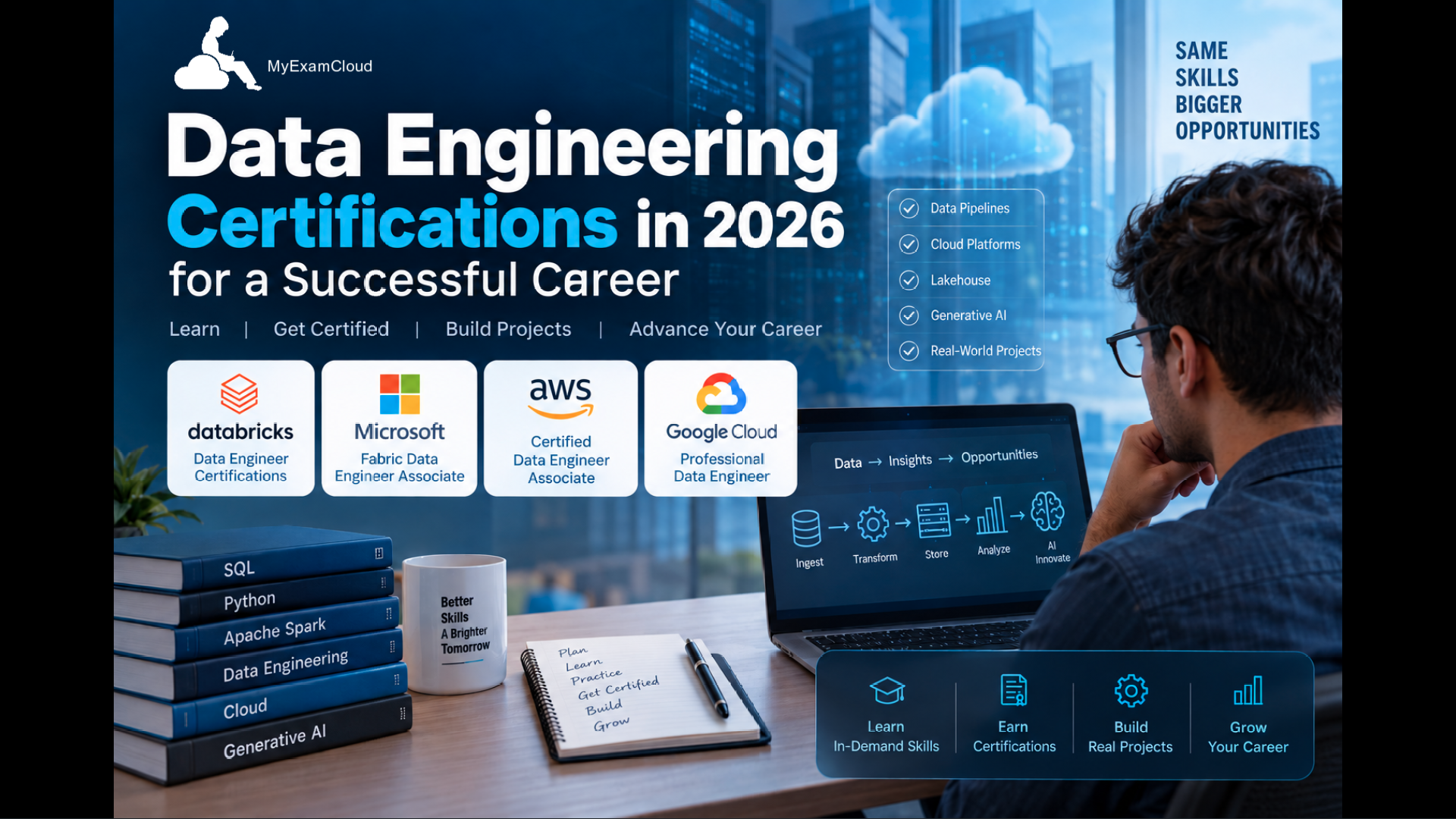
Data Engineering Certifications in 2026 for a Successful Career
Read this MyExamCloud Blog article for practical insights on Data Engineering. Explore more blog categories, search related topics in blog search, or return to the MyExamCloud Blog home.
Data engineering continues to be an important technology career path as organizations increasingly depend on reliable data platforms, cloud infrastructure, analytics systems, and AI applications.
If you are planning a career in data engineering, certifications can help demonstrate your knowledge, provide a structured learning path, and strengthen your resume. However, certification alone is not enough. Data engineering interviews and real-world jobs also require strong technical skills, practical experience, and the ability to work with data platforms and engineering tools.
This guide looks at some of the important Data Engineering certifications in 2026, including Databricks, Microsoft Fabric, AWS, and Google Cloud Certification Mock Exams & Practice Tests, along with a practical certification roadmap.
Are Data Engineering Certifications Worth It?
A certification can be useful in several ways:
- It can help your resume stand out during initial screening.
- It provides a structured way to learn a technology or platform.
- It demonstrates knowledge of a specific technology or competency.
- It can help professionals transition into data engineering.
- It provides measurable learning goals while preparing for a new role.
However, certification should not replace practical knowledge.
A data engineer still needs to understand data pipelines, SQL, Python, distributed processing, cloud platforms, data storage, data transformation, orchestration, security, monitoring, and other concepts used in real-world data environments.
1. Databricks Certified Data Engineer Associate
Databricks is an important platform in modern data engineering, particularly for organizations working with Databricks Certified Associate Developer for Apache Spark practice tests, large-scale data processing, lakehouse architectures, and cloud data platforms.
The Databricks Certified Data Engineer Associate practice tests certification is a useful starting point for professionals who want to validate their data engineering skills on the Databricks platform.
Preparing for this certification can also encourage hands-on learning around data processing, data pipelines, Spark-based workloads, and Databricks technologies.
For someone entering the Databricks ecosystem, the Associate certification can provide a structured starting point before moving toward more advanced certifications.
2. Databricks Certified Data Engineer Professional
After developing practical experience with Databricks and data engineering, professionals can consider the Databricks Certified Data Engineer Professional practice tests certification.
This represents a more advanced level of data engineering knowledge and can fit professionals who are already working with Databricks-based data engineering environments.
Rather than treating the Professional certification as a first step, it is generally more useful after building a solid understanding of data engineering fundamentals and gaining practical experience.
3. Databricks Certified Generative AI Engineer Associate
Data engineering is increasingly connected with artificial intelligence and generative AI. Data platforms are responsible for preparing, processing, storing, and making data available for AI applications.
The Databricks Generative AI Engineer Associate Exam Questions certification can be considered by data professionals who want to expand from traditional data engineering into generative AI workloads.
This can be particularly relevant for professionals interested in the intersection of data engineering, machine learning, generative AI, and modern data platforms.
4. Microsoft Fabric Data Engineer Associate
Microsoft Fabric provides a unified data and analytics platform covering areas such as data engineering, data integration, analytics, and related workloads.
The Microsoft Fabric Data Engineer Associate certification is relevant for professionals building their careers around Microsoft's modern data platform and Fabric-based data engineering workloads.
For professionals already working in Microsoft environments, this certification can complement existing Azure and data engineering knowledge.
5. AWS Certified Data Engineer – Associate
AWS provides a broad ecosystem for building data pipelines, storage systems, analytics platforms, and data processing workloads.
The AWS Data Engineer Associate DEA-C01 Exam Questions certification is designed for professionals working with data engineering workloads on AWS.
AWS data engineering skills can be particularly useful for professionals who want to build and manage data pipelines and data solutions using AWS services.
If AWS is the primary cloud platform used by your target organizations, this certification can be incorporated into your broader data engineering learning path.
6. Google Professional Data Engineer
Google Cloud is another major cloud platform for data engineering, analytics, machine learning, and AI workloads.
The Google Cloud Professional Data Engineer Practice Tests certification focuses on data engineering capabilities within Google Cloud.
It can be relevant for professionals interested in designing and managing data processing systems, building data solutions, and working with Google Cloud data technologies.
Choosing Between AWS, Azure, and Google Cloud
There is no single cloud platform that every data engineer must learn.
A practical approach is to consider:
- The cloud platform used by companies you want to work for.
- Your existing technical experience.
- The ecosystem you already work with.
- The availability of relevant projects and hands-on environments.
- The certification requirements commonly mentioned in your target job descriptions.
If you are already working in AWS, starting with AWS data engineering technologies may be more practical. Similarly, Azure professionals may benefit from developing their data engineering skills within Microsoft Fabric and Azure, while Google Cloud professionals can focus on the Google Cloud data ecosystem.
The important point is to build meaningful expertise in one environment instead of collecting certifications across multiple clouds without developing practical skills.
Data Engineering Certification Roadmap for 2026
A structured roadmap can make certification preparation more manageable.
Step 1: Build Data Engineering Fundamentals
Start with the fundamentals required for data engineering:
- SQL
- Python
- Data structures and algorithms
- Databases
- Data modeling
- ETL and ELT concepts
- Data pipelines
- Distributed data processing
- Cloud fundamentals
Step 2: Choose a Data Platform
Next, choose one major platform to develop deeper expertise in.
Possible paths include:
- Databricks
- Microsoft Fabric and Azure
- AWS
- Google Cloud
Step 3: Earn a Data Engineering Certification
Once you understand the fundamentals, prepare for a certification aligned with your chosen platform.
For example, you could begin with the Databricks Data Engineer Associate, AWS Certified Data Engineer – Associate, Microsoft Fabric Data Engineer Associate, or Google Professional Data Engineer depending on your career direction.
Step 4: Build Real Projects
Certification preparation should be combined with hands-on projects.
For example, you could build a complete data pipeline that:
- Collects data from multiple sources.
- Stores raw data in a cloud-based storage system.
- Processes and transforms the data.
- Loads the processed data into an analytical data store.
- Implements data quality checks.
- Schedules pipeline execution.
- Monitors pipeline failures.
- Provides data for analytics or machine learning workloads.
A project like this can help connect certification concepts with practical engineering work.
Step 5: Add Generative AI Skills
Modern data platforms are increasingly being used alongside AI and generative AI systems.
After developing strong data engineering fundamentals, professionals can expand into areas such as:
- Generative AI
- Retrieval-augmented generation
- Vector search
- AI data pipelines
- Data preparation for AI applications
- Machine learning workflows
This creates a broader skill set that combines data engineering with modern AI workloads.
Step 6: Move Toward Advanced Certifications
Experienced professionals can eventually consider advanced certifications in areas such as data engineering, cloud architecture, Databricks, or cloud solutions architecture.
The goal should be to build depth rather than simply accumulate credentials.
Certification vs Real-World Data Engineering Skills
One of the most important points for anyone preparing for a data engineering career is that certification and practical skills serve different purposes.
A certification can demonstrate that you have studied and understood a defined set of technologies and concepts. A project demonstrates that you can apply those concepts to solve a problem.
For example, knowing the terminology around Apache Spark is different from actually designing and optimizing a Spark-based data pipeline.
Similarly, knowing cloud data services for an examination is different from building, deploying, monitoring, and troubleshooting a production-style data pipeline.
Therefore, a strong career preparation strategy combines:
- Certification knowledge
- Programming skills
- SQL expertise
- Cloud knowledge
- Data platform experience
- Hands-on projects
- System design knowledge
- Problem-solving skills
How Many Data Engineering Certifications Should You Get?
More certifications do not automatically mean better career opportunities.
If you are paying for certifications yourself, it can be more practical to select one primary platform and develop meaningful expertise around it rather than spending money on several overlapping certifications.
For example, you could build your initial expertise around Databricks and then add a cloud data engineering certification based on the platform used by your target employers.
As your experience grows, you can add advanced certifications that support your career direction.
Final Thoughts
Data engineering certifications can provide a useful structure for learning and can help demonstrate platform-specific knowledge. In 2026, professionals can choose from certification paths across Databricks, Microsoft Fabric, AWS, and Google Cloud.
A practical approach is to start with strong data engineering fundamentals, select one primary technology ecosystem, earn a relevant certification, and then build real projects that demonstrate your ability to apply what you have learned.
As data engineering continues to intersect with cloud computing, analytics, machine learning, and generative AI, professionals who combine certification knowledge with practical engineering experience can build a broader and more adaptable technical skill set.
| Author | Ganesh P(MrGanSun) Certified Artificial Intelligence Scientist (CAIS) | |
| Published | 4 weeks ago | |
| Category: | Data Engineering | |
| HashTags | #Programming #GCP #CloudComputing #Software #databricks |

