
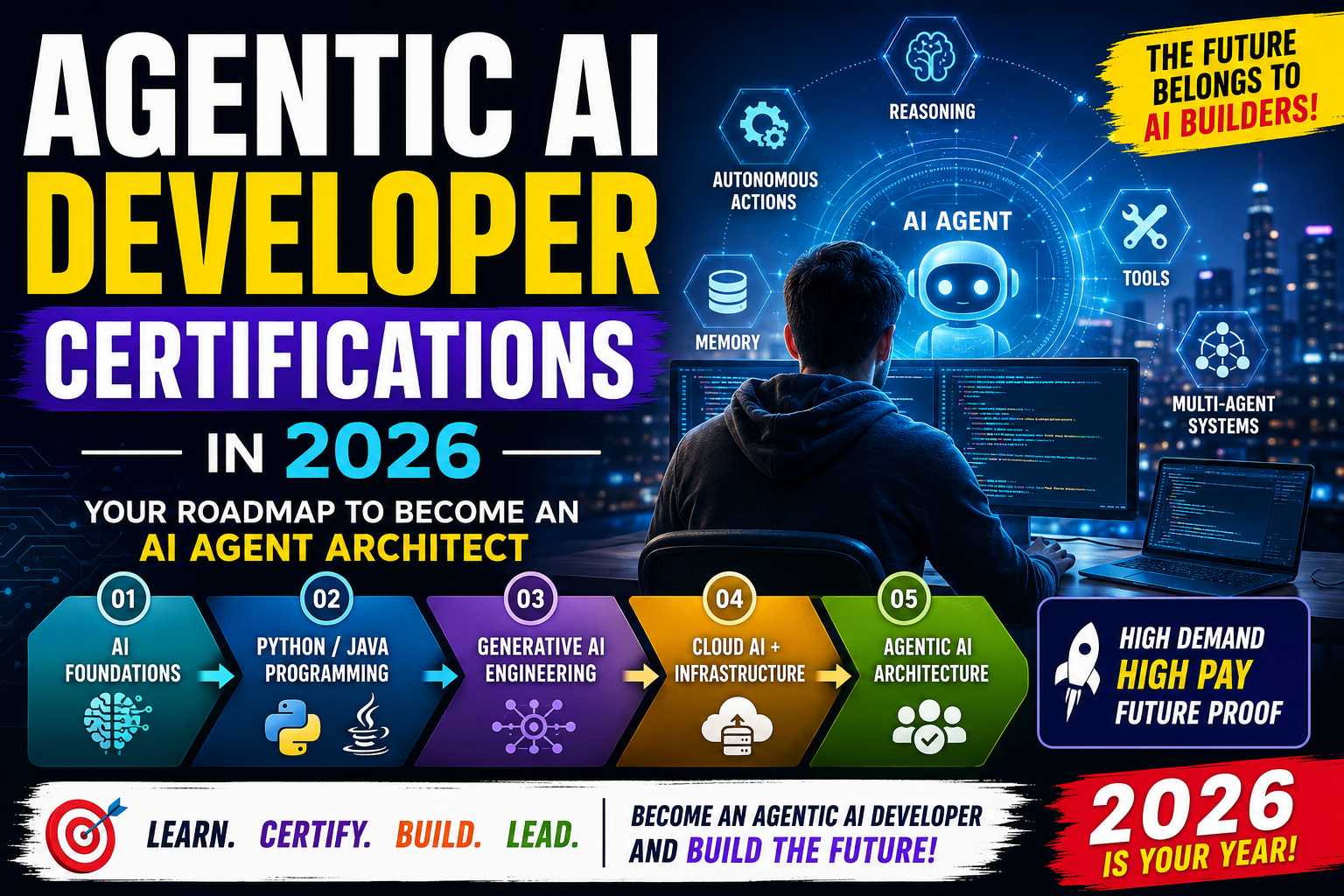
Agentic AI Developer Certifications in 2026: The Ultimate Career Roadmap
Read this MyExamCloud Blog article for practical insights on Agentic AI. Explore more blog categories, search related topics in blog search, or return to the MyExamCloud Blog home.
Agentic AI Developer Certifications in 2026: The Ultimate Career Roadmap
Traditional software developers build applications. AI developers build intelligent systems. But in 2026, the highest-value developers are becoming Agentic AI Developers — professionals who can build autonomous AI agents capable of reasoning, planning, using tools, connecting with enterprise systems, and executing intelligent workflows.
The world is moving from simple AI chatbots to AI assistants, AI agents, and finally enterprise-grade multi-agent systems. This shift is creating strong demand for developers who understand LLMs, RAG, cloud AI, orchestration, agent memory, tool calling, AI governance, and autonomous workflow design.
Agentic AI Developer Certification Roadmap 2026
Software Developer
      ↓
AI Fundamentals
      ↓
Python / Java AI Programming
      ↓
Generative AI Engineering
      ↓
Cloud AI + Infrastructure
      ↓
AI Agents + RAG + Tool Calling
      ↓
Enterprise Agentic AI Architect
Stage 1: AI Foundations
Start with AI fundamentals before jumping into advanced AI agents. These certifications help developers understand generative AI, machine learning basics, responsible AI, AI workloads, and enterprise AI use cases.
- AI-900 Microsoft Azure AI Fundamentals
- AWS Certified AI Practitioner (AIF-C01)
- Generative AI Leader Certification
Stage 2: Programming for AI Agents
Agentic AI development is not just prompt writing. Developers must know how to build APIs, connect models with tools, manage workflows, process data, and integrate AI into real applications. Python and Java remain two of the most important languages for AI development.
Python Certification Path
- PCEP Python Entry-Level Programmer
- PCAP Python Associate Programmer
- PCPP Python Professional Programmer
Java Certification Path
Stage 3: Generative AI Engineering
Generative AI engineering is the bridge between traditional development and Agentic AI. This stage focuses on LLM integrations, prompt pipelines, RAG systems, vector databases, AI APIs, and production-ready AI applications.
- AWS Certified Generative AI Developer – Professional (AIP-C01)
- Databricks Certified Generative AI Engineer Associate
- Microsoft Certified Azure AI Engineer Associate (AI-102)
Stage 4: Cloud AI and Infrastructure
AI agents need scalable infrastructure. They must run securely, connect with enterprise services, access data, use cloud AI services, and support production workloads. Cloud and DevOps knowledge are essential for serious Agentic AI developers.
- AWS Solutions Architect Associate (SAA-C03)
- Google Professional Cloud Architect
- Google Professional Machine Learning Engineer
- Kubernetes Certification Practice Tests
Stage 5: Enterprise Agentic AI Architecture
This is the advanced level where developers move into architecture and leadership. Enterprise Agentic AI Architects design multi-agent ecosystems, AI governance models, autonomous business workflows, AI transformation roadmaps, and secure AI platforms.
- Microsoft Certified Agentic AI Business Solutions Architect (AB-100)
- Microsoft Certified AI Transformation Leader (AB-731)
- Microsoft Certified AI Business Professional (AB-730)
Key Agentic AI Skills Developers Must Learn in 2026
- AI Agents
- Agentic AI Architecture
- RAG Systems
- Prompt Engineering
- Tool Calling
- MCP Servers
- Vector Databases
- Multi-Agent Systems
- AI Workflow Automation
- Cloud AI Deployment
- AI Security and Governance
- Enterprise AI Integration
Best Certification Path for Agentic AI Developers
A practical 2026 certification path for developers is:
- Start with AI fundamentals.
- Build strong Python or Java programming skills.
- Move into generative AI engineering.
- Learn cloud AI infrastructure.
- Specialize in Agentic AI and enterprise AI architecture.
Final Career Advice
The future of software development is moving toward autonomous, reasoning-based systems. Developers who learn Agentic AI now will be prepared for some of the most important roles in the next decade, including AI Engineer, Generative AI Developer, AI Platform Engineer, Agentic AI Developer, and Enterprise AI Architect.
Certifications alone are not enough. The winning strategy is to combine certifications with real projects such as AI agents, RAG applications, workflow automation tools, enterprise copilots, and multi-agent systems.
If you are a developer planning your AI career in 2026, the roadmap is clear: learn programming, master cloud AI, build generative AI applications, and then move into Agentic AI systems.
```
Frequently Asked Questions (FAQs)
1. What is an Agentic AI Developer?
An Agentic AI Developer is a software engineer who builds autonomous AI systems capable of reasoning, planning, tool usage, memory handling, workflow orchestration, and enterprise automation using modern AI technologies such as LLMs, RAG, and multi-agent systems.
2. Why are Agentic AI Developers in high demand in 2026?
Companies are rapidly moving from traditional AI chatbots to autonomous AI agents that can execute business workflows, automate operations, and integrate with enterprise systems. This transformation has created strong demand for developers skilled in AI agents and intelligent automation.
3. Which programming language is best for Agentic AI development?
Python and Java are currently the most important programming languages for Agentic AI development. Python dominates AI research and rapid prototyping, while Java is widely used for enterprise AI systems, scalable architectures, and secure business applications.
4. Which certifications are best for beginners starting in AI?
Beginners can start with certifications such as:
- AI-900 Microsoft Azure AI Fundamentals
- AWS Certified AI Practitioner (AIF-C01)
- Generative AI Leader Certification
5. Do I need cloud certifications for Agentic AI development?
Yes. Modern AI agents are typically deployed on cloud platforms. Cloud certifications help developers understand AI infrastructure, scalability, containers, APIs, Kubernetes, GPU services, and enterprise AI deployment strategies.
6. What is the difference between Generative AI and Agentic AI?
Generative AI focuses on generating content such as text, images, and code using LLMs. Agentic AI goes further by enabling AI systems to reason, plan tasks, use tools, maintain memory, collaborate with other agents, and autonomously execute workflows.
7. Which certification is best for Generative AI engineering?
Some of the best Generative AI certifications include:
- AWS Certified Generative AI Developer – Professional (AIP-C01)
- Databricks Certified Generative AI Engineer Associate
- Microsoft Azure AI Engineer Associate (AI-102)
8. What skills should every Agentic AI Developer learn?
Important skills include:
- AI Agents
- RAG Architecture
- Prompt Engineering
- Vector Databases
- LangChain
- Spring AI
- MCP Servers
- Tool Calling
- Cloud AI Infrastructure
- AI Governance
- Multi-Agent Systems
9. Is Agentic AI a good career in 2026?
Yes. Agentic AI is expected to become one of the fastest-growing technology domains in 2026 and beyond. Organizations across finance, healthcare, cloud computing, cybersecurity, education, manufacturing, and enterprise software are investing heavily in autonomous AI systems.
10. Which certification is best for becoming an Enterprise Agentic AI Architect?
Recommended certifications for enterprise-level AI architecture include:
- Microsoft Certified Agentic AI Business Solutions Architect (AB-100)
- Microsoft Certified AI Transformation Leader (AB-731)
- Microsoft Certified AI Business Professional (AB-730)
| Author | Ganesh P Certified Artificial Intelligence Scientist (CAIS) | |
| Published | 4 months ago | |
| Category: | Agentic AI | |
| HashTags | #Java #Python #AWS #Programming #GCP #CloudComputing #Software #Architecture #AI #ArtificialIntelligence #career #generativeai #agenticai |

